A leader can keep unfinished work hidden for a long time. You can outrun it with competence. You can cover it with charisma. You can distract people with activity. You can even win for a season.
Pressure changes that. Pressure makes your interior gaps exterior conditions. Pressure takes what you refuse to govern in yourself and turns it into the climate your team has to breathe.
Most leaders assume the team is anxious because the market is uncertain, the org chart is changing, or the work is hard. Those things matter, but they are not usually the deepest source of the anxiety. Your team is often anxious because they live inside your unfinished work. They feel the places where your integrity foundation is thin, where your emotional walls are cracked, and where your relational gates swing open without warning.
Here is the governing idea: your private structure becomes your public environment.
You do not have to announce your insecurity for your people to feel it. You do not have to confess your fear of conflict for your team to start tiptoeing. You do not have to admit you are managing perception instead of telling the truth for your team to learn that reality is negotiable. Leadership authority has a kind of gravity. Whatever is unresolved in you starts pulling the room toward it.
Unfinished integrity work makes the room unstable. When your words are not reliable, your people stop listening to what you say and start studying what you do. They begin to gather data the way you gather data. They learn to hedge, qualify, and protect themselves. A leader who is loose with truth teaches everyone else to become a risk manager. Meetings become choreography. Updates become spin. Everyone gets good at saying what is safe instead of what is real.
Scripture speaks to this with uncomfortable clarity. Proverbs does not describe a person with weak self-governance as merely “going through a rough patch.” It describes them as structurally unsafe. “A person without self-control is like a city with broken-down walls.” (Proverbs 25:28, NLT)
That is not just about moral failure. It is about exposure. Broken walls mean anything can get in. Panic gets in. Rumors get in. Ego gets in. Impulse gets in. In a city with broken walls, the people who live there adapt. They stop sleeping deeply. They keep a hand near the sword. They do not assume safety is normal.
Your team adapts the same way when your governance is inconsistent.
Unfinished emotional work makes the room loud, even when no one raises their voice. When you have not learned to name what you feel and bring it to God, your emotions leak sideways into everyone else. The leak can look like overreaction. It can look like coldness. It can look like sudden sarcasm. It can look like silence that feels like punishment. Those are not personality quirks. Those are walls under construction that you keep asking people to live behind.
The Bible does not command you to become numb. It commands you to govern. Paul’s instruction is not “never feel.” It is “do not let the feeling take the wheel.” “Don’t sin by letting anger control you. Don’t let the sun go down while you are still angry.” (Ephesians 4:26, NLT)
Notice the assumption: anger will happen. Anger is part of leadership because leadership carries weight. The issue is control and timeline. Anger that lingers becomes a door left open. It invites narratives, suspicion, and retaliation.
Unfinished relational work makes the room unsafe, even when your intentions are good. A leader’s words gain mass. Your offhand comment becomes an unofficial policy. Your “just joking” becomes a warning shot. Your frustration becomes a forecast. James uses two images for a reason. Words are not only steering mechanisms. Words are fire.
“In the same way, the tongue is a small thing that makes grand speeches. But a tiny spark can set a great forest on fire.” (James 3:5, NLT)
A team living under that risk starts protecting itself. People avoid bringing you bad news. People soften their opinions. People forward emails instead of having conversations. People become careful instead of courageous.
The tragic part is that many leaders interpret these adaptations as character flaws in their people. “They are not resilient.” “They are too sensitive.” “They cannot handle feedback.” Sometimes that is true. Many times it is not. Many times the team is reacting normally to an abnormal environment.
Nehemiah shows what wise leadership looks like when the work is unfinished. He does not pretend the wall is already secure. He names reality and governs accordingly.
“But we prayed to our God and guarded the city day and night to protect ourselves.” (Nehemiah 4:9, NLT)
Prayer and guarding. Spiritual dependence and practical governance. Nehemiah does not call watchfulness a lack of faith. He treats watchfulness as obedience.
Leaders often reverse that. They treat personal governance as optional, then they demand emotional bravery from everyone else. They leave the wall half-built, then they complain when the city sleeps lightly.
You cannot build a peaceful team on an anxious leader.
You cannot build a truthful culture on a leader who edits reality.
You cannot build relational trust on a leader whose gates swing between warmth and weapon.
Your team lives in your unfinished work.
That statement can produce shame, or it can produce clarity. Shame is useless. Clarity is a gift.
Here is a practical framework you can run this week. Call it a “Fortress Exposure Audit.” It is not a performance review of your leadership. It is a diagnostic of what your team is being forced to carry because you have not finished the work.
First, audit your Integrity Foundation.
- Where have I used strategic exaggeration in the last two weeks?
- Where have I presented confidence when I only had hope?
- Where have I let someone else take the blame to preserve my image?
- Where do my people have to translate my words because they do not trust them at face value?
Second, audit your Emotional Walls.
- What emotion has been driving me that I have not named: fear, anger, grief, envy, shame?
- When I feel that emotion, what is my default leak: control, withdrawal, criticism, sarcasm, overwork?
- Who gets the spillover: my spouse, my peers, my direct reports, or God?
- What decision have I been making while H.A.L.T. (hungry, angry, lonely, tired)?
Third, audit your Relational Gates.
- What tone do people brace for when they bring me bad news?
- What “joke” of mine has landed like a policy?
- Where have I corrected someone publicly for a private issue?
- What hard conversation have I avoided, then punished people for not reading my mind?
Fourth, choose one repair action in each category.
Integrity repair action: correct the record. Pick one place where you spun, minimized, or overpromised. Say the true thing plainly, without theater.
Emotional repair action: lament upward. Take ten minutes and tell God what you feel, without editing it into something respectable. Then ask Him for the wisdom to lead without leaking.
Relational repair action: set a gate rule. Choose one boundary for your words. Examples include: “No sarcasm in correction,” “No important messages after 9 p.m.,” or “No feedback in public that I would not deliver in private.”
Fifth, tell your team what you are repairing.
You do not need a dramatic confession. You do need a clear statement. Your people cannot adjust to a repair you keep secret.
Try something like this: “I have noticed that I get sharp when I feel pressure. That is not fair to you. I am working on it, and I am setting one rule for myself. If I get heated in a meeting, I will pause, name it, and reset. You have permission to ask me to slow down.”
That kind of sentence does not weaken authority. It strengthens it. It tells the team the wall is being built on purpose.
The goal is not leadership perfection. The goal is leadership safety.
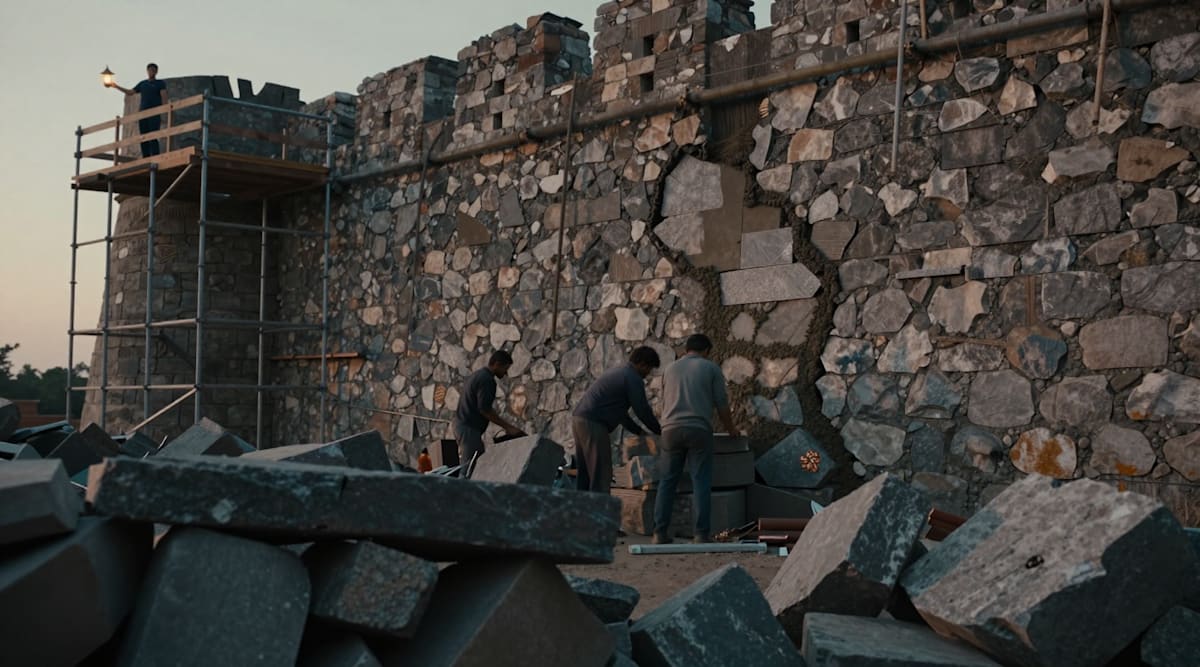
A fortress is not built in a day, but it is built in public. People can see the scaffolding. People can see where the stones are being set. People can see whether the builder is serious.
Your team does not need you to be finished. Your team needs you to be honest about what is unfinished and disciplined about repairing it.
Sharp charge: stop demanding peace from your people while you refuse to build peace in yourself.
Question prompt: What unfinished work in you is your team paying for right now?