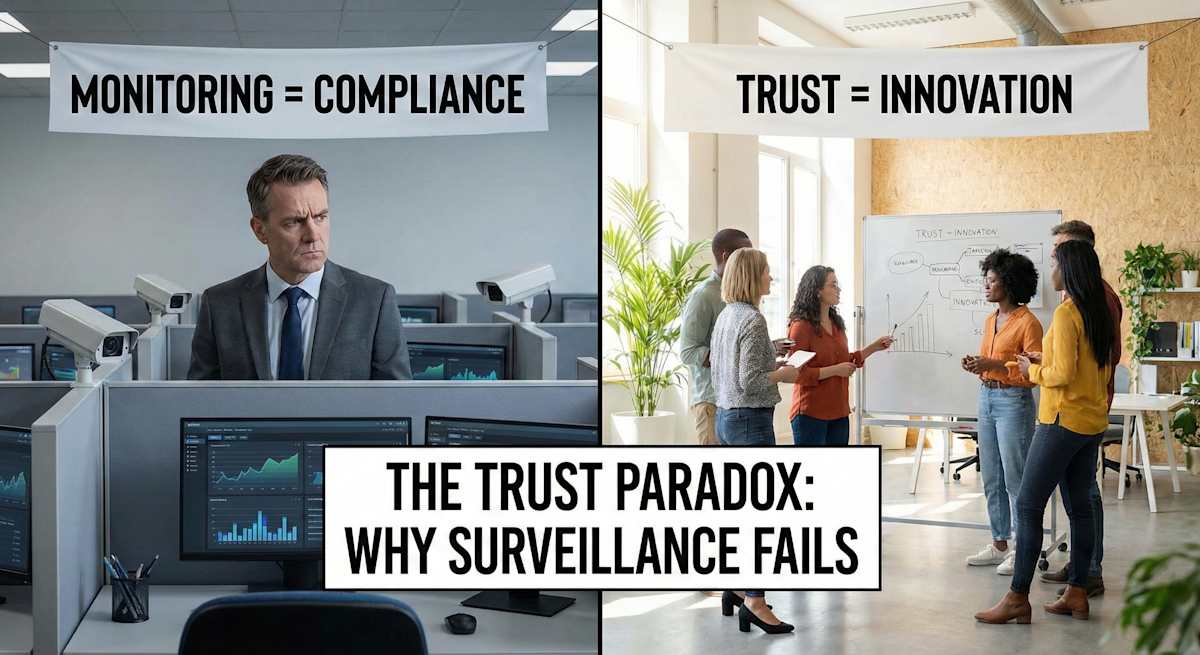
I once worked for a boss who installed keystroke loggers on every computer in the office.
He monitored our emails. Tracked our browsing. Even hacked into personal accounts.
His reasoning? He needed to “stay ahead of problems.” He could not afford to trust people who might betray the company.
Here is what actually happened: every talented person left within eighteen months. The only people who stayed were those who could not find other options. Innovation died. The company limped along on compliance alone.
He got exactly what he measured for, and nothing more.
The Trust Paradox
There is a counterintuitive truth about workplace trust: the more you try to verify it, the faster you destroy it.
When you install monitoring software, you are not just tracking productivity. You are broadcasting a message: I assume you are guilty until proven innocent.
Your team receives that message clearly, even if you never say it out loud. And they respond rationally. They give you exactly what you measure, nothing more. They stop taking risks. They hide mistakes instead of fixing them. They update their resumes.
Surveillance is the confession of a leader who has already lost.
What the Research Shows
Google’s Project Aristotle spent years studying what makes teams effective. The number one factor was not talent, resources, or clear goals. It was psychological safety.
Teams perform best when people feel safe to take risks, ask questions, and admit mistakes without fear of punishment. The moment surveillance enters the picture, safety exits.
This is not soft thinking. It is hard economics. High-trust organizations outperform low-trust ones by every measurable metric: speed, innovation, retention, profitability. Trust reduces transaction costs. It enables delegation. It scales leadership beyond one person’s ability to monitor everything.
You cannot monitor your way to loyalty.
The Leader’s Audit
If you are a leader, here is a question worth sitting with: Would I be comfortable if my team knew exactly what I track and why?
If the answer makes you uncomfortable, that discomfort is data.
Appropriate oversight exists. Clear expectations, regular check-ins, and transparent metrics build accountability without destroying trust. The difference is dignity. Are you treating your team as partners in a shared mission, or suspects in an ongoing investigation?
From Servants to Friends
In John 15:15, Jesus told his disciples, “I no longer call you servants… instead, I have called you friends.” This was not sentimentality. It was a leadership philosophy.
Servants do what they are told. Friends invest themselves in the mission. Servants comply. Friends contribute. The shift happens when trust flows first from the leader, not because the team has proven themselves worthy, but because trust given tends to create trust returned.
This principle is ancient, but it has never stopped being true. The best leaders elevate their teams from hired hands to trusted partners. They share information instead of hoarding it. They explain the “why” behind decisions. They treat people like adults capable of self-governance.
Suspicion broadcast creates suspicion confirmed. Trust extended creates trust earned.
The Practical Path Forward
If you have inherited a low-trust culture, or built one yourself, the path forward is not complicated. It is just uncomfortable.
Start by auditing your monitoring. What are you tracking? Why? Does your team know? If transparency about your practices feels risky, that is a sign the practices themselves may be the problem.
Replace surveillance with structure. Clear goals, regular check-ins, and honest feedback accomplish what monitoring only pretends to do. Structure creates accountability through clarity; surveillance creates compliance through fear. One builds people up, the other wears them down.
Most importantly, go first. Trust is a two-way street, but leaders have to make the first move. Share information before you are asked. Admit uncertainty when you do not have the answers. Give people room to fail and recover. Measure outcomes, not activity. The question is not “are they busy?” but “are they effective?”
The Bottom Line
Control feels safe. It is not.
Every keystroke logged is a message sent. Every monitored email is a relationship eroded. Every surveillance tool is a confession that you have chosen compliance over commitment.
The best leaders I have studied and worked with share a common trait: they extend trust before it is earned, because they understand that trust given is the only thing that creates trust returned.
Your team is watching how you lead. They will give you exactly what you ask for.
Choose wisely what you ask for.
I write about leadership at the intersection of timeless principles and modern workplaces. Follow for weekly insights on building teams that actually work. For more articles like this consider subscribing to my Substack at: https://justinwilson411.substack.com/publish/home