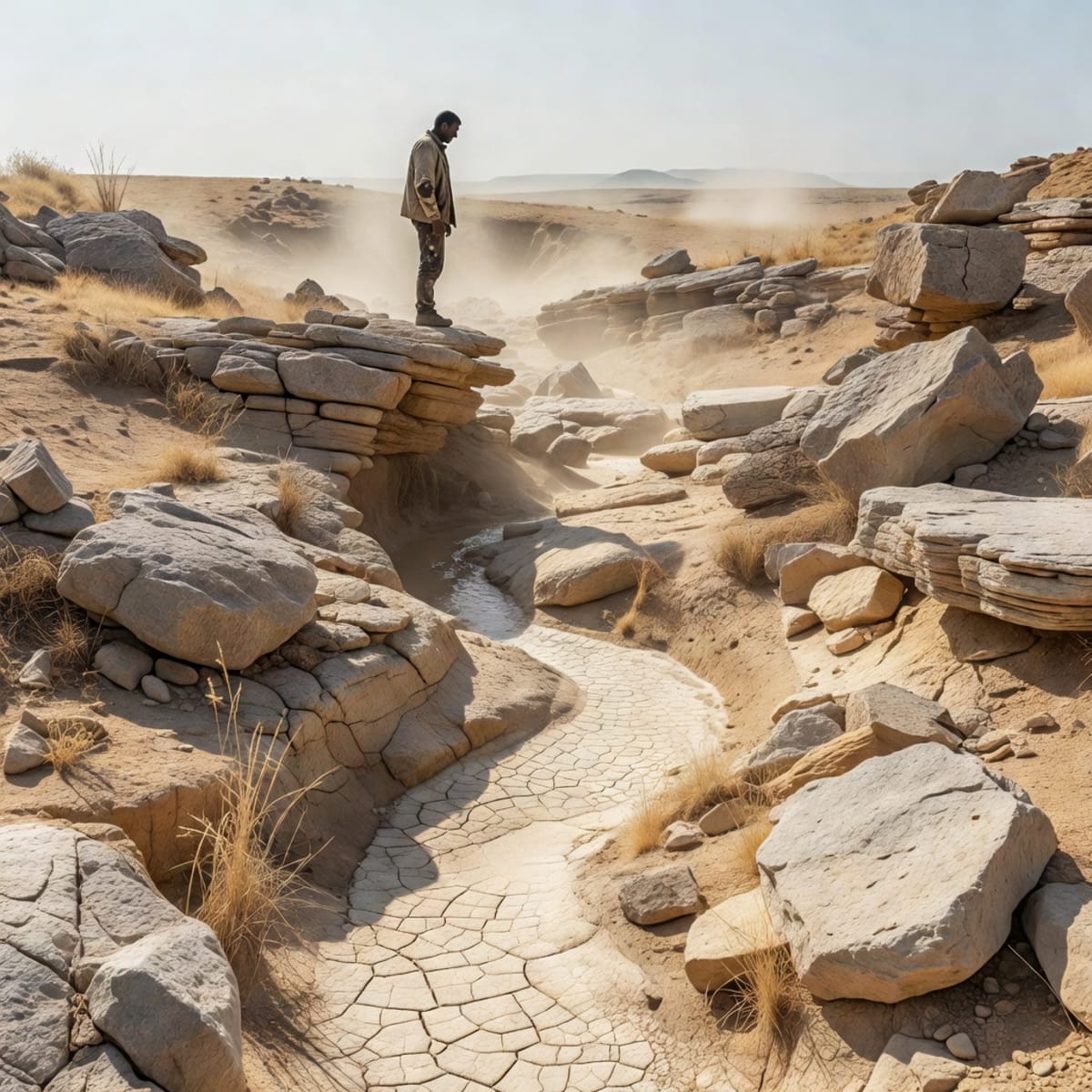
The water did not fail with a warning Elijah could put on a calendar. One morning the brook that had been his entire supply chain was a dry cut in the rock. The ravens had been bringing bread and meat. The hiding place had been working. The method God had given him ended, and the prophet who had learned to receive had to learn to release.
Yesterday I stayed at Kerith while the water still ran. God had sent Elijah east after the bravest public sentence of his life and fed him with birds. Hidden was not abandoned. Today the same story turns a harder corner. The provision was real. It was also temporary.
But after a while the brook dried up, for there was no rainfall anywhere in the land. Then the Lord said to Elijah, “Go and live in the village of Zarephath, near the city of Sidon. I have instructed a widow there to feed you.” (1 Kings 17:7-9, NLT)
Read the reason the verse names: “there was no rainfall anywhere in the land.” That drought is the word Elijah carried into Ahab’s court. The method ended because the assignment was working. Baal was supposed to own the clouds. The land is thirsty on schedule. God is not reversing Himself. He is keeping the word His prophet announced, and the prophet is not exempt from the weather that word created.
The next instruction still matters. Zarephath sits near Sidon, in the region Jezebel came from, in the religious neighborhood of the storm god Elijah had publicly defied. God does not send him back to a safer brook. He sends him deeper into Baal country, to a widow He has already instructed. Elijah does not invent the next plan while staring at dry stone. The Lord speaks. The next assignment has a name, a village, and a person. The first move after a dried brook is not hustle. It is attention.
I will not turn this into a relocation promise. This is narrative. It tells us what God did with this prophet when this particular supply ended. It does not guarantee that your next closed door will open onto a widow in Sidon. The miracle is not a career path you can copy. The miracle is that the God who commanded ravens can also close a brook without leaving the man He sent there.
Here is the principle. Faithful leaders must release a method when God changes the assignment, without confusing the method with the Provider. The brook was a gift. The ravens were a gift. Neither of them was God. When a leader treats the last thing that worked as the source, every change feels like abandonment. When a leader remembers who sent the ravens, a dry brook can be an instruction instead of a verdict.
James draws the line Elijah is standing on. “Whatever is good and perfect is a gift coming down to us from God our Father, who created all the lights in the heavens. He never changes or casts a shifting shadow.” (James 1:17, NLT) James is writing to scattered believers who were ready to accuse God of being two-faced in their trials. Gifts come down. Lights move. Shadows shift. The Father does not. That is not a slogan for ignoring loss. It is the reason you can tell the truth about a dried brook without deciding God has moved. The gift can end. The Giver remains.
I have watched this fail in both directions. A VP whose entire pipeline ran through one enterprise relationship keeps flying to that account after the champion has left, calling the trips loyalty. The method is dead. She is watering a dry cut in the rock and naming it perseverance. A founder whose first product was the company treats every signal to sunset it as a personal rejection. The product was a gift. It is not the source. A pastor whose Wednesday night used to fill the room keeps running the same format for a room that is gone, because stopping would feel like admitting God left with the crowd. None of them would say they are worshiping a brook. They would say they are being faithful to what worked. Faithfulness to a method after God has closed it is not faithfulness. It is nostalgia with a spiritual vocabulary.
The other failure wears the opposite costume. A leader hits one hard quarter and torches every process, every relationship, every practice that used to hold the work, then baptizes the panic as obedience. Elijah did not abandon Kerith because he got bored. The brook dried. The Lord spoke. Discernment still has to do its job. Some of what you want to call a dried brook is a channel you neglected. Some of it is a market that moved for ordinary reasons. Some of it is God. Do not dress a restless exit in Elijah’s clothes. Do not cling to a corpse and call it Kerith either. The test is the same one we used yesterday: assignment. Has the word changed, or have you?
Paul learned this without ravens. “I know how to live on almost nothing or with everything. I have learned the secret of living in every situation, whether it is with a full stomach or empty, with plenty or little.” (Philippians 4:12, NLT) He is writing from hardship to a church that had supported him, and he is careful not to treat their gift as the thing that keeps him alive. The secret is not a technique for keeping the brook full. The secret is a life attached to Christ in plenty and in empty. I am not mapping a Roman cell onto your P&L. I am noticing what Scripture says a leader can learn. The circumstance is not the source. Plenty is not proof you were right. Empty is not proof you were abandoned. Both can be seasons in a life that is still held.
Bring this to Tuesday afternoon. Name the method you have been treating as the source. Write it in one line. A sponsor. A channel. A meeting. A title. A product. A donor. A way of working that used to carry you. Then tell the truth about its condition. Is the water still running, and you are tired of drinking it? Is it actually gone? If it is gone, do not invent the next village in the next hour. Elijah received a word before he moved. Put one hour on the calendar this week to ask what the next assignment is, without announcing a reorg to cover the grief. If you are a believer, ask God whether He is closing a method or whether you are. If you are still exploring faith, the next move is still honest. Consider whether you have been treating every ended provision as evidence that you are finished. Some of what you call collapse is a change of supply. The work may still be yours. The old way of feeding it may not.
This will not feel like faith on a dashboard. Releasing a method looks like loss before it looks like obedience. Tomorrow we walk with Elijah into Zarephath, into a widow who thinks she is preparing a last meal. Scarcity is about to get more personal, and the passage will not let us turn a hungry household into a fundraising technique. The month still builds toward Stand and Rebuild, the paid field guide at the end of September. Today’s piece of that work is simpler than fire and harder than a strategy offsite. When the brook dries, do not confuse the creek with the One who sent you there.
Leadership Challenge: What method have you been treating as the source? Write it in one line. Has that method actually ended, or are you tired of it? If it has ended, what would it look like to wait for the next assignment this week instead of inventing one to cover the grief?
I write about leadership at the intersection of timeless principles and modern workplaces. Follow for weekly insights on building teams that actually work. For more articles like this consider subscribing to my Substack at: https://christianleadership.now