The emergency ends, and the report looks good. Payroll cleared. The doors stayed open. Customers received what they needed. A leader can point to people who would have suffered without the intervention, and those people may be sincerely grateful. There is another part of the report worth reading: who now controls the decisions that used to belong to someone else? A rescue can preserve something precious while leaving a lasting concentration of authority behind it. Genesis 47:13–26 asks us to look at both realities. Joseph’s administration feeds a population during famine. The arrangement also enlarges Pharaoh’s power. Reading this passage carefully means resisting the urge to make one fact erase the other before we have considered what the text actually says.
“You have saved our lives!” they exclaimed. “May it please you, my lord, to let us be Pharaoh’s servants.” Genesis 47:25, NLT
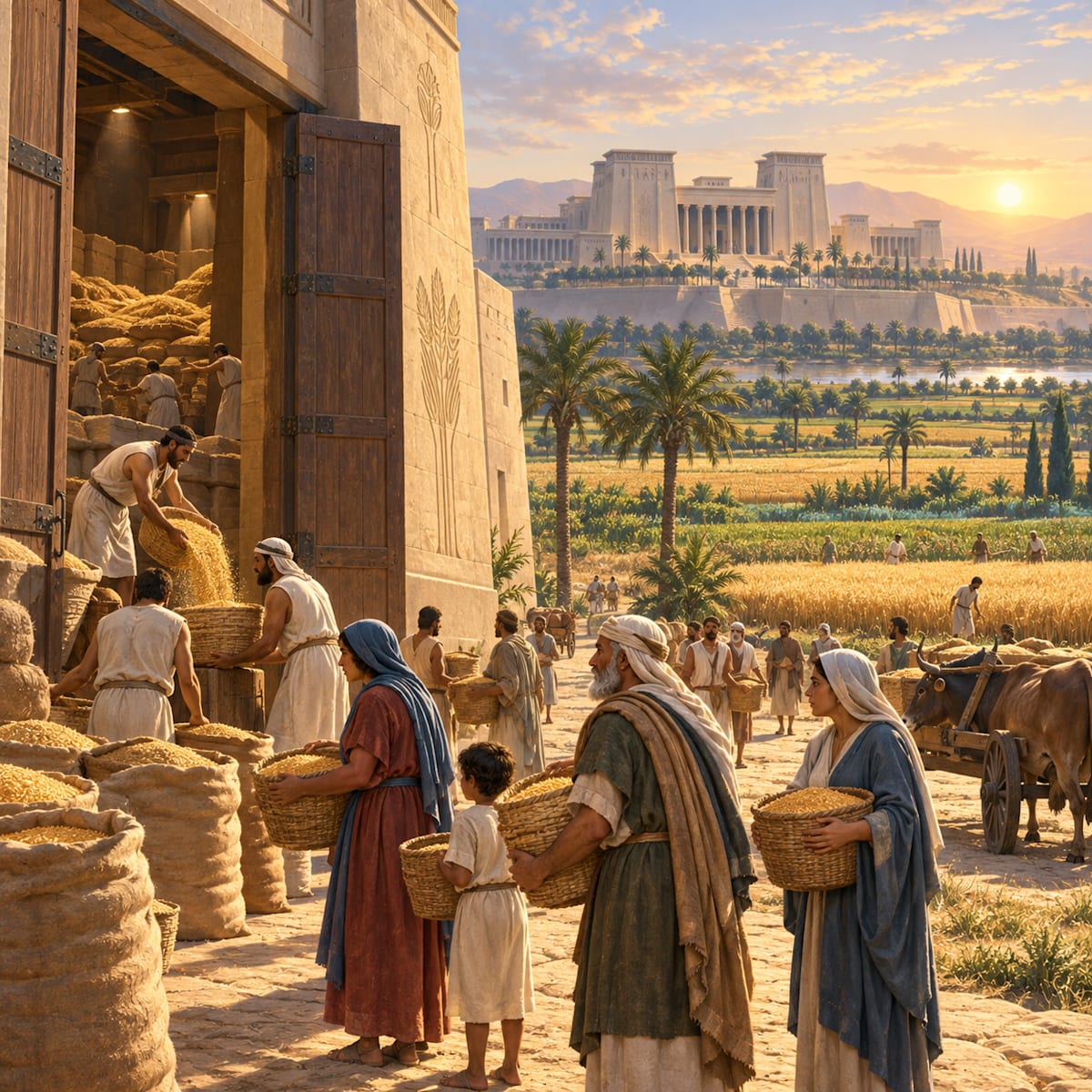
The exchanges unfold as the famine continues. People first spend their money on grain, then trade their livestock when the money is gone. Eventually they offer their land and themselves in exchange for food and seed. Joseph acquires the land for Pharaoh and establishes a continuing claim on its produce: one-fifth goes to Pharaoh, while the people keep four-fifths for planting and feeding their households. The priests’ land remains exempt because they receive an allowance from Pharaoh. These details belong together. Food and seed make survival and cultivation possible. Ownership and obligation change, and an exception protects a particular group. The people’s gratitude is part of the account, along with the enduring arrangement under which they will live. A faithful reading pays attention to the whole transaction.
Genesis does not pause here to give us a comprehensive moral evaluation of Joseph’s economic policy. We should be equally careful about supplying one. The account does not establish that every measure Joseph takes is a command for future leaders. It also does not tell us that he secretly engineers the crisis to enrich himself. Readers may debate the justice of the arrangement, but speculation about motives cannot carry that debate. The wider story concerns God’s preservation of Jacob’s family and the continuation of his covenant purposes through a devastating famine. That purpose matters without becoming a blanket endorsement of every administrative detail. We can recognize God’s faithfulness while examining human exercises of power with care. Our task is to receive the story honestly, including the questions it leaves open, rather than turn Joseph into a convenient spokesman for our preferred management philosophy.
The sentence about saved lives deserves to slow us down. Gratitude can be entirely sincere when the options are terrible. A hungry family receiving food has reason to give thanks; acknowledging that reason does not require us to assume that every lasting obligation is therefore beyond examination. The people themselves propose the exchange in Genesis 47:19, but they do so under the pressure of famine. Their proposal and their desperation are both relevant. In our own decisions, a person’s willingness to accept help tells us something important about their immediate need. It does not, by itself, answer every question about the terms we attach. Christian leaders should be able to hear appreciation without treating it as permission to stop asking whether their arrangements are fair. The harder question may arrive after the public thank-you, when the person who received help still needs a safe way to raise a concern.
Jesus gives his disciples an explicit standard for their use of authority in Matthew 20:20–28. The conversation begins with a request for places of honor and spreads into indignation among the other disciples. Jesus answers their competition by directing them toward service, grounding that direction in his own self-giving mission. His death as a ransom is unique; a successful business rescue is not its equivalent. His teaching nevertheless gives Christian leaders a clear moral direction: power must serve others rather than become an opportunity to dominate them. We do not need to settle every historical question about Egypt before applying that instruction to ourselves. We can ask whether the authority we hold makes room for the good of the people entrusted to us, especially when doing so costs us convenience, recognition, or control.
Consider a hypothetical company facing a serious cash shortage. Its director temporarily requires personal approval for spending and hiring. Concentrating decisions helps the company meet payroll and avoid commitments it cannot afford. Six months later, the immediate danger has passed, but every purchase still waits in the director’s inbox. Managers carry responsibility without the authority to act, and employees discover that normal requests move faster through personal favors. The director remembers the emergency whenever someone questions the arrangement. This workplace is not ancient Egypt, and employment should not be equated with the conditions described in Genesis. The narrower comparison is useful: a measure introduced to meet urgent needs can create continuing dependence. The company needs a second review that addresses what its successful rescue changed. Otherwise, the story of the crisis can become the reason nobody is allowed to question its aftermath.
A practical review begins by naming the powers that moved. Write down which decisions were centralized, who previously made them, and the specific danger each restriction addressed. Then ask what evidence would justify keeping each restriction today. Some controls may still protect people, funds, or essential operations. Others may have outlived their purpose. The answer should be specific enough for someone outside the decision to examine. A statement such as “we cannot afford another crisis” is too broad to distinguish prudent oversight from an indefinite claim on every choice. Set a review date and identify who can recommend changes. If you benefit from retaining the authority, include someone whose judgment you cannot quietly dismiss. Accountability becomes more credible when it can change an arrangement you personally prefer, not merely record that you explained it well.
The exception for the priests in Genesis 47:22 and 26 also invites a question about our own arrangements: who is exempt from the burdens everyone else carries? The narrative reports the exception; it does not give us permission to invent every reason behind it. In an organization, however, leaders can investigate the exceptions they themselves approve. Perhaps a restriction has a sound operational boundary. Perhaps a senior colleague bypasses it because challenging them would be uncomfortable. Write down the reason and ask whether you would defend it to the people who must follow the rule. Invite those people to describe its actual effects without requiring them to begin by praising the rescue. A system that only accepts grateful feedback cannot tell you much about the burdens it imposes. Listening requires some willingness to hear that a helpful decision has also made another person’s work or life harder.
Restoring authority does not mean withdrawing responsible oversight overnight. A manager may need training, clear spending limits, access to information, or a staged return of decision-making responsibility. Some functions properly remain centralized. Service requires judgment about those differences, with safeguards that fit the real risk. It also requires an honest look at the leader’s attachment to being indispensable. There can be satisfaction in knowing that every consequential choice still comes through you. The people around you may even encourage that dependence because it feels safer than learning to decide. Helping them develop sound judgment takes time and includes the possibility that they will make a choice you would not have made. A responsible handover defines the limits, explains the reasons, and gives people room to exercise the responsibility they are expected to carry. Their growing capacity is worth more than your permanent place at the center of every decision.
Before this week ends, choose one authority you acquired during a difficult season and put its present justification on a page. Identify the need it addressed, the people affected, the exceptions you allow, and the person who will review it with you. Decide whether to retain it with a clear reason, revise it, or return part of it by a stated date. This is a small enough action to take while the larger questions remain difficult. The forthcoming Long Middle field guide will return to the work of carrying responsibility through prolonged pressure. Tomorrow, Jacob’s final instructions and blessings turn our attention toward a future we cannot control. Today’s work prepares us for that question: the people helped by our leadership will have lives and responsibilities beyond the moment when they needed our rescue. What authority can we exercise today so they are better prepared to carry those responsibilities tomorrow?
Leadership Challenge
Review one power you gained during a crisis. Record its purpose, present justification, affected people, exceptions, review partner, and review date. Decide what to retain, revise, or return.
About the Author
I write about leadership at the intersection of timeless principles and modern workplaces. Follow for weekly insights on building teams that actually work. For more articles like this consider subscribing to my Substack at: https://christianleadership.now