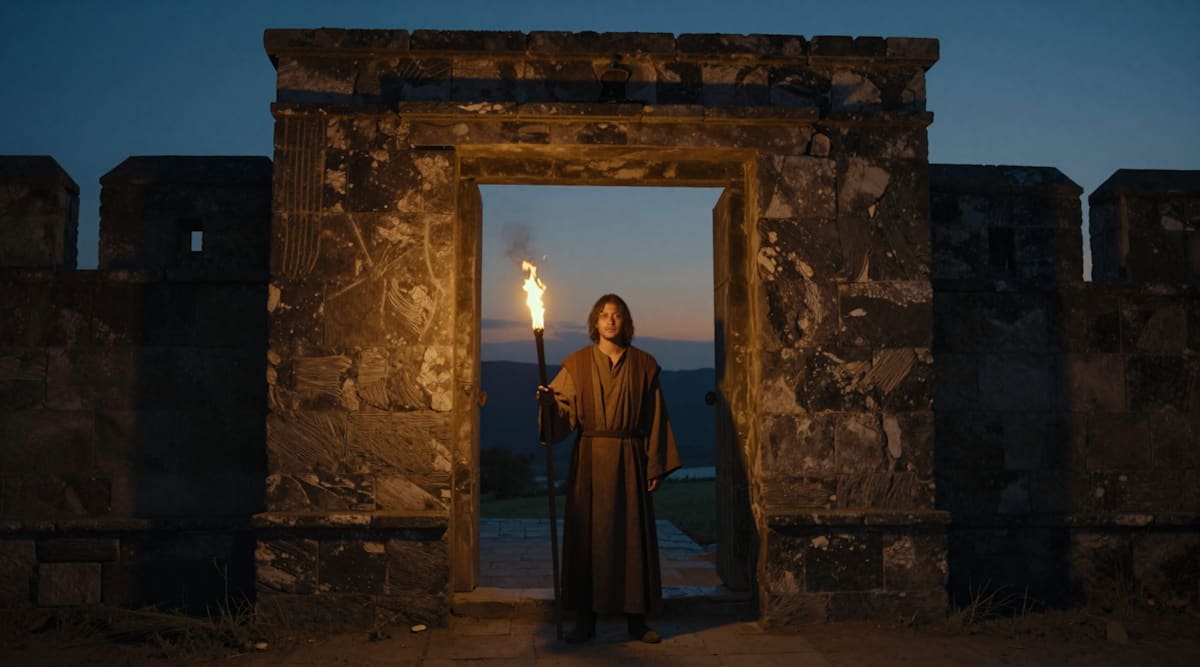
A leader can carry weight for months without anyone noticing. You keep the calendar moving, you keep the team fed with clarity, you keep the board calm, you keep the family stable. Then one small moment slips through the gate. A late-night text you should have slept on. A defensive comment in a meeting that changes the temperature of the room. A private resentment that becomes a public posture. People will call it “out of character.” You will know it was not. It was an unguarded gate.
February has been a slow build through The Watchman’s Protocol: ARREST, AUDIT, ALIGN, ACT. Yesterday we walked through running the whole sequence in real time, the kind of day where pressure shows up without warning and you do not get to pause the meeting. Today is the quieter and harder truth that keeps the whole framework from turning into a motivational poster: the Watchman never sleeps.
Here is the governing idea for the day: self-governed leaders do not rely on motivation, they rely on vigilance. Motivation comes and goes. Pressure comes in cycles. Temptation changes costumes. Vigilance is what stays. A watchman does not wait for an invasion to decide whether alertness matters. A watchman treats ordinary hours as the place where the city is either kept or lost.
Leadership exposes one stubborn pattern. You can be wise at 10:00 a.m. and foolish at 10:00 p.m. You can be patient with a customer and sharp with your spouse. You can preach calm to your team while your inner world runs on panic. That gap is not mysterious. It is usually maintenance. A fortress does not fall because the builder forgot masonry. It falls because the builder stopped doing the boring inspections.
Scripture does not treat watchfulness as a spiritual personality type. Scripture treats it as normal maturity. Peter writes, “Stay alert! Watch out for your great enemy, the devil. He prowls around like a roaring lion, looking for someone to devour.” (1 Peter 5:8, NLT). A lion does not schedule an attack for when you feel strong. A lion looks for tired prey, isolated prey, distracted prey. Vigilance is not paranoia. Vigilance is humility about how quickly desires can hijack judgment.
Paul brings that same watchfulness down to the level most leaders ignore: thoughts. “We destroy every proud obstacle that keeps people from knowing God. We capture their rebellious thoughts and teach them to obey Christ.” (2 Corinthians 10:5, NLT). Capturing thoughts is not a one-time event. It is a patrol. Thoughts show up dressed as urgency, righteousness, exhaustion, entitlement, pragmatism. A watchman learns the familiar footfalls.
Most leaders assume governance is something you do when a decision is big. That assumption is how you lose the city. Big decisions rarely arrive out of nowhere. They arrive after a hundred small permissions. You let yourself rehearse an argument in your head for two weeks, then you “suddenly” explode in the meeting. You let private cynicism become your default, then you “unexpectedly” stop believing in your own people. You let your schedule starve your soul, then you “mysteriously” start needing shortcuts to feel alive.
ARREST, AUDIT, ALIGN, ACT is not a ladder you climb once. It is the rhythm you live in. ARREST keeps you from being driven by kinetic emotion. AUDIT forces you to name what you are leaning on, your resources or God’s. ALIGN checks you against standing orders through Scripture, counsel, and conscience. ACT is obedience with imperfect information. The Watchman never sleeps because pressure never stops shopping for a gap.
This is where leaders get cynical. You read “stay alert” and imagine a life of constant tension. That is not the goal. The goal is calm attention. A good watchman is not frantic. A good watchman is faithful. A good watchman knows the difference between a harmless noise and a real breach because he has been at his post long enough to recognize the sounds.
Here is the practical framework I recommend for the long game. Call it the Watchman’s Shift Change. It is a short checklist you run three times a day. It keeps the gate from being decided by whatever hour you are in.
Watchman’s Shift Change Checklist
Morning: set standing orders before the day takes you hostage.
- What will I not do today, even under pressure?
- What conversation am I tempted to avoid?
- What decision must wait for counsel?
Midday: run a quick AUDIT before the afternoon turns reactive.
- Hungry: Do I need food or a break before I answer anyone?
- Angry: Am I carrying heat that will leak into my tone?
- Lonely: Am I isolated, performing strength, refusing to ask for help?
- Tired: Am I about to lead from depletion?
Evening: close the gates so tomorrow does not inherit today’s unresolved chaos.
- What thought do I need to capture and hand to Christ?
- What repair do I owe someone?
- What do I need to stop rehearsing?
Those three check-ins sound small. They are not. They are how you keep ARREST from being something you remember after damage is done. They are how you keep AUDIT from being a tool you use only when you are already in trouble. They are how you keep ALIGN from becoming selective Bible study that blesses your instincts. They are how you keep ACT from becoming impulsive action that feels brave but is really just relief.
One more practice matters for leaders who carry weight: put the night watch on a leash. Fatigue makes you vulnerable to false urgency. Late hours make you vulnerable to false courage. “I should send this now” is one of the most common lies leaders believe. Wisdom often waits until morning. James says, “Understand this, my dear brothers and sisters: You must all be quick to listen, slow to speak, and slow to get angry.” (James 1:19, NLT). Speed and anger travel together. Governance breaks that partnership.
The Watchman never sleeps does not mean you never rest. It means you build the kind of life where rest does not become lawlessness. Rest should lower your shoulders, not lower your standards. Rest should make you kinder, not make you reckless. Rest should make your leadership more human, not more impulsive.
If you have followed this series, you can feel the shape of the whole protocol now. You have the vocabulary. You have the tools. You can run it in the room when pressure spikes. The next step is integration: building a personal set of standing orders, failure modes to watch, and practical templates you can use when the stakes are high.
That is the reason I am releasing the paid deep dive at the end of this theme. It will be a complete guide to The Watchman’s Protocol, with worksheets and scenarios to help you build your own governance plan. No hype. No theatrics. Real tools for leaders who cannot afford an unguarded gate.
Here is the charge: take your post seriously. Your title does not make you a watchman. Your habits do. Your people experience the overflow of what you permit in your inner world.
Question: Where does your watch usually fail, morning, midday, or night?