A room can be full and still lack a shared life. People may sit through the same service, receive the same announcements, and leave without knowing who is grieving, who needs a meal, or who has been praying for courage all week. Attendance can place us near one another without teaching us to belong to one another. Acts 2:42–47 describes something deeper than a crowd gathered by a successful event. The gospel had formed a people, and their ordinary practices began to make that new life visible.
The scene comes immediately after Pentecost and Peter's proclamation of Jesus. The Spirit had been poured out, the risen Christ had been announced, and about three thousand people had received the message and been baptized. Only then does Luke describe the community's shared rhythms. That order matters. Teaching, fellowship, meals, prayer, and generosity did not manufacture the church or persuade God to act. They were the response of people whom God had called and gathered through the good news of Jesus. We should resist turning this passage into a technique for producing impressive results. It first shows what grace was producing among those who believed.
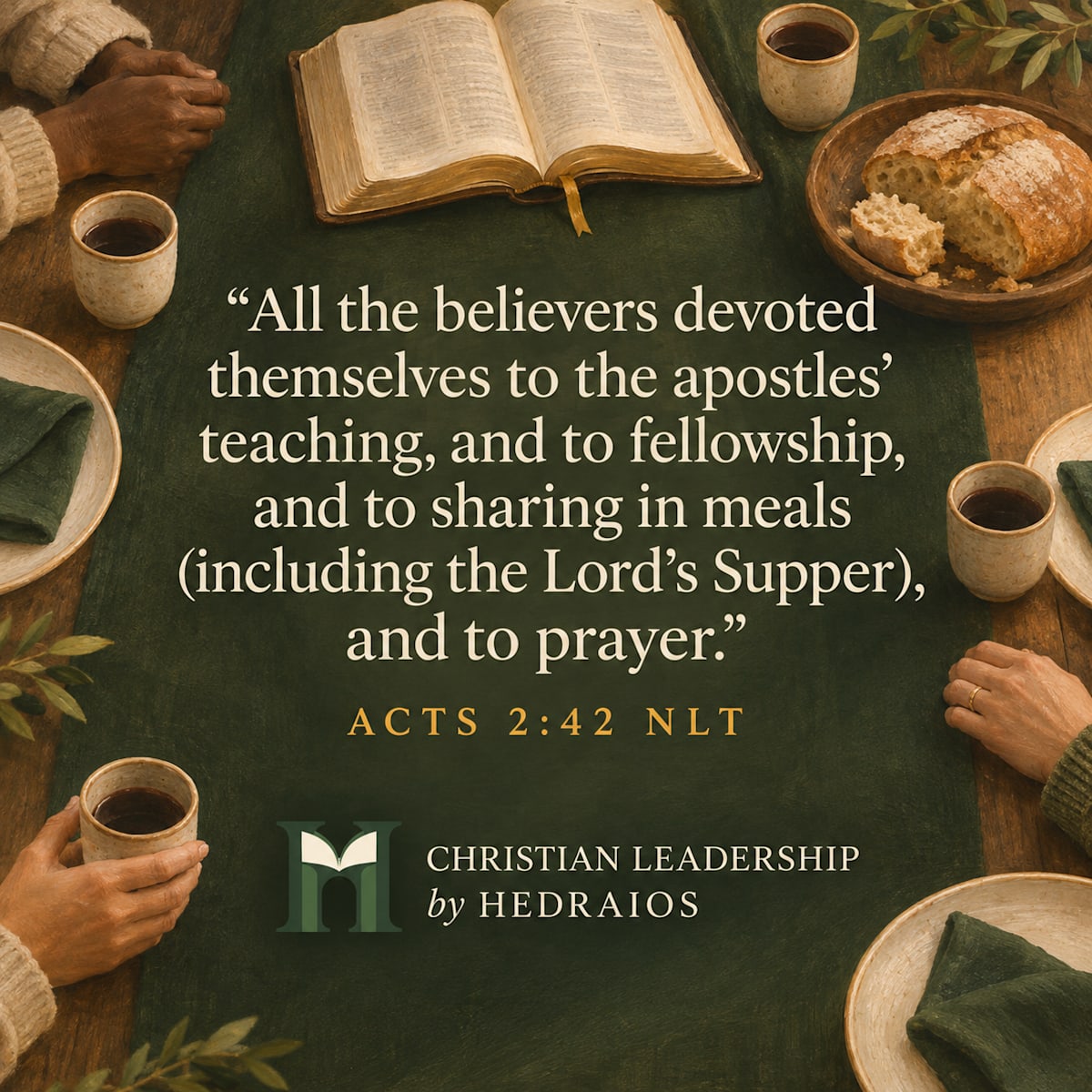
Luke summarizes their devotion in one sentence: “All the believers devoted themselves to the apostles’ teaching, and to fellowship, and to sharing in meals (including the Lord’s Supper), and to prayer” (Acts 2:42, NLT). Each practice belongs with the others. Teaching keeps the community anchored in the truth about Jesus. Fellowship means more than friendly conversation; it is participation in a shared life. Meals bring that life to an actual table, where time and food are received together. Prayer turns the gathered people toward God in dependence. The passage does not present a collection of religious options. It describes a people learning to remain together under the word they had received.
These practices also keep one another honest. Teaching without fellowship can become information we admire without allowing it to reshape our relationships. Fellowship without teaching can shrink into belonging based only on preference. A meal without prayer can remain hospitality without shared dependence on God, while prayer without material care can become language that never reaches a neighbor's need. Acts joins all of them. The first believers listened, prayed, ate, worshiped, and responded to concrete need as parts of one life. Their faith was neither merely private nor merely ceremonial.
Their generosity deserves careful attention. Some sold property and possessions so that resources could be shared with anyone who had need. Luke is describing willing, costly care within this Jerusalem community. He is not handing every later church a complete economic policy, and the passage should not be used to pressure people into surrendering money or property to leaders. It does show that fellowship reaches the way believers hold what they have. Need is not treated as someone else's interruption. When the gospel forms a people, another person's hunger, housing problem, or sudden loss becomes a concern the community is willing to face together, with wisdom, transparency, and appropriate safeguards.
Discussion Topic:
Which practice in Acts 2:42 is easiest for a church to organize but hardest for us to share faithfully: learning, fellowship, meals, or prayer?
The setting is strikingly ordinary. The believers gathered at the temple and met in homes. They shared meals with gladness and generosity. Some moments were public, while others happened around household tables. A new community took shape through repeated acts that could look small from the outside: listening again, praying again, opening a door, noticing a need, sharing food. None of those actions is glamorous by itself. Together, they trained the believers to receive one another as people joined by Christ rather than as strangers who happened to attend the same gathering.
God's action remains central throughout the scene. Awe accompanied signs and wonders through the apostles, and the Lord added to the community those who were being saved. The passage therefore gives no guaranteed formula for church growth. A congregation cannot copy a list of practices and demand the same visible results on its preferred timetable. Faithful communities still experience conflict, fatigue, limited resources, and the need for repentance. Acts does not hide later tensions in the church. What it does establish is that the community's life is a response to God, sustained by attention to his word and dependence on him. The practices are not levers that control God. They are ways a people lives because God has acted.
That distinction can help us examine our own participation. It is possible to evaluate a church as a consumer while remaining unavailable to the shared life we say we want. We can appreciate strong teaching but never discuss it with another believer. We can praise community while declining every invitation to a table. We can request prayer without learning to pray with others, or value generosity while keeping every need at a safe distance. This is not a call to accept unsafe access, ignore wise boundaries, or remain in a community that conceals abuse. Christian fellowship never makes another person entitled to our private information, our home, or immediate trust. Healthy shared life honors consent, protects people at risk, and keeps leaders accountable.
Within those boundaries, the passage invites a simple next step: join one local practice rather than merely approving the idea of community. Attend a small prayer gathering and learn one person's name. Invite someone to a modest meal. Take part in a Bible discussion and listen before speaking. Ask a trusted church leader where practical care is needed, then offer something specific you can actually sustain. One act will not create the whole pattern of Acts 2, and no individual can carry a community alone. It can move us from admiration to participation. Repeated faithfulness gives shared life room to grow.
The first believers were not made into a people by their efficiency. They had received the message of Jesus, the Spirit had been given, and the Lord was at work among them. Their practices expressed that grace in forms others could see: attention, prayer, food, worship, generosity, and joy. Our settings will differ, but the question remains close to the ground. Where can the life we confess become a life we share? The answer may begin this week at a table, in a prayer circle, beside an open Bible, or in a quiet act of care.
Leadership Challenge
Read Acts 2:42–47 in its wider setting in Acts 2. Choose one local practice of shared prayer, learning, meals, or care that you can join this week. Make the step concrete by naming the time, place, and person you will contact. Do not use the passage as a scorecard for criticizing everyone else's church participation. Ask instead how the grace of Christ can become visible through one faithful act you are prepared to share.
I write about leadership at the intersection of timeless principles and modern workplaces. Follow for weekly insights on building teams that actually work. For more articles like this consider subscribing to my Substack at: https://christianleadership.now