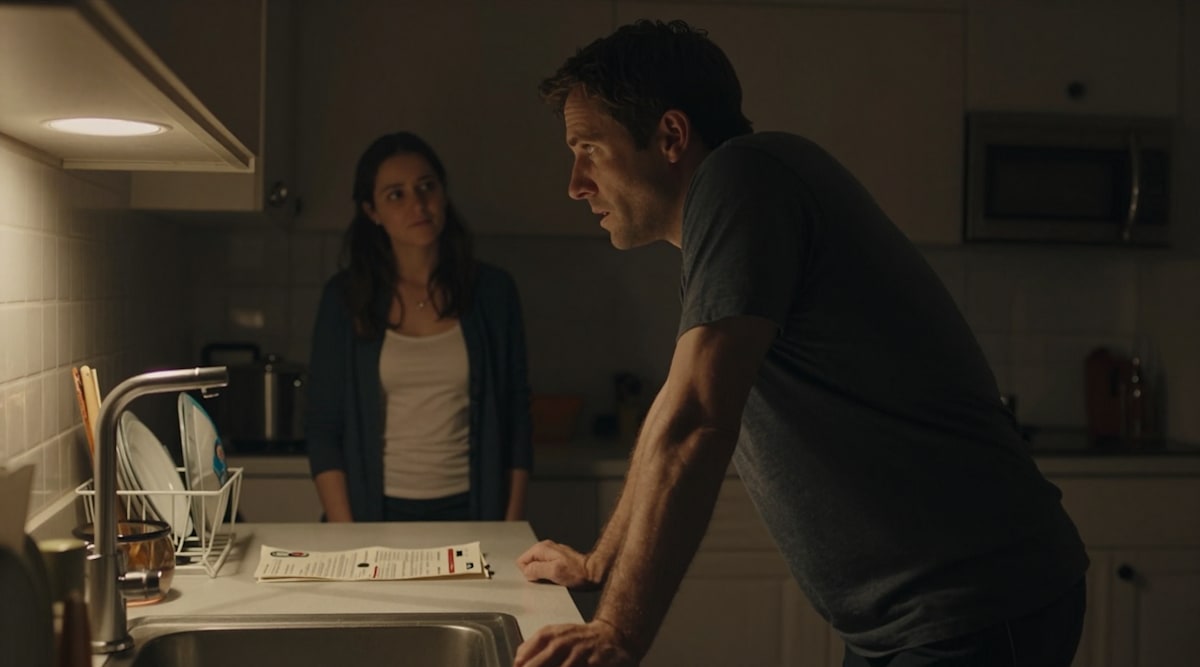
The moment happens in a kitchen, a hallway, a car somewhere between dinner and bedtime. She says something. The words themselves are not the problem. You have heard words just like them before and they glanced off you without a scratch. The problem is that tonight you are tired. Tonight you are carrying something from work you have not named. Tonight the words land and something in you rises before you decide whether to let it. You feel the heat moving up through your chest. You know the next sentence out of your mouth is going to cost you. The Protocol says halt. Every part of you says the opposite. Every part of you wants to win this fight right now, because winning feels like strength and stopping feels like surrender, and no man wants to surrender in his own kitchen.
This is the Marriage Gate, and this month we are walking all twelve gates every man must guard. Yesterday we finished a two-part walk through the Brotherhood Gate, the foundation gate without which every other gate eventually collapses. The Jury you built or strengthened or at least admitted you need matters here more than anywhere else, because the Marriage Gate is the one where your Audit is least trustworthy. When you are angry at your wife, your Audit will tell you she started it. Your Audit will tell you she is being unreasonable. Your Audit will tell you that you are the one being attacked and defending yourself is noble. Your Audit is lying. Every married man's Audit lies about his wife when his defenses are up, and the only way to catch the lie is to have a brother who will ask, "What were you feeling before she said the first word?"
Your wife is not your enemy. Your flesh keeps treating her like one.
The failure mode at the Marriage Gate is not that men stop loving their wives. Most men who are reading this love their wives. The failure mode is that in the half-second between the trigger and the response, men default to reflexes that treat their wife as an opponent. Something she says registers as a threat, and the threat triggers one of three responses. Forward is escalation: the sharp word, the raised voice, the statement that will land on her like a weight and you say it anyway because it feels like evening the score. Backward is withdrawal: going silent, leaving the room, giving her the answer she hates most. Frozen is the worst of both: standing there, present in body, completely absent in engagement, and she can feel you leaving without watching you walk out the door.
All three responses share the same root. The root is not that you do not love her. The root is that something inside you has interpreted her as a threat, and men respond to threats by fighting or fleeing or freezing. The Protocol was built for exactly this half-second.
The Watchman's Protocol has four moves. ARREST. AUDIT. ALIGN. ACT. Let me walk each one through the Marriage Gate, where the moves are hardest and the cost of skipping them is highest.
ARREST at the Marriage Gate means halting before the sharp word leaves your mouth. It is literally stopping the kinetic energy that is already in motion. Your jaw is tensing. Your shoulders are rising. The words are forming. ARREST is the discipline of not letting them form into sound. This is the move that feels most like weakness to a man. Every instinct says speak. Every instinct says the faster you respond, the stronger you look. The Scripture says the opposite. "Understand this, my dear brothers and sisters: You must all be quick to listen, slow to speak, and slow to get angry. Human anger does not produce the righteousness God desires" (James 1:19-20, NLT). Quick to listen. Slow to speak. Slow to get angry. Three commands and the order matters. Listening comes before speaking. Slowing down the anger comes before evaluating whether the anger is justified. The first move at the Marriage Gate is not to determine whether you are right. The first move is to close your mouth.
AUDIT at the Marriage Gate asks a single question that most men never ask in the moment: what am I actually feeling beneath the anger? Men are permitted one emotion in most rooms and it is anger, so everything beneath it gets rerouted through the same exit. Fear, shame, hurt: all three come out sounding like anger, and the person nearest to us when the pressure finally breaches the wall is the person we swore to love and protect. Almost always the anger is covering one of those three. Fear that you are failing as a provider. Shame that you did something you cannot face yet. Hurt that she does not see how hard you are trying and her words landed on a wound that was already open. The Audit does not ask "is my anger justified." It asks "what is the anger covering." If you cannot answer that question honestly, you are not ready to speak.
Solomon understood this. "A gentle answer deflects anger, but harsh words make tempers flare" (Proverbs 15:1, NLT). The gentle answer is not possible until you know what you are actually answering. The Audit gives you that. Three seconds is the difference between a conversation and a crater.
ALIGN at the Marriage Gate brings in the Witnesses. Scripture says, "and don't sin by letting anger control you. Don't let the sun go down while you are still angry, for anger gives a foothold to the devil" (Ephesians 4:26-27, NLT). The command is not "do not feel anger." The command is "do not let anger control you" and "do not let the sun go down while you are still angry." Most men misread the second part as permission to escalate: resolve this right now, win this right now. That is not what Paul is saying. He is saying that unresolved anger is a gate the enemy walks through. ALIGN asks: what do the Witnesses say about what I am about to do? Scripture says love your wife as Christ loved the church. "For husbands, this means love your wives, just as Christ loved the church. He gave up his life for her" (Ephesians 5:25, NLT). Christ did not escalate. Christ did not withdraw. Christ governed himself all the way to the cross, and his self-governance is the model for every husband standing in his kitchen trying to decide whether the next sentence will build or burn.
Counsel, the second Witness, is the brother you built the Jury with yesterday or the brother you are going to call because you read yesterday and knew you needed to. The brother asks the question your Audit will not ask on its own: "Brother, what were you feeling before she said the first word?" That question changes everything. It moves the conversation from what she did to what was already happening inside you.
Conscience, the third Witness, is the quiet knowing that you are about to do something you will regret. Every married man knows this feeling. The words are forming and something inside you is saying stop, do not say that, you cannot take that back. Most men ignore it. The governed man halts. The Witnesses do not remove the anger. They frame it and force it to answer questions. They make the anger prove it belongs to righteousness and not to the flesh, and most of the time the anger cannot pass that examination.
ACT at the Marriage Gate is the hardest move because it often looks like doing nothing. After you have arrested the sharp word, audited what is underneath, and aligned with the Witnesses, what is left is not a triumphant declaration. What is left is something smaller: saying, "I need a minute. I am not shutting down. I am going to the other room to run the Protocol because I do not want to say something I cannot take back. I will come back." That is ACT. That is obedience at the Marriage Gate. It does not feel like victory. It feels like surrender, and surrender is what the flesh fights hardest. The Proverbs call it guarding the heart. "Guard your heart above all else, for it determines the course of your life" (Proverbs 4:23, NLT). Guarding the heart means governing what comes out of it. The words you speak in your kitchen determine the course of your marriage. The Watchman who stops at the gate instead of letting the words through is guarding his heart and his home in the same motion.
One hard truth before the takeaway. The Protocol does not require your wife to run it. If you are waiting for her to arrest her words before you arrest yours, you are not running the Protocol. You are negotiating. The Watchman governs himself regardless of what anyone else in the house is doing. If she is escalating and you are arresting, one governed person in the room changes the physics of the room. Govern yourself first. The marriage does not need you to win. The marriage needs you to govern yourself. The man who cannot tell the difference between winning and governing is the man whose marriage is slowly eroding under a pile of arguments he thought he won.
The fight you win today can cost you a marriage tomorrow. Every sharp word you let through the gate is a brick removed from the fortress. One brick does not bring the wall down. A thousand bricks, a decade of bricks, and one day the wall is gone and neither of you remembers when the first brick was pulled. The Protocol exists to stop the first brick. The first brick is the one you are holding in your hand right now, in the moment after she says the thing and the heat rises and the words are waiting. ARREST. Close your mouth. AUDIT. What is underneath. ALIGN. What do the Witnesses say. ACT. "I need a minute. I will come back." That is the Protocol at the Marriage Gate. The Watchman who runs it in the kitchen tonight is the same man whose fortress will still be standing in twenty years.
Leadership Challenge: The next time your wife says something that triggers the rise, the heat, the forming of the sharp word, run the Protocol out loud. Not silently. Out loud, so she can hear you doing it. Say these exact words: "I feel myself getting defensive right now. I need two minutes to run the Protocol so I do not say something I cannot take back. I am not shutting down. I will come back." Then leave the room. Run ARREST by literally closing your mouth. Run AUDIT by asking what is underneath the anger: fear, shame, or hurt. Run ALIGN by checking Ephesians 4:26 and remembering that the command is not "do not feel anger" but "do not let anger control you." Then ACT by returning to the room and saying one honest sentence about what you found. "I think I got defensive because I was already feeling like a failure at work and your comment landed on an open wound." That sentence is terrifying to say. It is also the sentence that turns an argument into a conversation. Your wife has been waiting years to hear it. Try it once this week. If you do nothing else from this article, try it once.