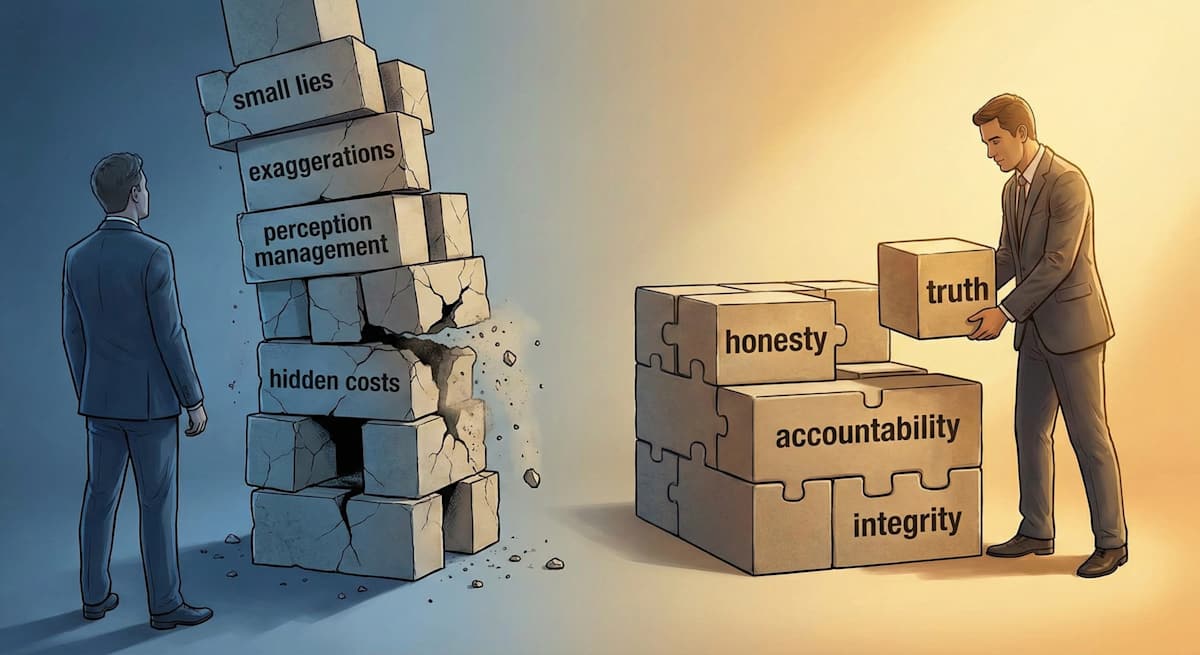
I once told a client, “We are almost done,” when I had not even started. I told my wife, “I am leaving the office now,” while I was still typing an email. I expensed a personal lunch because I decided the company owed me for all the unpaid overtime. None of these felt like moral failures at the time. They felt like management. I was managing perceptions, buying time, balancing the scales. I was also training myself to lie.
Years later, I faced a $350,000 billing decision that would have required me to sign off on something I knew was wrong. I failed that test. For a long time, I blamed the pressure of that moment. If only I had been stronger when it mattered. But looking back, I realize the collapse did not happen because the pressure was high. It happened because my foundation was shallow. You do not become a liar the day you sign a fraudulent contract. You become a liar the day you lie about why you were late to a meeting.
This is how integrity actually works. It is not a trait you either have or do not have. It is a stack. Every time you tell the truth when it is awkward, you add a beam. Every time you admit a mistake when you could have blamed someone else, you pour concrete. Every time you exaggerate a number to look good, you remove a bolt. Every time you say “I am fine” when you are not, you create a hairline fracture. The structure looks solid from the outside, but the load-bearing capacity is compromised.
The most common failure mode for leaders is not the bold-faced lie. It is strategic exaggeration. “I will have it to you by end of day,” when you know you will not. “The traffic was bad,” when you left ten minutes late. “It is in final review,” when you have not opened the file. These feel harmless because no one gets hurt and no one finds out. But someone does find out. You do. You teach your own nervous system that truth is negotiable. You train your reflex to spin before you speak.
Jesus said something that sounds almost too strict: “Let what you say be simply ‘Yes’ or ‘No’; anything more than this comes from evil” (Matthew 5:37). He was not being a moralist. He was describing the blueprint for authority. When your word means something, people can build on it. When your word is hollow, people learn to work around you. The leader who habitually manages perception loses the one thing perception management was supposed to protect: credibility.
Daniel understood this. He did not start his career by facing lions. He started by refusing the king’s food. It was a small thing, a dietary preference, nothing that would make the history books. But he drew a line. Because he held the line on the menu, he had the strength to hold the line on worship decades later. You cannot survive the lion’s den if you have not survived the king’s table. The small tests are not warmups. They are the actual training.
Here is a practical test. Think about your expense report. You took a client to lunch for $48 and tipped $12 to make it an even $60. On the way back, you bought a $4 coffee for yourself. Do you lump it in? It is just $4. The company makes millions. They owe you for all the extra hours you work. But it is not about the money. It is about the stack. If you can be bought for $4, you can be bought for $350,000. The price is different, but the principle is the same. You are selling your integrity for a benefit.
The good news is that stacks can be rebuilt. You can start adding beams today. Find one area where you are managing perception instead of telling the truth. Maybe it is how you describe your progress in meetings. Maybe it is the reason you gave for missing a deadline. Maybe it is something you told your spouse last week. Correct the record. Say, “I told you I was stuck in traffic. Actually, I just left late. Sorry for the inaccuracy.” It will feel awkward. It will feel like death to your ego. But it will bring life to your soul, and it will add a brick to a foundation that will hold when the real pressure comes.
The big collapses are just the final receipt for a thousand small compromises. Stop waiting for the high-stakes moment to prove your integrity. The high-stakes moment will only reveal what you have already built. Start telling the truth in the low-stakes moments, and you will have something to stand on when it actually matters.
What is one area of your life where you have been “managing perception” instead of telling the truth?
I write about leadership at the intersection of timeless principles and modern workplaces. Follow for weekly insights on building teams that actually work. For more articles like this consider subscribing to my Substack at: https://justinwilson411.substack.com/