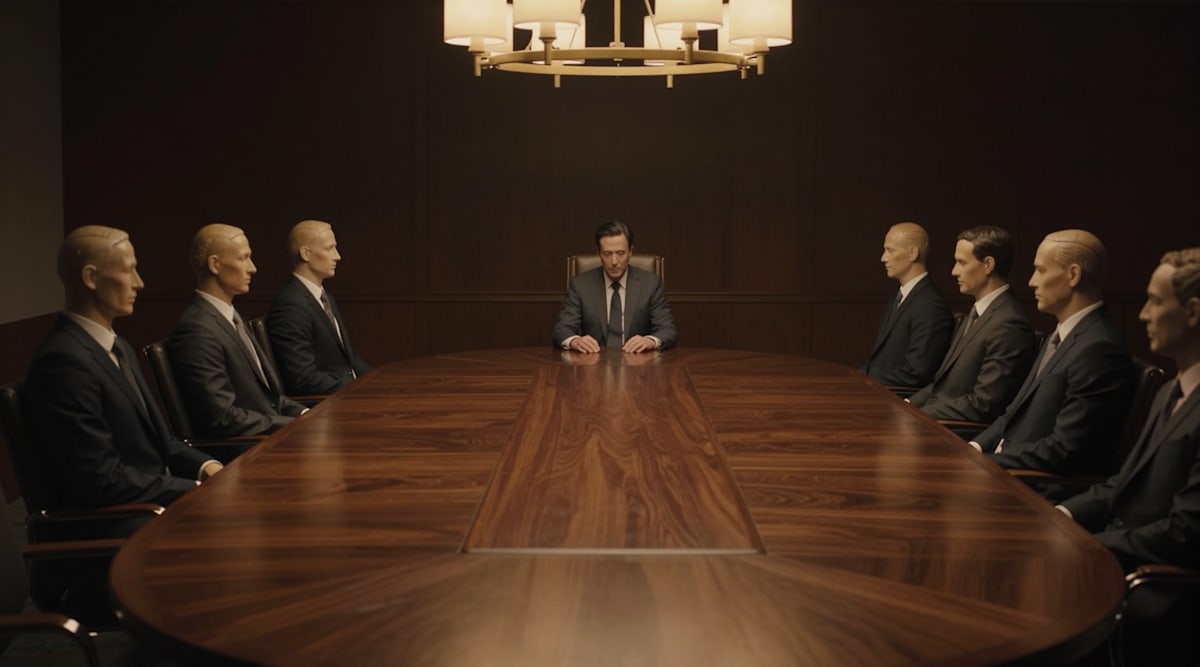
A chief executive walks into a Wednesday morning strategy session with a major decision already half-made. He has framed it as a question, but the framing is doing work. He presents the plan to three people. His COO, the one he hired. His VP of Strategy, the one who reports to the COO. The consultant he has used on every major decision for the last four years, the one whose retainer he renewed three weeks ago. All three give him the same answer. He calls it consensus. He goes home Wednesday night and tells his wife the team is aligned. By the following Tuesday, the plan is in motion. By the Tuesday after that, he is sitting in his office wondering why no one warned him.
This is the Echo Chamber Jury, and it is the second failure mode in the ALIGN family. Yesterday we named Deciding Alone on High-Stakes Issues, the leader who runs ALIGN with the Counsel witness missing entirely. Today we name what happens when the Counsel witness shows up, sits down, and turns out to have been hand-picked for what they would say before they ever opened their mouths. The empty room is one problem. The rigged room is a worse one, because the leader running it feels covered.
The Echo Chamber Jury is the leader who technically complies with Standing Order #7 and quietly violates it at the same time. He did ask for counsel. He did get input. He did weigh the opinion of others. The decision was not made in isolation. The forms are filled in. The boxes are checked. What he did not do is bring counsel that had the standing to tell him no. The room held people whose paychecks he signs, whose careers he sponsors, whose access to power he gates. They were not advisors. They were witnesses he had pre-selected for the verdict he had already reached. The wisdom literature has little patience for this kind of room. The clearest treatment of it sits one chapter into the reign of a king most leaders would rather not be compared to.
Solomon's son Rehoboam has just inherited the throne in 1 Kings 12. The northern tribes come to him and ask for relief from the heavy taxation his father had imposed during the temple construction years. Rehoboam does the right thing first. He goes to the elders, the men who had served his father, the counselors who had been in the room when the original decisions were made. They tell him to lighten the load. They tell him that a king who serves his people earns servants for life. He does not like the answer. He sends them away. The text is direct about what happens next. "But Rehoboam rejected the advice of the older men and instead asked the opinion of the young men who had grown up with him and were now his advisers" (1 Kings 12:8, NLT). The young men, who had spent their lives in his orbit, who owed their positions to his favor, who had never served in any seat but his, told him what he wanted to hear. He took their counsel. He spoke to the people in language meant to harden them. The northern kingdom seceded that day. Israel never reunified. The Echo Chamber Jury split a nation.
The diagnosis underneath this anti-pattern is harder than the diagnosis underneath yesterday's. The leader who decides alone is at least honest about the empty room. The leader running the Echo Chamber Jury is performing the form of counsel while shaping the substance. The flesh under the surface is not laziness. It is fear, dressed up as efficiency. He is afraid of a dissenting voice in the room. He has discovered, over time, that one strong "no" can change his mind, and he has decided he does not want his mind changed. He stocks the room with people who will not change it. The system is humming. The decision feels weighed. The verdict was selected before the trial.
There is a second layer to the diagnosis that most leaders miss. The Echo Chamber Jury is not always intentional. Sometimes it is the slow drift of a leader who has been at the top long enough that the people around him have learned. They have watched what happens to the colleague who pushed back too hard in a meeting. They have watched what happens to the consultant who told the chief executive the strategy was wrong. They have watched what happens to the VP who would not soften the report. The pattern has been trained. The jury has been silently coached. When the leader asks for honest input, what he gets is the input the room has learned is safe. He thinks he is hearing counsel. He is hearing the survival instinct of the people who depend on him.
The proper pattern, ALIGN running clean, requires a precise definition of what the middle witness actually is. Chapter 9 of Book 2 names the Three Witnesses as Scripture, Counsel, and Conscience. The middle witness is not "people who care about me," or "people who know my situation," or "people I respect." The middle witness is a counselor who has the freedom and the standing to disagree, and whose disagreement will not cost them their job, their access, or their relationship. Without that freedom, what looks like Counsel is theater. The witness is on the stand in costume.
There is a Scripture that turns this idea over and shows the bottom of it. "Wounds from a sincere friend are better than many kisses from an enemy" (Proverbs 27:6, NLT). The wisdom literature understood that praise from the wrong person is more dangerous than criticism from the right one. The kiss of the flatterer feels like favor. It is not. The wound of the friend feels like opposition. It is not. The leader who has surrounded himself with kisses has not surrounded himself with friends. He has surrounded himself with people who have learned what he wants to hear and have priced the cost of telling him otherwise.
The recovery from the Echo Chamber Jury is three steps, in this order, and none of them are negotiable. First, audit your current counsel list. Write down the three to five people you typically run high-stakes decisions past. Next to each name, write down what they have to lose by disagreeing with you. If the answer for every name is "nothing meaningful," the list is real counsel. If the answer for any name is their job, their contract, their access, their family's livelihood, their next promotion, or their professional standing inside an organization you control, that name is not a counselor. That name is a witness. The list is the problem. The list is also the place to start.
Second, add a counselor who has nothing to lose. The criteria are not friendship or loyalty or admiration. The criteria are independence and willingness. You need a person who does not work for you, will not work for you, and is not angling to work for you. You need a person who can say "this is wrong" without taking a calculated risk by saying it. The wise leader keeps a peer outside his organization, a counselor who shares his values but not his payroll, a mentor who knew him before he had the title, a spouse who is willing to ask the hard question over dinner. The witness who pays no price for honesty is the witness whose verdict can be trusted.
Third, the next time you have a high-stakes decision to weigh, identify the person on your list most likely to disagree with you, and call them first. Not last. Not after the rest of the jury has voted. First. The leader who calls the dissenter last is not running ALIGN. He is using the dissenter to verify a verdict the room has already confirmed. The dissenter who arrives at the end of the meeting is a formality. The dissenter who is asked first is a witness. The order tells you which one your decision is being built on.
There is a hard truth at the bottom of this anti-pattern that the leader running it has to face directly. If everyone you have asked agrees with you, you have not yet asked enough people. The unanimous verdict of a curated room is not consensus. The unanimous verdict of a curated room is a mirror, and the witness you have been listening to all along has been your own reflection. The Three Witnesses cannot do their work if two of them have been replaced by the third in costume. ALIGN requires three independent voices, and the leader who cannot find disagreement in his room has not built a room. He has built a chapel of self-confirmation.
Tomorrow we name the third anti-pattern in the ALIGN family, Ignoring the One Witness Who Disagrees. Today's failure mode is the room that does not contain a "no." Tomorrow's is the room that does contain one, and what the leader does to that voice when he hears it. The recovery work runs together. The leader who refuses to build a real jury today is the same leader who will not listen to the lone dissenter tomorrow, because the entire system has been built to silence that voice. Today we name the construction of the echo chamber. Tomorrow we name the dismissal of the one voice that was never supposed to be in it.
Leadership Challenge: Write down the three to five people you typically consult on high-stakes decisions. Next to each name, write down what they have to lose by disagreeing with you. If the answer for every name is "nothing meaningful," who is missing from the room, and what is keeping you from adding them this week?