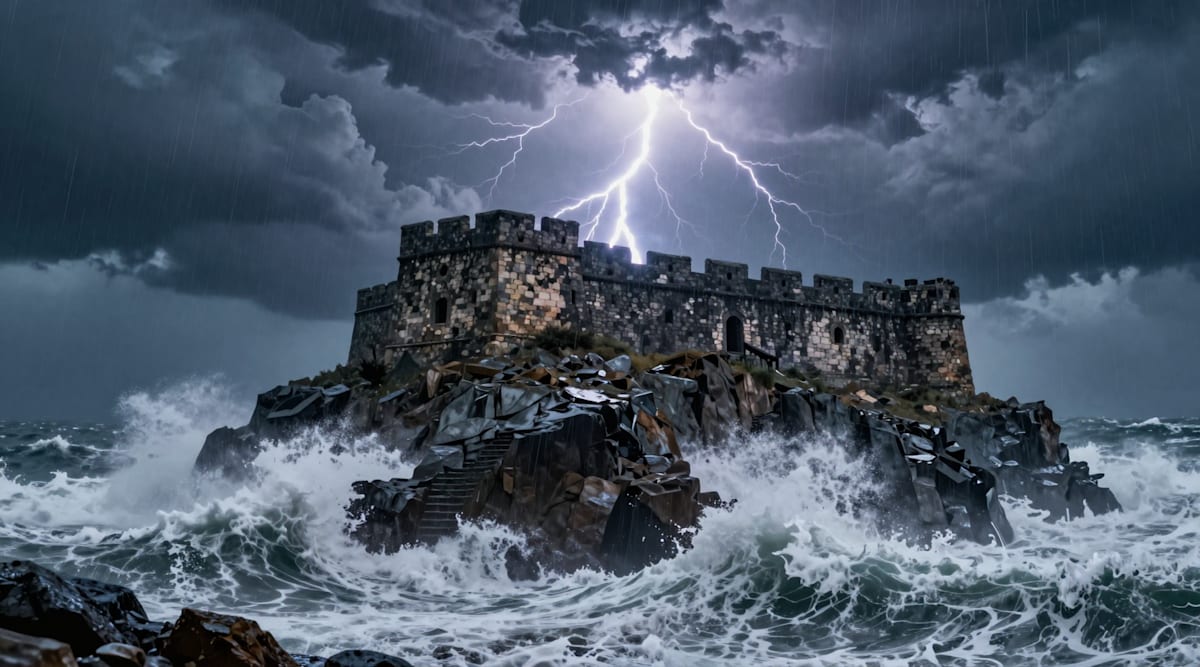
The call comes on a Tuesday afternoon, or maybe it is a Saturday night. It does not matter when it comes, because you never see it coming. The phone call from the boss. The email from HR that lands at 4:55 PM on a Friday. The test result your doctor reads over the phone. The text from your wife saying she needs to talk, and you know before you read the rest that nothing good follows that sentence. In that moment, the ground drops. Not metaphorically. The ground actually drops. Every assumption you built your life on evaporates in a sentence, and you discover what you are made of. The Crisis Gate is the one you do not choose to enter. It chooses you. When the storm hits, it does not create who you are. It exposes what you have already become.
The failure mode at the Crisis Gate is not panic. It is not fear. Panic and fear are the symptoms. The failure mode is the quiet conviction that the storm should not have caught you off guard because you were supposed to be better prepared. This is the deepest wound a man carries into crisis: the secret shame of having believed he was immune to it. He built a career. He saved for retirement. He bought the insurance. He did everything right. He stands in the rubble of a Tuesday afternoon, realizing that none of those things could hold the weight he put on them. The real failure mode is the belief that the fortress was ever going to be enough.
Jesus speaks directly to this failure mode in Matthew 7, and the passage lands harder on a man who has just lost something. "Anyone who listens to my teaching and follows it is wise, like a person who builds a house on solid rock. Though the rain comes in torrents and the floodwaters rise and the winds beat against that house, it will not collapse because it is built on bedrock" (Matthew 7:24-25, NLT). Notice that the rain comes. Jesus does not say the wise man avoids the storm. He says the wise man builds for it. The house on rock still gets rained on. It still gets flooded and wind-beaten. The difference is not that the storm spares the wise builder. The difference is that the house holds. The house holds because of what it was built on, not how high the walls were or how good the curb appeal looked from the street.
The diagnosis at the Crisis Gate has to answer one question before any other: What was your fortress actually built on? If it was built on your job, your portfolio, your reputation, your health, your marriage, or any other good thing you did not create and cannot control, then the storm was always going to expose the foundation. This is not a guilt trip. It is physics. A structure that collapses in a hurricane does so because its foundation was sand. The man did not build poorly. He built in the wrong location entirely. The AUDIT at the Crisis Gate asks a question that feels cruel in the moment and is the most merciful thing you will hear: Was your peace ever in something that can be taken from you?
ARREST at the Crisis Gate looks nothing like ARREST at the other gates. At the Anger Gate, ARREST means stopping your hand before it reaches the keyboard. At the Integrity Gate, ARREST means looking away. At the Digital Gate, ARREST means putting the phone down. At the Crisis Gate, ARREST means sitting down. Not making a call, not sending a reply, not solving the problem, not doing any of the things your adrenal system screams at you to do. The first move at the Crisis Gate is the hardest move of all: stop moving. Paul writes about the weapons this fight requires: "We are human, but we do not wage war as humans do. We use Gods mighty weapons, not worldly weapons, to knock down the strongholds of human reasoning and to destroy false arguments. We destroy every proud obstacle that keeps people from knowing God. We capture their rebellious thoughts and teach them to obey Christ" (2 Corinthians 10:3-5, NLT). The worldly weapon at the Crisis Gate is frantic action: fix it, control it, manage it, get ahead of it. The mighty weapon is the moment of stillness where you refuse to let the crisis define your next move. ARREST is not passivity. It is the refusal to let the storm set the tempo of your response.
The AUDIT at the Crisis Gate has to go deeper than the H.A.L.T. framework can reach, because the thing driving you in a crisis is not hunger, anger, loneliness, or tiredness. It is terror. The AUDIT at this gate asks: What am I afraid of losing, and was it ever mine to lose? This is the question Job answered while sitting in ashes. "I came naked from my mothers womb, and I will be naked when I leave. The Lord gave me what I had, and the Lord has taken it away. Praise the name of the Lord" (Job 1:21, NLT). Job does not deny the loss. He does not minimize it. He tethers himself to the reality that everything he had was a gift, and gifts can be withdrawn by the giver. The AUDIT at the Crisis Gate is not an exercise in stoic indifference. It is an inventory of what you actually own. The answer, when you are honest about it, is close to nothing. Your next breath is borrowed. Your next heartbeat is not guaranteed. The people you love are on loan. The AUDIT does not produce despair. It produces the hardest freedom a man can experience: the freedom of having nothing left to protect because you were never the owner anyway.
The ALIGN at the Crisis Gate is where the work of the other eleven gates pays its dividend. The man who has been governing his Anger Gate, his Integrity Gate, his Marriage Gate, his Brotherhood Gate all year has built something he may not recognize until the storm hits. He has built the reflex of turning toward the Witnesses instead of turning inward. He has built relationships with brothers who will tell him the truth when he does not want to hear it. The ALIGN at the Crisis Gate does not require him to invent a theological framework under pressure. It requires him to apply the one he has been building all year. Proverbs says, "A prudent person foresees danger and takes precautions. The simpleton goes blindly on and suffers the consequences" (Proverbs 22:3, NLT). The prudent man has been taking precautions all year, and the precaution is not a bigger savings account. It is a governing framework that does not collapse when the pillars of his life are shaken.
The ACT at the Crisis Gate is counterintuitive. Every instinct tells you to act fast, act big, decisively, assert control over the chaos. The Protocol says something different. The first ACT at the Crisis Gate is not toward the problem. It is toward the first brother on your list. Call him. Tell him what happened. Do not manage his reaction. Do not soften the news. Let him carry part of the weight. The man who calls his brother before he calls his attorney is already operating differently, because he has already acknowledged the most important truth about the Crisis Gate: you were never meant to walk through it alone. Solomon said it this way: "Two people are better off than one, for they can help each other succeed. If one person falls, the other can reach out and help. But someone who falls alone is in real trouble" (Ecclesiastes 4:9-10, NLT). The ACT at the Crisis Gate is reaching out your hand before you fall.
The Standing Orders for the Crisis Gate proceed in three moves. First, do not make any significant decision in the first 72 hours except breathing and telling your brother. Most of the damage men do in a crisis happens in the first three days, when the adrenaline is still pumping and the fear drowns out everything else. Second, write down what you are afraid of losing. Then write down what of those things was ever truly yours. The exercise exposes what needs to be grieved and what needs to be released. Third, return to the Standing Orders for the gates you already govern. Do not abandon the Protocol because you are in crisis. Sleep when you should. Eat when you should. Arrest your anger. Do not scroll. Call your brother. The discipline of the other gates is the scaffolding that will hold you while this one shakes. It will shake. The storm does not stop just because you ran the Protocol. The storm stops when the storm stops. Your job is not to stop the storm. Your job is to be standing when it passes.
The fortress you built on Tuesday is the one that holds on Saturday night. The man who governed his gates on ordinary Tuesday afternoons will discover, when the call comes on Saturday night, that he has been building the stronghold one Standing Order at a time. He built it during the ordinary days when no one was watching and no storm was forecast. He built it by governing his anger when no one provoked him. He built it by guarding his eyes when no one tested him. He built it by calling his brother when nothing was wrong. Then Saturday night came, and the storm hit everything he built, and the foundation held. Not because the storm was mild. The foundation was rock, and rock does not become rock in a storm. Rock becomes rock over millennia of pressure, and the man becomes a stronghold over thousands of governed Tuesday afternoons.
The Tuesday afternoon takeaway is the hardest one in this series, because it asks you to do work when you do not yet need it. If you are not in a crisis today, you are building for the one that is coming. Everyone gets a Saturday night. Everyone gets the call. The storm does not care if you are ready. It comes. The question is not whether the storm will hit your house. The question is what your house is built on, and whether you are building it one obedient Tuesday at a time. If you are in a crisis right now, your takeaway is simple: call your brother before you do anything else. If you are not in a crisis, your takeaway is harder: govern the gate you are in today as if Saturday night were tomorrow, because it might be.
Leadership Challenge: If you are in a crisis right now, who is the first brother you need to call, and what is stopping you from making that call within the next hour? If you are not in a crisis, look at the gate you have been neglecting most consistently this month. The fortress you are building on ordinary Tuesdays is the one that will hold or fail on a Saturday night you cannot see coming. What is one Standing Order you can install today that will still be standing when the storm arrives?
I write about leadership at the intersection of timeless principles and modern workplaces. Follow for weekly insights on building teams that actually work. For more articles like this consider subscribing to my Substack at: https://christianleadership.now