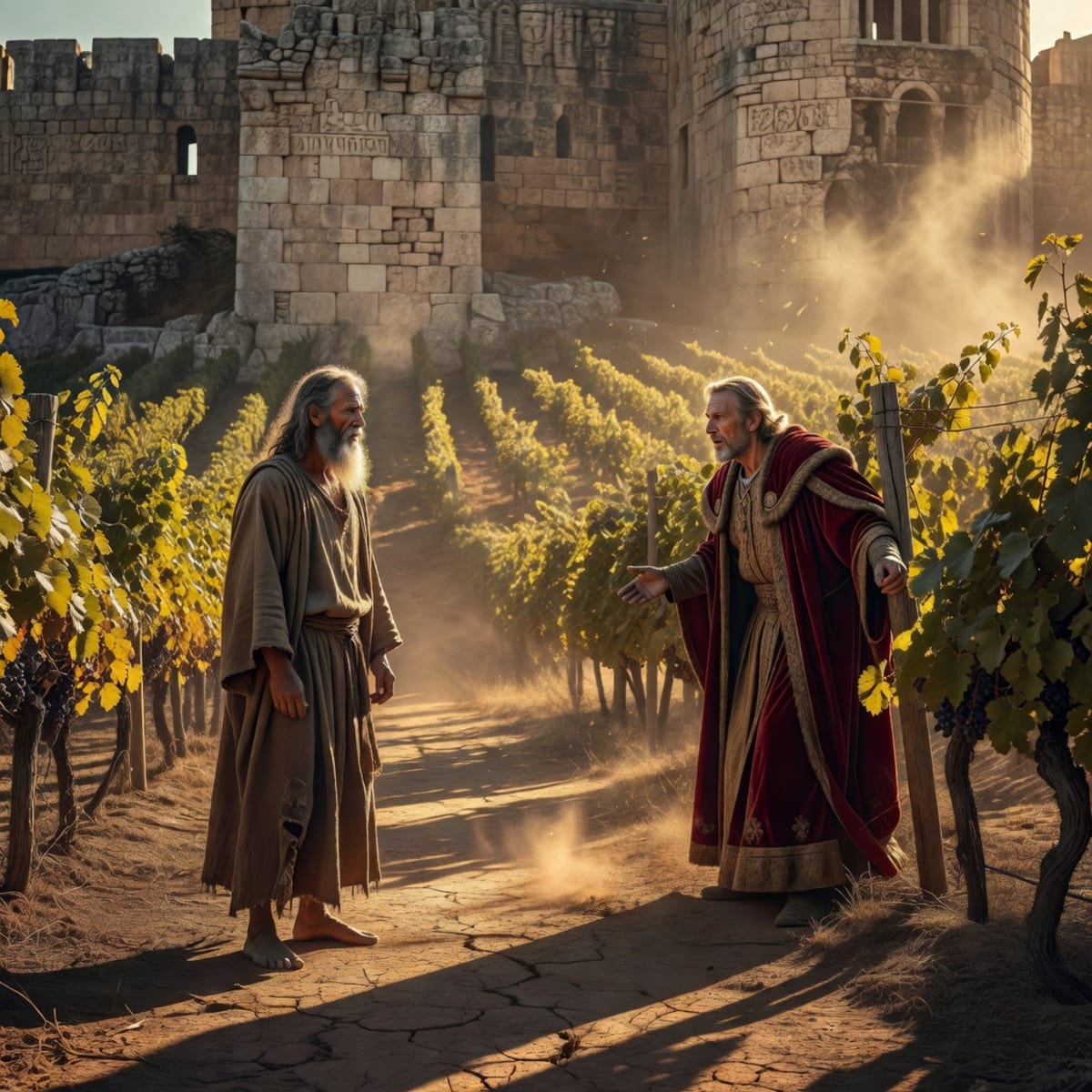
Ahab was standing in a dead man’s vineyard when the prophet found him. He had wanted the plot beside the palace. Naboth had refused to sell the inheritance of his fathers. Jezebel staged the trial and the killing. The king went down to claim what murder had purchased, and the first person waiting in the rows was the last person he wanted to see.
Yesterday Elijah walked into this month with no résumé and a sentence that could have gotten him killed. Today I am staying with that sentence long enough to tell the truth about courage. Courage is not volume. Courage is not a personality that enjoys conflict. Courage is the willingness to tell the truth when the person who can punish you is standing in the room.
The first time Elijah stood before Ahab, the word was about rain.
Now Elijah, who was from Tishbe in Gilead, told King Ahab, “As surely as the Lord, the God of Israel, lives—the God I serve—there will be no dew or rain during the next few years until I give the word!” (1 Kings 17:1, NLT)
Ahab’s court had already given Baal the credit for clouds, harvest, and national security. To announce a drought in that room was not a weather report. It was a public claim that the God of Israel, not the palace god, decides whether the land drinks. Elijah did not form a coalition first. He did not wait for a friendlier administration. He stood. The authority in the sentence is not his nerve. “The God I serve” is the whole credential. Tishbe impressed nobody in Samaria. The living God did.
That is the part most leadership talks keep: the prophet with a spine, the man who will say it to the king’s face. Scripture will not let us stop at the speech. Years later, after drought and after fire, God sends Elijah back to the same king. The assignment is uglier. Ahab is not on a throne. He is at the crime scene, treating a murdered man’s vineyard as a prize.
But the Lord said to Elijah, “Go down to meet King Ahab of Israel, who rules in Samaria. He will be at Naboth’s vineyard in Jezreel, claiming it for himself. Give him this message: ‘This is what the Lord says: Wasn’t it enough that you killed Naboth? Must you rob him, too? Because you have done this, dogs will lick your blood at the very place where they licked the blood of Naboth!’” (1 Kings 21:17-19, NLT)
I will not turn the judgment in that message into a technique. Dogs and blood belong to God’s judgment against a king who used the machinery of the state to kill a man for a garden. The leadership lesson is not how to predict someone’s end. The lesson is that God sent Elijah to say the true thing in the place where power was enjoying the spoils. Ahab’s greeting tells you what the word cost.
“So, my enemy, you have found me!” Ahab exclaimed to Elijah. “Yes,” Elijah answered, “I have come because you have sold yourself to what is evil in the Lord’s sight.” (1 Kings 21:20, NLT)
My enemy. That is what truth often gets named when it arrives without permission. Elijah does not sand the edges to keep access to the palace. He also does not pick this fight because confrontation feels like strength. The Lord said go. The Lord named the vineyard. The Lord wrote the message. Courage in this story is obedience under threat. Recklessness would have been inventing a speech. Silence would have been self-preservation wearing the clothes of wisdom.
Here is the principle. A leader’s courage is measured by the true sentence he is willing to say in the room that can punish him for it. Volume is not the test. A reputation for being direct is not the test. The test is whether the people with the most to lose still hear the truth from you, or whether they only hear it after the damage is public and you can no longer be blamed for staying quiet.
I have watched this fail in quieter rooms than Ahab’s court. A director knows the hiring freeze is a fiction and the layoffs are already scoped, and she lets the all-hands talk about discipline and focus because the CEO has already briefed the board. A plant manager knows a safety number was massaged. He tells himself that raising it in this meeting will only make him look disloyal. A pastor knows a staff member is harming people, and he waits for a better week. None of those leaders think of themselves as cowards. They think of themselves as prudent.
The other failure wears the opposite costume. A new VP inherits a bruised culture and uses the first staff meeting to tell it like it is, burning trust he has not earned, calling the wreckage courage. Elijah did not do that. He carried a word God gave him, to a man God named, at a place God specified. Bluntness without assignment is not courage. It is a leader using truth as a weapon because it feels cleaner than patience.
Proverbs names the quieter trap without flattering us. “Fearing people is a dangerous trap, but trusting the Lord means safety.” (Proverbs 29:25, NLT) That is wisdom literature. It describes how life usually works. It is not a contract that honesty will preserve your title. The board can still fire you. The donor can still walk. The king can still hunt you. Elijah knew that. Fear of people still catches competent leaders because the room is real. Trusting the Lord does not mean the conversation will go well. It means you stop treating the room as god.
Bring this to Tuesday afternoon. What true sentence are you avoiding because the person across the table can make you pay for it? Write the sentence down. If you cannot get it onto paper, you are already managing the atmosphere instead of telling the truth. Then ask a second question before you speak: is this your word to deliver, or a speech you want to give because you are angry? Elijah’s courage was not a vent. Recklessness skips discernment. Cowardice never arrives at it.
Take the director with the fictional hiring freeze. The courageous sentence is not a speech about culture. It is one true line in a room that can freeze her career: the freeze is not a freeze. She does not need Elijah’s thunder. She needs Elijah’s obedience. Say the true thing. Stop managing the weather in the room.
If you are a believer, the next move is not a dramatic confrontation you have been rehearsing in the car. Bring the sentence before God before you bring it into the room. Ask whether this is obedience or ego. Ask who else will be harmed if you keep smoothing the air. If you are still exploring faith, the next move is still honest. Name the room. Name the cost. Name the true thing you have been calling timing. Prudence that never speaks is not prudence. It is fear with a better vocabulary.
This will not make you safer. Elijah’s first stand was followed by hiding, which is where we go tomorrow. God will send him to a brook before He ever sends him to a mountain. Courage does not cancel the need for formation. It also does not wait until formation feels complete before the first true sentence is required. Ahab was in the vineyard. The word still had to be said.
Tomorrow we watch God hide the prophet He has just used. The brook comes before Carmel. Hidden seasons are not wasted seasons. The month still builds toward Stand and Rebuild, the paid field guide at the end of September. Today’s piece of that work is simpler than a wall and harder than a speech. Find the true sentence. Say it where it costs.
Leadership Challenge: What true sentence are you avoiding this week because the person who can punish you is in the room? Write it in one line before the meeting. If you cannot write it, what are you protecting besides the truth?
I write about leadership at the intersection of timeless principles and modern workplaces. Follow for weekly insights on building teams that actually work. For more articles like this consider subscribing to my Substack at: https://christianleadership.now