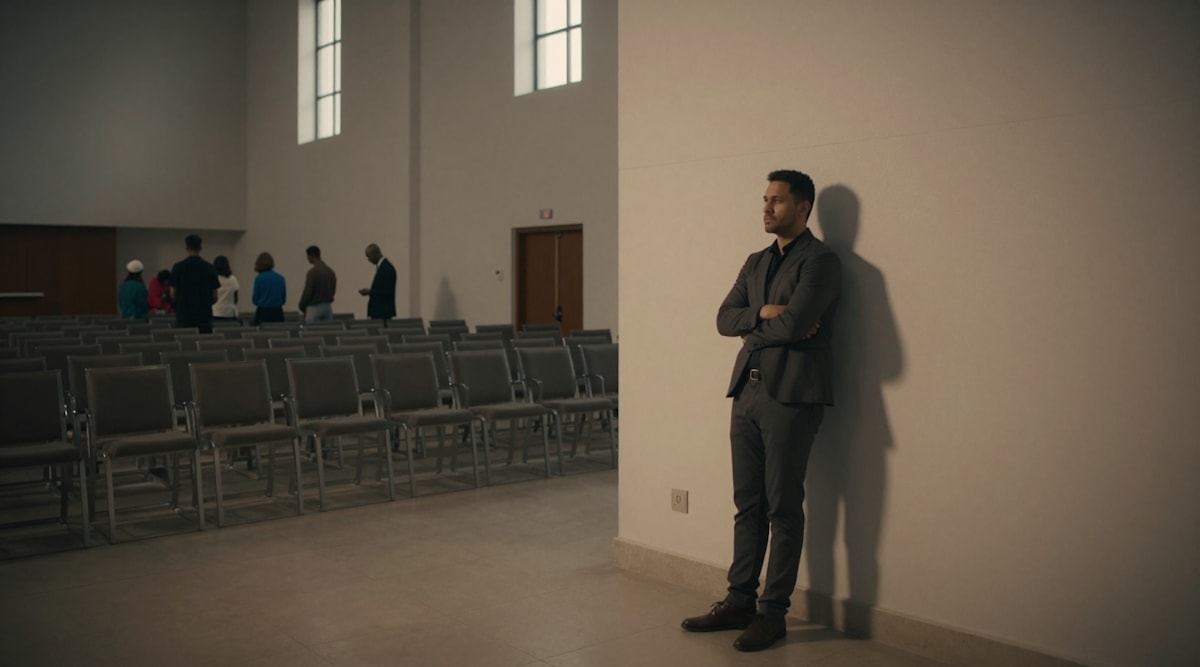
He had been at the same church for six years. He knew where to park, where to sit, when to stand up and when to sit down. He could mouth the songs without looking at the screen. He had opinions about the preaching, the music, the programming, the coffee, the carpet. He had never joined a small group. He had never served on a team. He had never sat across from another man and answered a direct question about the state of his soul. He consumed church the way a man consumes a podcast: ingest, evaluate, move on. He would have told you he was part of a church. He would have been wrong. He was a subscriber to a religious experience that asked nothing of him and gave him nothing that required his presence to receive. The Church Gate is the battleground where a man decides whether he attends a service or belongs to a body. Most men choose the service. The service is safe. The body makes demands.
The anti-pattern at the Church Gate has a name: consumer-attendance. The man who treats church as a product he evaluates rather than a body he belongs to. He shows up when it is convenient. He checks the box. He leaves. He has never been sharpened by another man because sharpening requires proximity, and proximity requires commitment, and commitment requires showing up when you do not feel like it, staying when it is uncomfortable, and answering questions you would rather avoid. The consumer-attendance pattern is not rebellion. It is drift. It is the slow, quiet process of pulling far enough back that the church cannot touch you, cannot question you, cannot see you clearly enough to notice that something is wrong. The man who drifts to the edge of the congregation is not running from God. He is running from the thing God uses to keep him honest: other people who know him.
The writer of Hebrews saw this pattern unfolding in the first century. He addressed it not with a gentle suggestion but with a command that lands with particular weight on men who prefer to do their spiritual life alone. "Let us think of ways to motivate one another to acts of love and good works. And let us not neglect our meeting together, as some people do, but encourage one another, especially now that the day of his return is drawing near" (Hebrews 10:24-25, NLT). Notice the three pieces. First, the purpose of gathering is mutual motivation. You show up not primarily for what you receive but for what you bring. Your presence is a gift to someone else before it is a benefit to yourself. Second, the command assumes the temptation. The writer says "as some people do" because some people were already drifting. The pattern is not modern. It is as old as the church. Third, the urgency escalates. The day is drawing near. The time for casual attendance, for half-committed drift, for keeping the church at arm's length, is not infinite. The gate is open now. It will not always be.
ARREST at the Church Gate is the decision to stop treating church as optional infrastructure. If you have brothers who tell you the truth, they do not become your brothers by accident. They become your brothers because you showed up consistently enough that relationship had time to form. No man builds a Jury by attending twice a month and slipping out during the closing song. The ARREST is not a dramatic moment. It is a quiet, decisive shift from consumer to contributor, from attender to member, from someone who receives to someone who belongs. Proverbs names the mechanism by which this happens, and it is not comfortable. "As iron sharpens iron, so a friend sharpens a friend" (Proverbs 27:17, NLT). Sharpening is friction. It is two hard surfaces grinding against each other until both are more effective. You cannot be sharpened by a sermon. You can be informed, inspired, convicted. Sharpening, however, requires contact. It requires another man close enough to see the dull edges you have stopped noticing. The man who ARRESTs at the Church Gate is the man who stops avoiding the friction and walks toward it.
The AUDIT at the Church Gate asks a single question that cuts through every rationalization a man has assembled. "If every man in my church engaged the way I engage, would this church still exist?" If the answer is no, the drift is not neutral. It is parasitism. You are drawing from a body you are not feeding. You are criticizing leadership you are not supporting. You are evaluating programming you are not contributing to. The AUDIT exposes the consumer-attendance pattern for what it actually is: a man receiving benefit from a community he has not joined, expecting service from a body he has not committed to, and reserving the right to critique what he has refused to build. Paul dismantled any notion of the independent Christian with the most direct metaphor in Scripture for how the church actually works. "The human body has many parts, but the many parts make up one whole body. So it is with the body of Christ. Yes, the body has many different parts, not just one part. The eye can never say to the hand, 'I don't need you.' The head can't say to the feet, 'I don't need you.' If one part suffers, all the parts suffer with it, and if one part is honored, all the parts are glad. All of you together are Christ's body, and each of you is a part of it" (1 Corinthians 12:12,14,21,26-27, NLT). You are either a functioning part of the body or you are a weight the body carries without benefit. There is no third category. The man who says "I do not need the church" is the eye telling the hand it has no use for it. The body disagrees.
ALIGN at the Church Gate brings the Three Witnesses to the specific moments when a man's consumer posture collides with a legitimate grievance. Every man who drifts has a reason. The worship is not his style. The pastor said something he disagreed with. Someone on the leadership team disappointed him. Another man in the congregation hurt him in a way he has never fully named. These are not imaginary problems. Church conflict is real. Church disappointment is real. Church hurt leaves marks. ALIGN does not dismiss the grievance. It asks whether the grievance justifies the drift. The Witnesses ask three questions. Scripture: does the command to not neglect meeting together contain an exception for musical preference or pastoral disagreement? The Jury: what do the brothers who know my story say about whether I am avoiding the body under cover of a legitimate complaint? Conscience: if I am being honest, is this about what happened, or is this about my preference to not be sharpened? The man who drifts from church over a disagreement has often made the disagreement larger in his mind than it was in the room, because the disagreement gave him permission to do what his flesh already wanted: pull back far enough that no one could ask him hard questions.
ACT at the Church Gate is not finding a perfect church. Perfect churches do not exist. Perfect churches are full of imperfect people, which means the church you are looking for has exactly one member and that member is you. The church is not a product you find. It is a people you join. The ACT is joining them. Showing up on the weeks when you do not feel like it. Staying through the season when the preaching does not land for you. Sitting across from another man and answering his questions. Serving somewhere that does not put you on stage. The ACT is the decision to stop being a consumer of religious goods and start being a part of the body, even if the body is sometimes awkward, sometimes disappointing, and sometimes harder to love than you wish it were. The man who guards the Church Gate is not the man who found a flawless congregation. He is the man who stopped requiring the church to be flawless before he would commit to it.
The church is not a service you attend. It is a body you belong to. The gate is open for you to walk through it, not around it. The drift is quiet, and quiet things do their work slowly, until one day the man who consumed church for years realizes he has no brothers who know his actual life, no Jury to audit his decisions, and no one close enough to sharpen him. The consumer leaves when the product disappoints. The member stays because the body is his own.
Leadership Challenge: This week, name the real reason you keep the church at arm's length. Is it a legitimate grievance you have allowed to justify a drift? Is it a preference for autonomy that you have dressed up as discernment? Is it simply the friction of being known, which is uncomfortable before it is redemptive? Tell one brother what you find. Then walk through the gate.
I write about leadership at the intersection of timeless principles and modern workplaces. Follow for weekly insights on building teams that actually work. For more articles like this consider subscribing to my Substack at: https://christianleadership.now