Yesterday we named the gap. The question was simple: name the man who has permission to walk into your interior and name what he sees without you punishing him for it. If you did the work, you now hold a number. Some of you hold a zero. Some of you hold the name of a man you have not called in eight months and the relationship you describe as a Jury is actually a memory of one. Some of you hold the name of a man who would show up for anything except the conversation where he tells you the truth you do not want to hear, because that conversation has never happened and neither of you knows how to start it.
Naming the gap is step one. The harder question is what to do about it. Most men know they need brothers. What they do not know is how to find them, how to build the relationship into something that can hold weight, and how to sustain it past the first awkward conversation about pornography or anger or the argument with your wife you are still convinced you won. The absence of a Jury is rarely a desire problem. It is almost always a mechanics problem. Men want brothers. They do not know how to build the structure that makes brotherhood possible.
The Watchman's Protocol can be memorized in an hour. The moves are simple. ARREST: halt at the gate. AUDIT: what is actually happening inside me right now. ALIGN: what do the Witnesses say. ACT: obey. The mechanics are not the hard part. The hard part is that two of the four moves, AUDIT and ALIGN, cannot be run honestly without a brother in the room. The Audit asks a question the flesh will always answer in its own favor. The Align requires Counsel, one of the Three Witnesses, and Counsel is another person who knows the Protocol and knows you well enough to see when you are cheating. The Protocol without the Jury is a car with two wheels. You can sit in it and turn the steering wheel and make engine noises. It will not go anywhere.
Here is the good news. Building a Jury is not mysterious. It is not a spiritual gift some men have and others do not. It is a sequence of moves, just like the Protocol itself, and men who follow the sequence get the result. The sequence has never changed. It worked for David and Jonathan in the caves of Adullam. It worked for Paul and Timothy across the Roman Empire. It works now for men who are willing to stop wishing they had brothers and start building the structure brothers require.
The first move is the hardest. You have to ask one man one hard question and you have to do it in person or on the phone, not over text. Text is where accountability goes to die. The question does not need to be dramatic. It just needs to be real. "I am trying to get control of my anger and I need someone to check in with me about it. Would you be willing to ask me how it is going once a week?" That is it. Seven seconds to say. The asking is the gate. Most men never walk through it because they think the question needs to be perfect, or the timing needs to be right, or the relationship needs to be deeper before they can ask. The relationship becomes deeper because you ask. The ask creates the depth, not the other way around.
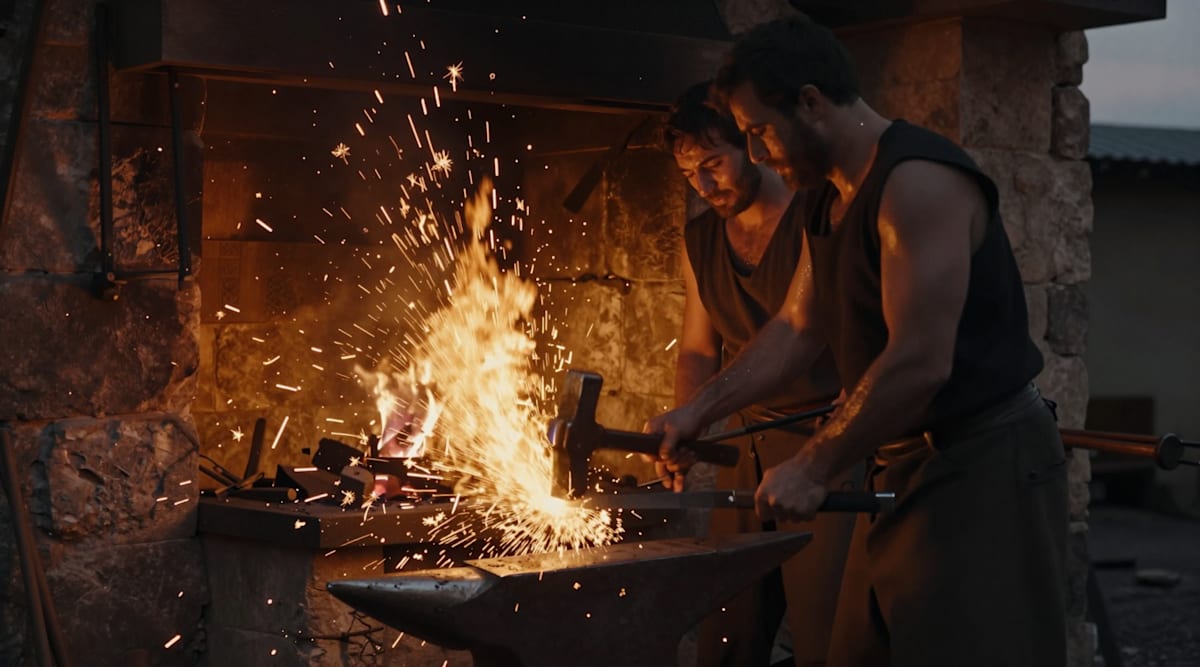
Solomon put the principle in a single sentence: "As iron sharpens iron, so a friend sharpens a friend" (Proverbs 27:17, NLT). The sharpening happens through friction. Iron against iron means two hard things striking each other. The metaphor is not comforting. It is confrontational. A friend who only affirms you is not sharpening you. He is polishing you. A Jury sharpens. The friend who says "I noticed you were short with your wife at dinner and I want to ask what was happening underneath that" is striking iron against iron. The friend who says "That sounds hard, man, you are doing great" is not. Both are present. Only one is a Jury.
The second move is structure. Brotherhood without structure dies in the calendar. Every man who has ever started an accountability relationship and watched it fade six weeks later knows this is true. The relationship that runs on intention alone runs out of intention. The relationship that runs on a standing meeting has a chance. Pick a day. Pick a time. Make it recurring. Friday morning at seven. Tuesday lunch. Thursday night after the kids are down. Does not matter when. Matters that it repeats. The writer of Hebrews understood this. "Let us think of ways to motivate one another to acts of love and good works. And let us not neglect our meeting together, as some people do, but encourage one another, especially now that the day of his return is drawing near" (Hebrews 10:24-25, NLT). The command is not to feel encouraged. The command is to think of ways to motivate each other and to not neglect the meeting. The structure carries the weight. The feelings follow the structure, not the other way around.
The third move is permission. A Jury does not work on assumption. It works on explicit invitation. The men in your life who have opinions about how you live your life are not your Jury unless you have invited them into that role. Unsolicited advice is noise. Solicited accountability is brotherhood. The invitation sounds like this: "I am giving you permission to ask me about my marriage, my anger, my phone, and my thought life. You do not need to wait for me to bring it up. If you see something, you ask. I will not punish you for it. I will not get defensive. I asked you to do this and I want you to do it for real." Most men never give anyone that permission because giving it means they cannot hide anymore, and a man who has permission to confront you is a man you cannot manage with image. That is precisely the point.
The fourth move is reciprocity. A one-way Jury is a therapy arrangement. A real Jury is mutual. If you are asking a brother to audit your Anger Gate, you had better be willing to audit his Integrity Gate when he needs it. Paul described the posture exactly: "Dear brothers and sisters, if another believer is overcome by some sin, you who are godly should gently and humbly help that person back onto the right path. And be careful not to fall into the same temptation yourself" (Galatians 6:1, NLT). Gently and humbly. Not from above. Not as the expert. As the brother who knows he could fall in the same way tomorrow. The Jury is a circle, not a pyramid. Every man in it is both watchman and watched.
The fifth move is the hardest to sustain. The Jury has to survive the first disagreement. At some point a brother will tell you something you do not want to hear, and your flesh will respond with the full arsenal: defensiveness, deflection, counterattack, withdrawal. This is the moment most Juries break. The man who hears something hard and disappears for three weeks and then comes back pretending nothing happened has broken the Jury, and rebuilding it after a break is harder than building it the first time. The response that saves the Jury is simple and brutal: "Thank you. I do not want to hear that and I need to hear it. Keep going." If you can say that sentence, or something close to it, the Jury holds. If you cannot, the Jury was never a Jury. It was a mutual admiration society with spiritual language draped over it.
Solomon saw the alternative and named it plainly. "Unfriendly people care only about themselves; they lash out at common sense" (Proverbs 18:1, NLT). The unfriendly man is not the man with no friends. He is the man who has isolated himself on purpose, who has walled himself off from the correction that would save him. The Hebrew carries the sense of a man who separates himself for his own purposes, who pursues his own desire and therefore quarrels against all sound wisdom. The man who cannot receive a hard word from a brother is this man. The man who builds a Jury and then dismantles it the first time the Jury does what it was built to do is this man. The wisdom literature does not call him misunderstood. It calls him unfriendly and self-destructive.
The Tuesday-afternoon takeaway is a single action and it is the only thing that matters from this article. Choose one man. Not three. Not a group. One. Text him before the end of the day and say: "I am working on something and I need a brother. Can we get coffee this week?" That is it. Do not overthink the wording. Do not wait until the relationship feels ready. The relationship becomes ready when you ask. If you do nothing else from this two-part walk through the Brotherhood Gate, do this one thing. Ask one man for coffee. Tell him what gate you are working on. Give him permission to ask you about it. The Jury of twelve starts with one man and one question. Most men never ask it. The ones who do are the ones whose fortresses hold.
Tomorrow we walk the Marriage Gate. Your wife is not your enemy, but your flesh keeps treating her like one. The moment before the sharp word is the moment the Protocol was built to interrupt. The Brotherhood Gate is the foundation. Everything else depends on it, and tomorrow you will see why.
Leadership Challenge: Choose one man. Right now. Before you close this article. Text him a single sentence: "I am working on something and I need a brother. Can we get coffee this week?" Do not edit it. Do not soften it. Do not add a joke at the end to make it less vulnerable. Send it exactly as it is. Then, when you meet him, name one specific gate you are trying to guard. Give him permission to ask you about it. Not permission to be generally encouraging. Permission to ask the specific question about the specific gate. "I am working on the Anger Gate. Would you be willing to ask me once a week how my anger has been and call me out if I dodge the answer?" That is how a Jury begins. One man. One question. One invitation. You have known you needed this for years. Today is the day you do the one thing that changes it.