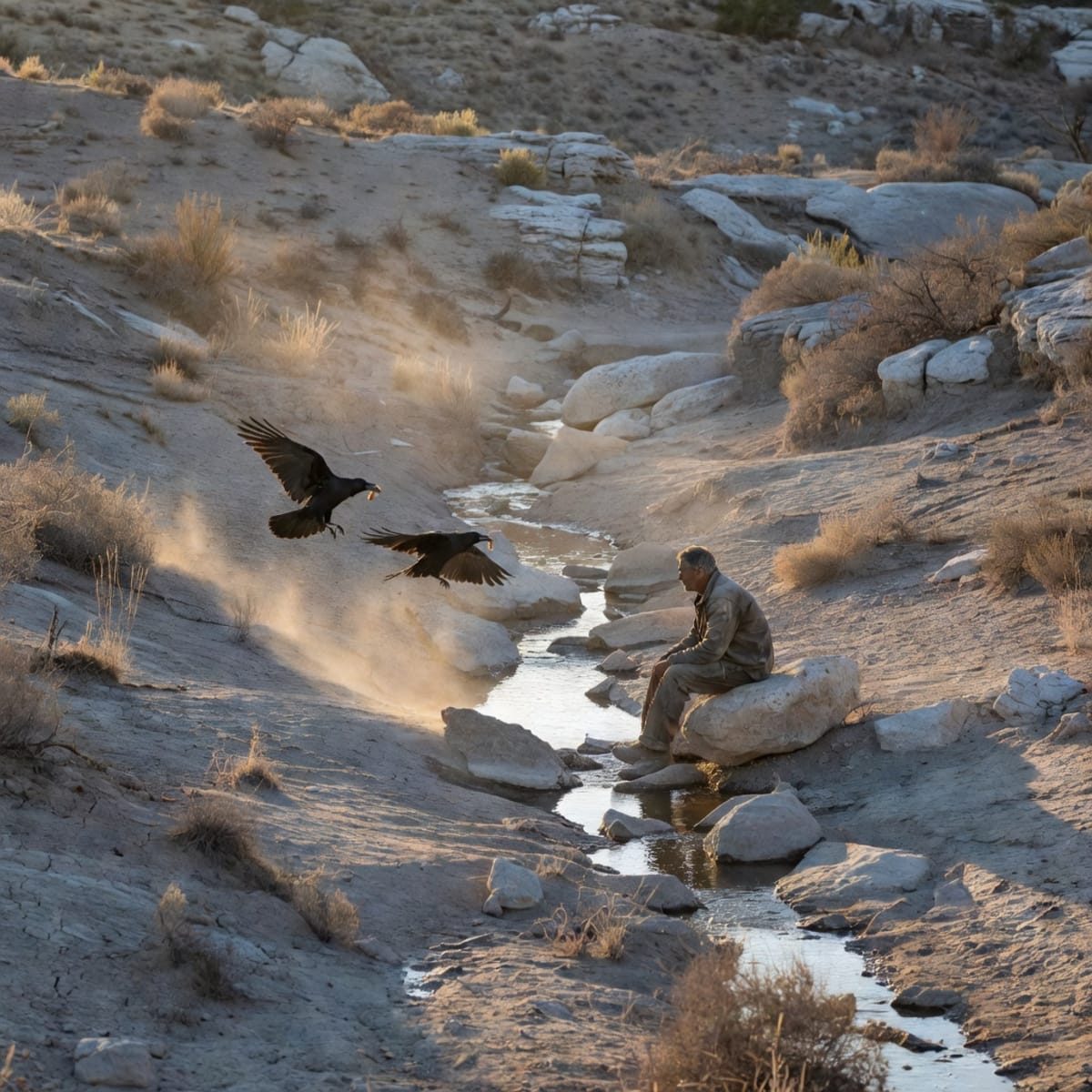
After Elijah told a king the rain was finished, God did not send him to the next palace. He sent him east, to a brook named Kerith, to wait for birds.
Yesterday I stayed with the courage that first sentence required. Today I am staying with what God did next, because this is the part most leadership talks skip. The prophet had just done the bravest public act of his life. The living God answered with a hiding place.
Then the Lord said to Elijah, “Go to the east and hide by Kerith Brook, near where it enters the Jordan River. Drink from the brook and eat what the ravens bring you, for I have commanded them to bring you food.” So Elijah did as the Lord told him and camped beside Kerith Brook, east of the Jordan. The ravens brought him bread and meat each morning and evening, and he drank from the brook. (1 Kings 17:2-6, NLT)
The setting still matters. Ahab’s court had given Baal the credit for clouds and harvest. Elijah had walked into that room and announced a drought in the name of the God of Israel. Then God pulled His prophet out of the story the palace could see. Kerith sits east of the Jordan, away from Samaria, away from the audience that would have turned the drought announcement into a speaking circuit. The same drought Elijah declared is the drought he now lives inside. He is not exempt from the word he carried. God feeds him there, not with a plan he can present, but with water he did not create and food he did not hunt. Ravens bring bread and meat morning and evening because God commanded them. Elijah’s contribution is obedience. He camps. He drinks. He receives.
I will not turn the ravens into a logistics promise. This is narrative. It tells us what God did for this prophet in this hour. It does not guarantee that your next hidden season will arrive with breakfast on wings. The miracle is not a method you can copy. The miracle is that the God who sent Elijah into Ahab’s court is the same God who can sustain him when nobody is watching. Hidden does not mean abandoned. Hidden means God is still the primary actor.
Moses had already told Israel what seasons like this are for. “Remember how the Lord your God led you through the wilderness for these forty years, humbling you and testing you to prove your character, and to find out whether or not you would obey his commands.” (Deuteronomy 8:2, NLT) That sentence belongs to Israel’s story with God, not to your org chart. I am not mapping forty years onto your calendar. I am noticing what Scripture says God does when He leads people into a place they cannot manage. He humbles. He tests. He proves character. He finds out whether obedience was a performance for the room or a habit for the ravine. Kerith is not wasted time. Kerith is the work.
Here is the principle. Leaders often want public authority without private dependence. They want Carmel without Kerith. They want the mountain, the fire, the moment that proves they were right, and they treat every quiet season as a career stall. God forms Elijah in a place that cannot be posted. The brook cannot be accelerated by visibility. You cannot hire a consultant to drink for you. You cannot announce a personal brand and skip the formation that only happens when the audience is gone.
I have watched this fail in both directions. A newly named VP spends the first ninety days collecting keynotes and skipping the unglamorous work of learning how the operation actually breaks. She is not lazy. She is hungry for the mountain. A founder publishes thought leadership while the product still lies to customers. He calls it building the platform. The platform is covering a gap he has not sat with. A pastor chases a larger room while his own prayer life has gone thin. None of them would say they are refusing God. They would say they are staying productive. Kerith looks like a demotion when you have just been brave. That is why it is hard. After a costly stand, hiding feels like punishment. In this story it is provision.
The other failure wears the opposite costume. A leader ducks a hard conversation, disappears from the floor, and names the silence a brook season. Elijah did not invent Kerith to avoid Ahab. The Lord said go. The Lord named the brook. The Lord commanded the ravens. Cowardice after a true sentence can masquerade as formation. The test is assignment. Were you sent here to depend, or did you send yourself here to hide? Private dependence is obedience. Self-protection in religious clothes is still self-protection.
Jesus later locates the Father’s attention in the same direction. “But when you pray, go away by yourself, shut the door behind you, and pray to your Father in private. Then your Father, who sees everything, will reward you.” (Matthew 6:6, NLT) The original point is hypocrisy. Jesus is confronting prayer done to be noticed. The leadership implication is quieter than a technique. The Father already sees the private work. Visibility is not the measure. Reward in that sentence is not a promotion. It is the knowledge that the unseen hour counted. Whether you are a believer or still exploring, the operational truth holds. The formation that makes you fit to carry public weight is almost never public. You cannot skip it by getting a bigger stage.
Bring this to Tuesday afternoon. Name the formation work you have been trying to accelerate with visibility. Write it down in one line. Is it a skill you have not built? A character gap you cover with a title? A prayer life that has not caught up with the platform? A team you have not actually learned because you are too busy representing them? Put that work on this week’s calendar as if it were a board meeting. Do not announce it. Do not turn the brook into content. Elijah did not need an audience for the ravens.
If you are a believer, the next move is to ask God what He is forming in the quiet, rather than asking Him to end the quiet. If you are still exploring faith, the next move is still honest. Consider whether you have been treating every hidden season as evidence that you are falling behind. Some of what you call delay is the only work that will keep the public assignment from crushing you later.
This will not feel like progress on a timeline. Kerith does not photograph well. Carmel is coming later this month, and when it comes it will still belong to God, not to Elijah’s reputation. The brook comes first. Private dependence is not a personality. It is the way a leader stays attached to the source after a public sentence has made him a target.
Tomorrow the brook dries up. The provision God gave was temporary. Its ending will not mean He has left. Faithful leaders have to release a method without confusing the method with the Provider. That is where we go next. The month still builds toward Stand and Rebuild, the paid field guide at the end of September. Today’s piece of that work is simpler than fire and harder than a speech. Stay at the brook long enough to be formed. Do not rush the mountain.
Leadership Challenge: What formation work have you been trying to skip by getting more visible? Write it in one line. Then put one hour on this week’s calendar for that work, with no audience and no post about it. If you cannot name the work, what are you using the stage to avoid?
I write about leadership at the intersection of timeless principles and modern workplaces. Follow for weekly insights on building teams that actually work. For more articles like this consider subscribing to my Substack at: https://christianleadership.now