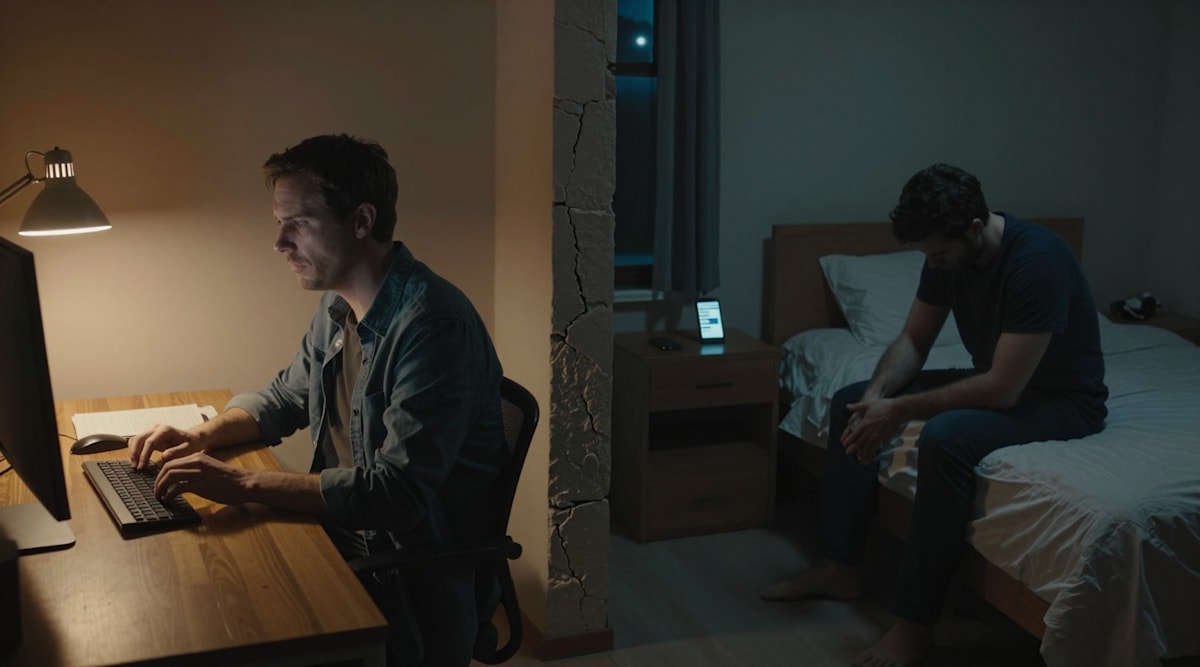
The man who cannot stop his mouth and the man who cannot stop his eyes are the same man. That is the claim this article makes, and it is the reason the Anger Gate and the Integrity Gate sit next to each other in the Protocol. They are not separate problems. They are the same ungoverned appetite expressing itself in two different rooms.
The original Anger Gate article on June 17 named the failure mode: the vent. The man who lets the sharp word exit without arrest has trained a reflex that fires faster every time he uses it. The original Integrity Gate article on June 18 named a different failure mode: the drift. The man who lets the thought linger without arrest has built a secret room that grows harder to leave the longer he stays. The two articles walked the Protocol through different gates, but if you read them closely, you saw the skeleton beneath the skin. Both gates fail at the ARREST. Both gates depend on a decision made in less than a second. Both gates require a man to interrupt a surge of energy that feels like it is moving faster than his ability to govern it.
The connection is the deeper cut that the original articles could only preview. Let us name it directly.
Anger and sexual failure share a root: ungoverned appetite. Not anger as an emotion. Anger as a surge that wants an immediate outlet. Not desire as a natural attraction. Desire as an appetite that wants without asking permission. The same man who cannot arrest his anger cannot arrest his eyes because the mechanism is identical. A stimulus arrives. The impulse rises. The body wants to move before the mind approves the motion. The gap between stimulus and response is measured in milliseconds. The man who has never trained the ARREST reflex in one room will not find it magically available in the other.
Here is what that looks like on a Tuesday afternoon. A man gets an email that frustrates him. He feels the heat. His fingers start typing a response before his brain has finished assessing whether the response is wise. He sends it. He regrets it. He apologizes. He tells himself he will do better next time. That same evening, after everyone in the house has gone to sleep, he opens a screen alone. An image appears. The impulse rises. He feels the same heat, the same surge, the same desire to move before the mind approves the motion. He does not arrest it. He entertains the thought, follows the impulse, and spends the next hour in a room he promised himself he would not enter. He tells himself he will do better next time.
The two failures feel different because the content is different. One is about a work email. One is about private behavior. The mechanism is the same. The man has trained himself, incrementally and across years, that the first impulse to act does not require his authorization. It receives his consent after the fact, or it does not receive it at all, but either way it acts. The vent and the drift are both disorders of self-governance. They are the same bridge, differently loaded.
James names the progression that governs both gates, and his language is biological because the process is biological. He writes: "Temptation comes from our own desires, which entice us and drag us away. These desires give birth to sinful actions. And when sin is allowed to grow, it gives birth to death" (James 1:14-15, NLT). Notice that James does not say temptation arrives from outside and you must fight it off. He says temptation originates in your own desires. The desire is already there. The external trigger just calls it out. The man who vents his anger had the desire to be right long before the email arrived. The man who drifts into integrity failure had the desire for escape long before the screen lit up. The ARREST is not about suppressing a new impulse. It is about governing a desire that was already awake.
This is why the two gates share walls. The work of governing the anger appetite is the same work as governing the lust appetite. It is the work of slowing the gap between desire and action, of inserting a moment of awareness between the stimulus and the response, of training the ARREST reflex to fire before the body moves. Every time you make that gap wider by even half a second at the Anger Gate, you are strengthening the muscle that must work at the Integrity Gate. Every time you shut the gate on a sharp word before it leaves your mouth, you are practicing the same decision you will need when an image appears on a screen and you have a fraction of a second to decide whether to look or turn.
The Integration is the insight that changes how you run the Protocol across multiple gates. You do not have two separate battles to fight. You have one war on two fronts, and the ARREST you win on one front is a win on the other. This changes everything about how you think about training.
If you treat the Anger Gate and the Integrity Gate as separate problems, you will try to solve them separately. You will work on your anger one week and your integrity the next, and you will wonder why progress in one area does not seem to transfer to the other. The truth is that progress does transfer, but only when you understand what is actually being trained. You are not training anger management. You are not training sexual discipline. You are training the ARREST reflex. The gate is the context. The reflex is the skill. A man who practices arrest in the context of anger will find himself naturally more capable of arrest in the context of temptation. Not because he has become a better man. He has trained a specific neural pathway until it fires faster than the impulse it is meant to interrupt.
Paul understood this connection without using the language of neuroscience. When he wrote to the Ephesians about anger, he warned that ungoverned anger gives a foothold to the enemy: "And 'don't sin by letting anger control you.' Don't let the sun go down while you are still angry, for anger gives a foothold to the devil" (Ephesians 4:26-27, NLT). The image is strategic. A foothold. A place to stand. The enemy does not need a stronghold. He just needs one crack in one wall. The man who leaves his anger ungoverned has given the enemy a foothold that the Integrity Gate will pay for. The same foothold. The same crack. The enemy does not care which gate you leave unguarded. He only needs one.
There is a practical implication here that most men miss. When you fail at one gate, you must immediately guard the other. The man who loses his temper at the dinner table and walks away without resolution has left both gates open. He has not vented the anger and now it is gone. He has vented the anger and now the shame of having vented it will feed the drift. He will isolate because he feels like a failure. He will reach for a screen because the screen does not judge him. He will tell himself he deserves a small escape because he already had a bad night. The anger gave the enemy a foothold, and before the sun goes down, the enemy will try to use it at the Integrity Gate. The governed man knows this. He knows that a failure at the Anger Gate requires immediate fortification at the Integrity Gate. He calls a brother before he opens a screen. He names what he did out loud so the secrecy cannot turn into drift fuel. He closes the foothold before the enemy can use it.
The Tuesday afternoon takeaway from the Anger Gate was to identify your anger pattern: escalate or withdraw. The takeaway from the Integrity Gate was to install one Standing Order that addresses your specific failure pattern. The takeaway from today is to see both gates as one connected front.
Here is the specific move. This week, whenever you feel the anger surge, treat it as an integrity alert. Not a separate problem. Not a momentary lapse with nothing to do with the rest of your life. An integrity alert. The ARREST you make or fail to make in this moment is training the same reflex that your Integrity Gate depends on. If you choose to arrest the sharp word, you have strengthened the muscle your Integrity Gate requires. If you choose to let the word fly, you have weakened it. There is no neutral outcome. Every surge is a training rep. An anger surge that arrives tonight is not just a test of your patience. It is a test of everything you are trying to protect in your private life. Govern the anger, and you are also governing the gate that opens when the house is quiet and the screen is the only thing awake.
The gates share walls. The cracks spread. The foothold does not care which gate you leave unguarded. The governed man understands that every arrest he makes strengthens every gate he guards. You are not fighting a dozen separate battles. You are building one wall, brick by brick, decision by decision, surge by surge. Every brick you lay at the Anger Gate is a brick that holds at the Integrity Gate.
Leadership Challenge: This week, the next time you feel the anger surge, stop yourself and name it as an integrity alert before you say a word. Say it out loud if you can: "This is an integrity moment." The act of naming it changes the gap. Then install one Standing Order that bridges the two gates. The man who knows that a failure at one gate weakens the other will guard both with the same vigilance. What is your Standing Order for the moment after you lose your temper? What will you do in the first hour after a failure to make sure the foothold does not spread?
I write about leadership at the intersection of timeless principles and modern workplaces. Follow for weekly insights on building teams that actually work. For more articles like this consider subscribing to my Substack at: https://christianleadership.now