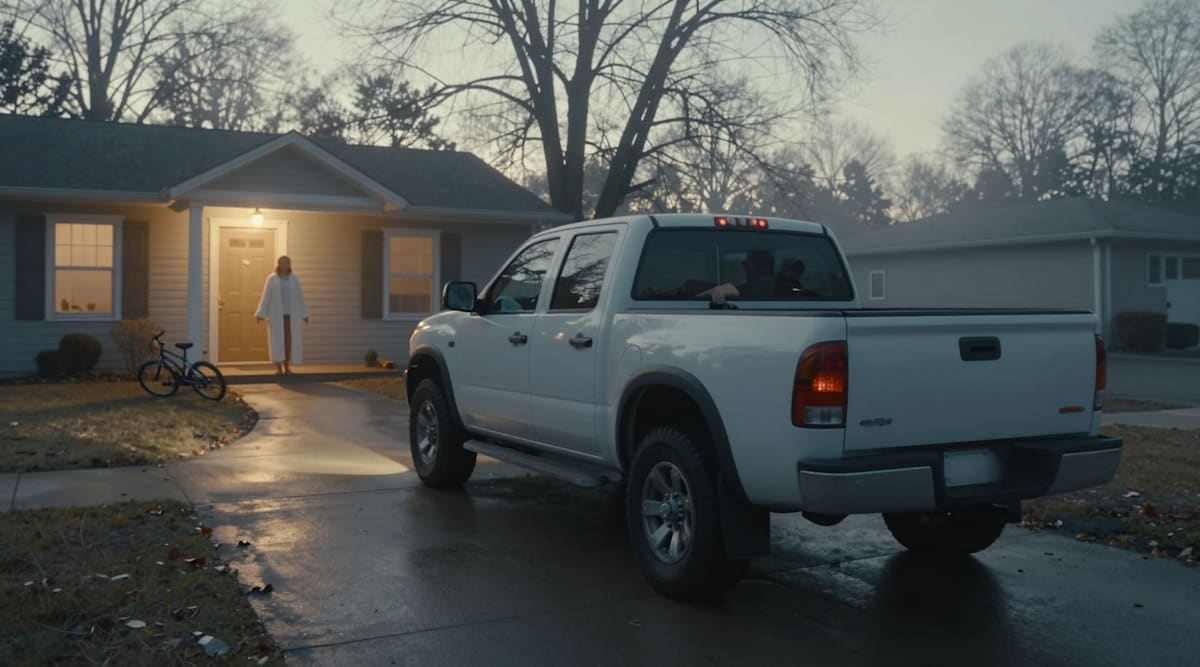
The truck is idling in the driveway at six-fifty-three on a Tuesday morning. The man behind the wheel is forty-four, broad in the shoulders, calloused in the hands, the kind of man other men ask to help them move a couch and never ask twice. His wife is standing in the open doorway of the house in a robe and bare feet, and she is talking. She is not yelling. She is saying a single sentence she has been holding since Sunday night, and the sentence is honest, and the sentence is hard, and the sentence requires a response that is not a sentence. The man in the truck does what the man in the truck has always done. He throws the truck into reverse. He says, over the open window, the words he has used for sixteen years of marriage to end a conversation his wife is still in. He says, "I have to get to work." He backs out. He drops it into drive. He pulls away. The wheels make the small sound on the wet concrete that wheels make when a man leaves before a conversation is finished. The driveway is empty by six-fifty-four. The man inside the truck feels, for about ninety seconds, the clean rush of resolution. He took action. He moved. He did not stand there. He did not flinch. He did not let himself be cornered. He is, in his own internal language, being strong. He is also, by every measure that matters, being weak. The strength that pulled the truck out of the driveway is the same strength that will pull the marriage apart over the next four years if no one shows him the difference.
This is the central reframe of the month, and it has to land before the gates can be walked. Cultural masculinity has spent a long time training men to equate strength with motion. The strong man moves. The strong man fixes. The strong man pushes through. The strong man does not stop in the doorway. The strong man does not stand in the driveway in a robe of his own and let the conversation finish. The strong man, in the version most of us were handed, has one default response to every interior moment of pressure, and the default is action. Reverse. Drive. Pull away. Get to work. The driveway is empty by six-fifty-four. The man feels strong. The man is, in fact, exposed in exactly the way yesterday's article named. The wall around his life is broken down on the side that matters most. The capacity to leave is not the capacity to lead. The reflex to act is not the same as the strength to act rightly. The Watchman's Protocol is not, has never been, a program to make a man softer. It is the structure that makes his strength safe for the people who depend on it. This is the difference between strength and strength that can be trusted, and a man's whole household runs on which one he is building.
Paul writes the verse the way only a man who fought hard for a long time can write it. He is closing the letter to the Corinthians. He has spent fifteen chapters correcting them on lawsuits, on idol meat, on sex, on communion, on the resurrection itself. He is about to sign off, and he loads four short imperatives into one sentence the way a sergeant loads ammunition into a magazine. He writes, "Be on guard. Stand firm in the faith. Be courageous. Be strong" (1 Corinthians 16:13, NLT). The footnote on that verse in many translations is worth knowing. The Greek behind "Be courageous" is andrizesthe, a single word, and it literally means "act like men." Paul does not bury the call to be a man inside a softer abstraction. He puts the call to be a man as the third beat of a four-beat command, and the command is bracketed on both sides by guarding and standing. The order is the point. Be on guard. Stand firm. Then act like a man. Then be strong. Paul does not let strength run first. Strength runs fourth, after guarding, after standing, after the conscious act of manhood. Strength, in Paul's command, is what comes out of a man who has already taken his post, planted his feet, and decided who he is. Strength that runs first, with no guard, no stance, no conscious manhood underneath it, is what walked the man out of the driveway at six-fifty-three. It is strength of a kind. It is not the strength Paul is commanding.
The Protocol is the architecture of strength that can be trusted, and it has four moves because untrusted strength has exactly four points of failure. ARREST is the failure of guarding. The man who cannot halt at the gate has no guard. He is a soldier who never stops moving, and a soldier who never stops moving is the soldier who walks into the ambush at full speed. ARREST is Paul's "Be on guard" in operational terms. The man stops at the threshold of action long enough for the gate to register as a gate. AUDIT is the failure of standing firm. A man who has not asked what he is feeling, what he is afraid of, what he is hungry for, what he has not slept enough to know, cannot stand firm because he does not know what ground he is on. AUDIT is the question asked in the silence after the halt. What am I bringing to this moment that the moment did not ask for. ALIGN is Paul's "act like men" in operational terms. The Greek imperative is not a call to swagger. It is a call to a specific kind of maturity, the maturity that subjects the moment to a higher voice. ALIGN is the man checking himself against the Three Witnesses, the Scripture in his chest, the brother who has permission to contradict him, the Spirit who has not yet gone quiet. ALIGN is where a man, in the older sense, acts like a man. ACT is the final move, the obedience the alignment requires, and it is the only step where strength runs at full power. Strength runs last because strength, untethered from the first three moves, is the thing that put the truck in reverse. Strength tethered to guarding, standing, and aligning is what makes a man trustworthy under load. Paul ends a different letter with the same theology when he writes, "For God has not given us a spirit of fear and timidity, but of power, love, and self-discipline" (2 Timothy 1:7, NLT). Notice the company power keeps in that verse. Power runs with love on one side and self-discipline on the other. Power flanked by love and self-discipline is power that can be trusted. Power without either flank is the man at six-fifty-three.
The cost of strength without the Protocol is not abstract, and it is not deferred. The cost arrives at the dinner table tonight. The cost arrives when the seventeen-year-old daughter stops bringing the hard thing to the man because she has learned, by patient observation, that the hard thing causes him to reverse the truck. The cost arrives when the wife stops standing in the doorway because she has finally accepted that the doorway is a place where she will be left. The cost arrives when the brother at church stops asking the diagnostic question because the man's last three answers were defensive sentences delivered at high volume. The cost arrives when the son, twenty-two and starting his own marriage, replays his father's driveway every time his own wife says the hard sentence on a Sunday night, and replays it because he has no other footage to run. The man who cannot be trusted with his own strength is the man whose strength becomes the inheritance the next generation has to undo. The same shoulders that closed every deal closed every door. The same lungs that finished every project finished every conversation his wife was still in. The capacity is the same. The wall around it is missing. Paul's order is reversed. Strength ran first. The guard never posted. The stance was never taken. The call to act like a man was answered by the reflex of a boy who learned, somewhere between nine and fifteen, that motion was the only acceptable response to interior pressure.
The recovery this week is one specific reversal of the order. In the next conversation the man cannot easily exit, the conversation his wife is still in, the call from his mother he was about to cut short, the moment his thirteen-year-old says the sentence that lands sideways, the man runs the four moves in Paul's order before he lets the fourth move loose. Guard the gate. Halt the reflex to reverse. Stand firm. Plant the feet. Stay in the doorway. Audit what is actually rising in the chest. Act like a man, in the older and harder sense, by submitting the moment to a voice higher than the reflex. Then, and only then, let the strength move. The strength is still real. The shoulders still hold. The voice still carries. The decision still gets made. The strength is now tethered to the first three moves, which means the strength is now strength that can be trusted. The Protocol does not subtract anything from the man. It adds the wall around the city we built yesterday. Tomorrow we go further into the first of the four moves, ARREST, and we name the specific reason most men cannot stop, which is that stopping feels, in their bodies, like losing. The hardest move for a man is the one he does not make. The Protocol is the structure that makes the unmade move the strongest move he has.
Leadership Challenge: Picture the most recent conversation you exited before it was finished. The exit might have been the truck in the driveway, the phone picked up at the table, the laptop opened on the couch, the silent walk to the garage, the clipped sentence that ended the discussion, the room you left while she was still talking. Name the conversation in one short phrase to yourself, out loud if you are alone, in your head if you are not. Now answer one question honestly. Which of Paul's four moves did you skip when you exited? Did you fail to guard, because you did not see the gate? Did you fail to stand firm, because your feet moved before your conscience did? Did you fail to act like a man, in the older sense, because no higher voice got a vote before your strength ran? Or did you fail to be strong in the right direction, because your strength ran first and ran alone? Pick the one move you most often skip. Write the move on the back of the index card from the last two days under the breach you already named, in one short word. ARREST. AUDIT. ALIGN. ACT. That single word is the move you will rehearse this week, the move you will run first the next time you feel the truck about to drop into reverse. Which one is yours, and what is the next conversation where you will run it?