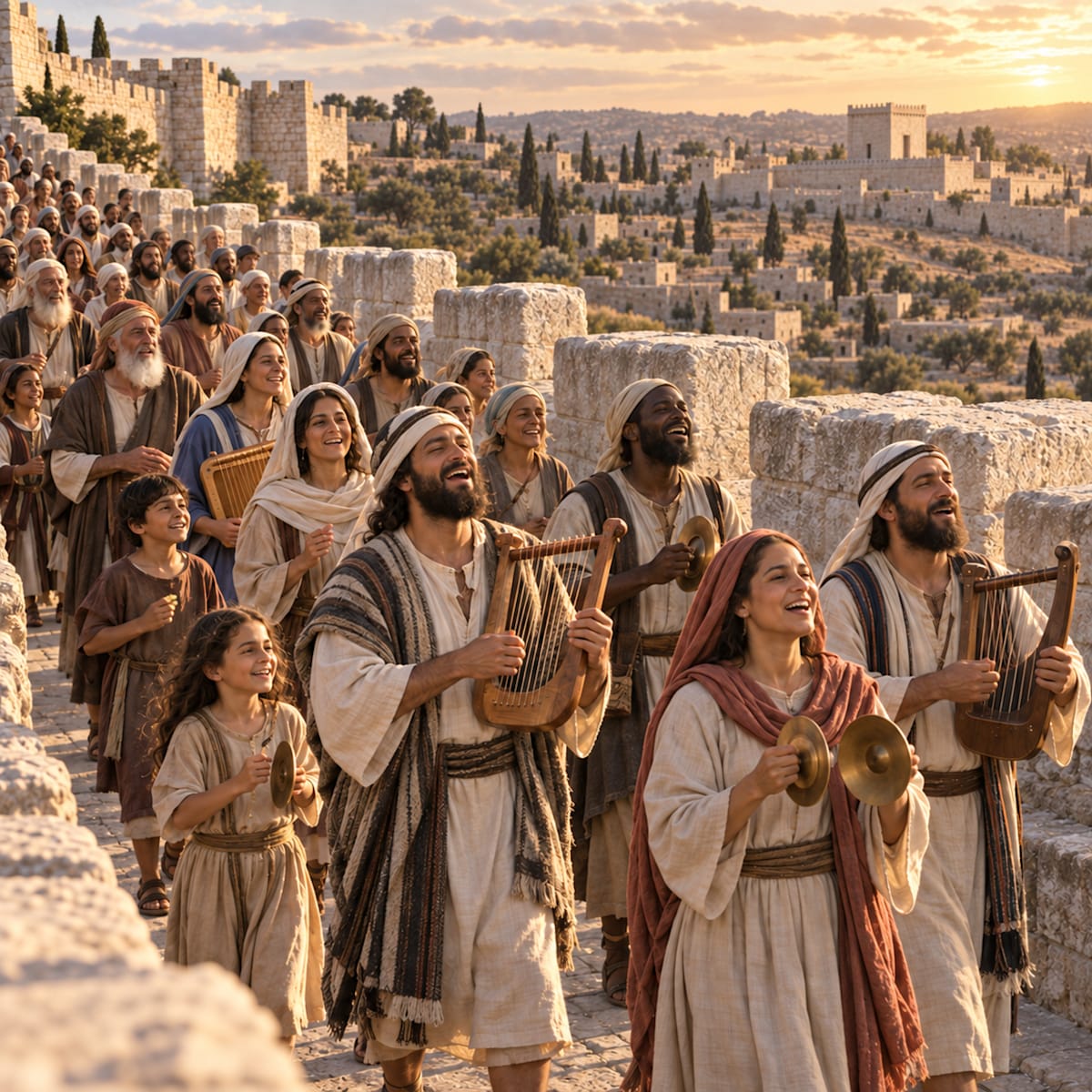
The project closes at four in the afternoon, and by four fifteen the leader is discussing what comes next. The release is stable. The migration is complete. The client has signed off. Everyone who carried the work is still absorbing the strain, solving the last small problems, and trying to understand what the achievement cost. The leader, eager to preserve momentum, turns the completed work into a sentence on the way to the next deadline. That habit can look disciplined. It can also train a team to believe that nothing they finish will ever be received as enough. Nehemiah 12:27 and 43 interrupt the rush. After the wall is rebuilt and the city is inhabited, the people stop to dedicate what God has enabled them to complete:
“For the dedication of the new wall of Jerusalem, the Levites throughout the land were asked to come to Jerusalem to assist in the ceremonies. They were to take part in the joyous occasion with their songs of thanksgiving and with the music of cymbals, harps, and lyres.” (Nehemiah 12:27, NLT)“Many sacrifices were offered on that joyous day, for God had given the people cause for great joy. The women and children also participated in the celebration, and the joy of the people of Jerusalem could be heard far away.” (Nehemiah 12:43, NLT)
The whole chapter keeps the dedication from becoming a spontaneous victory party built around Nehemiah. It begins with priests and Levites whose service reaches back across generations. Singers travel from settlements around Jerusalem. The priests and Levites purify themselves, the people, the gates, and the wall. Nehemiah organizes two large choirs that process in opposite directions along the wall before meeting at the Temple. Leaders, musicians, singers, women, and children share the day. The sound is thanksgiving to God, not applause for a governor who rescued the city. This is covenant worship in restored Jerusalem, with sacrifices, purification, and Temple service. A modern leader cannot reproduce its sacred meaning with an office party. The narrower principle is still worth receiving: when significant work is completed, faithful people make room to recognize the giver, the people, and the meaning of what has been done.
Leaders often skip that pause for reasons that sound responsible. The next problem is already visible. The budget is tight. The team is tired. Celebration can feel indulgent when customers still have requests and the next quarter has already begun. Some leaders also fear that acknowledging completion will lower urgency. They keep the organization slightly dissatisfied because hunger seems productive. The result is not sustained excellence. It is a culture in which every finish line moves as soon as someone reaches it. People learn that leadership notices defects immediately and contributions eventually, if at all. Gratitude becomes a private feeling instead of a public practice, while exhaustion becomes the only reliable evidence that the work mattered.
Nehemiah’s processions make the completed wall visible from a different angle. The same structure that had been a burden, a plan, a battleground, and a construction site becomes a route for thanksgiving. The people walk on the work and tell its meaning together. Their joy does not deny the threats, conflict, injustice, or sacrifice that preceded it. Celebration gathers those realities into a truthful memory: God had given them cause for great joy. Christian leaders should notice the direction of that sentence. The people worked, planned, guarded, carried, confronted, and built. God receives the credit for the cause of their joy. Gratitude does not erase human contribution. It places that contribution inside a larger story of provision and faithfulness.
Paul gives believers a direct pattern in his closing counsel to the Thessalonian church: “Always be joyful. Never stop praying. Be thankful in all circumstances, for this is God’s will for you who belong to Christ Jesus” (1 Thessalonians 5:16-18, NLT). Paul is describing Christian life before God, not a technique for improving employee engagement. He also says “in all circumstances,” not only after visible wins. That keeps gratitude from becoming triumphalism. A celebration can name what went well without pretending the process was painless, the result was perfect, or every person experienced the work in the same way. Christian gratitude tells the truth about the gift and the cost. It can hold joy and fatigue in the same room.
Consider a hypothetical team that completes a difficult system migration after six months. The usual closing meeting spends five minutes thanking everyone, forty minutes reviewing unresolved defects, and fifteen minutes assigning the next phase. A better completion practice does not need a stage, branded gifts, or forced enthusiasm. Give the team protected time to answer three questions. What was made possible that was not possible before? Who carried work that the final dashboard does not show? What did this effort cost that needs rest, repair, or a changed plan? Record the names, decisions, and lessons while memory is fresh. Thank people specifically for what they did, including those who challenged a flawed design, handled cleanup, protected customers, or absorbed an inconvenient handoff. Then change one condition that would otherwise make the next project repeat an avoidable cost.
Specific recognition matters because leaders teach value through what they name. The Best Answer Wins chapter tells of a chief technology officer who publicly thanked the junior developer whose challenge exposed a flaw in his design. His response did more than reward one person. It showed the whole room that truth mattered more than hierarchy. The Decision Fortress describes culture as the residue of repeated decisions. A completion gathering leaves that kind of residue. If the leader praises only speed, the team learns that pace matters more than care. If the leader thanks only the people who presented the result, invisible contributors learn where recognition stops. If the leader claims the win while distributing the cost, everyone learns that celebration is another form of status. Honest gratitude names the work accurately and gives credit without using praise to excuse overload, missed repair, or unequal reward.
Celebration also needs room for people whose emotions do not match the leader’s script. Some may be proud and relieved. Others may be disappointed by compromises, grieving a colleague who left, or too tired to feel much of anything. Nehemiah 12 describes real communal joy, but it does not authorize a manager to demand visible happiness. Do not turn attendance, enthusiasm, or public testimony into a loyalty test. Invite people to contribute to the account of what happened. Let someone name a hard lesson without being accused of spoiling the moment. Give practical thanks through time off, restored capacity, compensation, authority, or a corrected workload where those responses are warranted. A sincere speech cannot repay a burden the organization still refuses to see.
Schedule a completion pause for one piece of work your team has recently finished. Put it on the calendar before the next kickoff can consume the space. Bring the original purpose, the names of people who carried visible and hidden responsibilities, and evidence of what changed. Ask the three questions: What became possible? Who carried what others may have missed? What cost now needs repair? If you are a Christian leading other Christians, make room for prayer and thanksgiving without confusing the project with God’s kingdom. In a mixed-belief workplace, practice gratitude without imposing worship. Either way, resist making yourself the center. Receive the work, tell the truth about it, honor the people, and decide what should change because you stopped long enough to notice.
Yesterday’s passage honored the ordinary people who made a rebuilt city live. Today’s passage lets that community hear its shared joy. Tomorrow, Nehemiah will return to neglected worship, compromised stewardship, and promises that have begun to drift. The sequence is honest. Celebration does not guarantee that good work will remain healthy, and tomorrow’s problems do not make today’s gratitude naive. Leaders need both practices: the courage to dedicate what has been completed and the discipline to inspect what follows. Do not rush past the gift because another problem is waiting. Stop long enough to remember who gave the cause for joy, who carried the work, and what the completed work is for.
Leadership Challenge
Which completed project did your team move past without truly receiving? Schedule one protected hour to name what became possible, who carried hidden work, and what cost now needs repair.
I write about leadership at the intersection of timeless principles and modern workplaces. Follow for weekly insights on building teams that actually work. For more articles like this consider subscribing to my Substack at: https://christianleadership.now