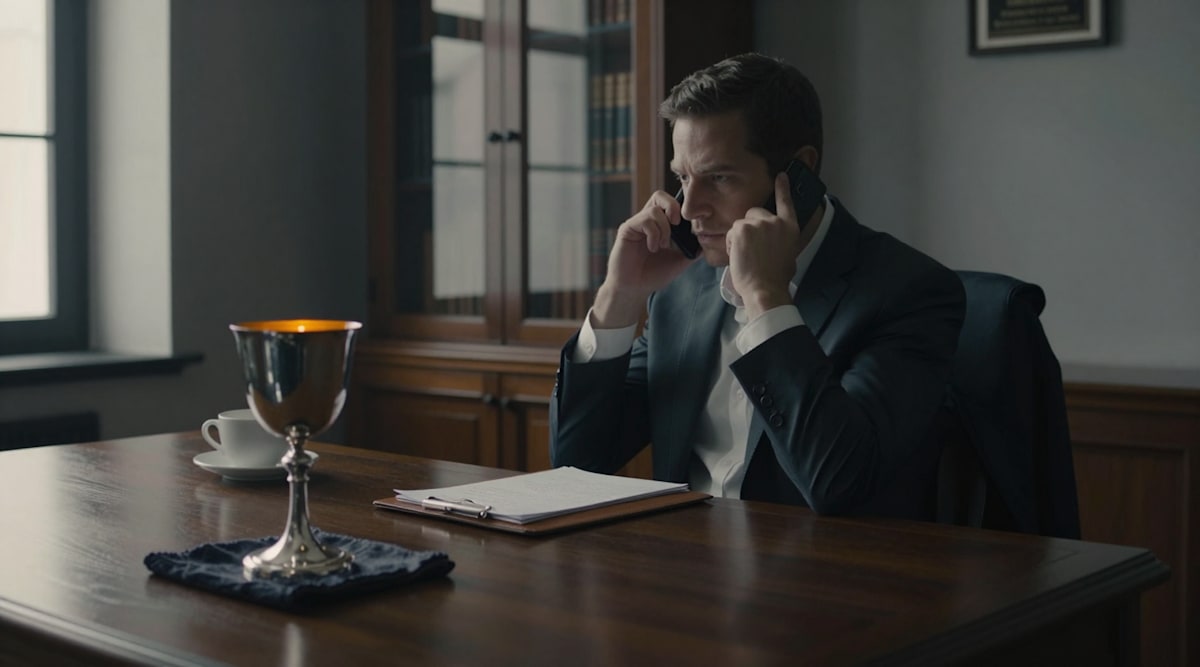
A VP stands at the front of the conference room on a Monday morning and walks his leadership team through what he calls the company's new posture on candor. He uses the word repentance twice. He apologizes for a way he handled a Q3 conversation that several people in the room remember. He says he is going to be the first one to receive hard feedback and the last one to defend himself, and he asks the team to hold him to it. Two people in the room have tears in their eyes. The meeting ends with a prayer he asked his second to lead. He walks out of the room with a clean conscience and an open calendar. At 2:47 that same afternoon, he is alone in his office with the door closed, on the phone with a peer at another company, and he is doing exactly what he stood in the room and renounced three hours earlier. He is rehearsing the case against the dissenting director. He is naming the people who told him hard things in the morning, and he is sorting them into the bucket of people whose performance reviews are about to get harder to read. He is, in private, the same man he told the room he was no longer going to be. The morning meeting was not a lie he knew he was telling. The afternoon call was not a sin he knew he was committing. He cannot tell you which one of the two men in his office today is the real one. He is not sure himself.
This is Public Obedience, Private Rebellion, the fourth failure mode in the ACT family of the Watchman's Protocol. Three days ago we named Knowing Without Doing, the leader who refuses to open the gate the verdict has already cleared. Two days ago we named Half-Obedience, the man who opens it and brings the leftover livestock along. Yesterday we named Waiting for the Feeling, the leader who reframes friction as reverence in the parking lot. Today's pattern is the cousin who does walk through the gate, on time, in front of witnesses, then sneaks around the back wall and lives the old life with the door closed. Public Obedience, Private Rebellion is the most theatrically successful of the four. It also produces the deepest internal damage, because the man practicing it spends every public minute training his face to lie to his own conscience.
Jesus named this anti-pattern more directly than He named almost any other. In Matthew 23 He is in the temple courts, in the last week of His public ministry, looking the religious leadership in the eye. "What sorrow awaits you teachers of religious law and you Pharisees. Hypocrites! For you are so careful to clean the outside of the cup and the dish, but inside you are filthy—full of greed and self-indulgence! You blind Pharisee! First wash the inside of the cup and the dish, and then the outside will become clean, too. What sorrow awaits you teachers of religious law and you Pharisees. Hypocrites! For you are like whitewashed tombs—beautiful on the outside but filled on the inside with dead people's bones and all sorts of impurity. Outwardly you look like righteous people, but inwardly your hearts are filled with hypocrisy and lawlessness" (Matthew 23:25-28, NLT). Read that slowly. He is not warning leaders about being secretly evil. He is warning leaders who already do the outward acts of obedience, already look the part, already pass every visible test the community runs on them. The diagnosis is the gap. Clean cup, contaminated interior. Pristine tomb, decay inside. The audience sees the wash; the Lord sees the residue. The Pharisees were not skipping the Protocol. They were running it in public and refusing it in private, and Jesus called the gap by its name. Hypocrisy in the New Testament Greek is the language of stage acting, the mask the actor lifted to his face. The man in the office at 2:47 wore a mask at nine. The afternoon is the actor backstage with the mask off, and the mask is the only version his team has ever met.
The diagnosis under this pattern is split-self management. The leader has decided, somewhere he could not point to on a calendar, that there are two ledgers. The public ledger records the version of him that walks into the room. The private ledger records the version of him that runs the company. The public ledger is balanced; the private ledger is not, and he has come to believe the two ledgers can stay separate indefinitely. They cannot. Jesus said no servant can serve two masters, and the principle holds beneath this anti-pattern. No leader can serve two selves. The split is unstable. One of the two men is going to win, and the man who wins in private always eventually wins in public, because the practiced reflex is the one that fires when the pressure is high enough to strip the performance off. The Tuesday afternoon test is not whether you can perform on Monday morning. The Tuesday afternoon test is which version of you shows up when the room is empty and the only audit you are facing is the one running inside your own head. The version that shows up on Tuesday afternoon is the version your team will meet on a Friday morning when something goes badly wrong and the performance budget is gone.
There is a particular Scripture corrective for this anti-pattern that goes underneath even the Pharisee diagnosis. When Samuel went to anoint a new king and stood looking at Jesse's tallest son, the Lord said, "Don't judge by his appearance or height, for I have rejected him. The Lord doesn't see things the way you see them. People judge by outward appearance, but the Lord looks at the heart" (1 Samuel 16:7, NLT). The verse is most often quoted as comfort, a reminder that God values the inner person over the outer. Read it the other direction tonight. The same eyes that see past Eliab's height to David's heart see past your conference-room face to your closed-door reflex. The Lord is not impressed by the morning meeting. The morning meeting is the outward appearance. The Lord is reading the afternoon call. The leader who has trained himself to manage two ledgers has been managing only the one God was never auditing.
The proper pattern is the corrected ACT under the Protocol, and the correction is sharper here than at any other ACT failure mode. ACT is integrated execution, not performed execution. The verdict ALIGN returned is the verdict, in the room and out of it, on Monday morning and on Tuesday afternoon, in front of the team and on the phone with the peer. The Protocol does not allow a public version and a private version. The public version is the cover; the private version is the man. If the Monday morning posture cannot survive the Tuesday afternoon call, the Monday morning posture was a performance, not an obedience. The Watchman is not the face the company sees. The Watchman is the reflex that fires when the door closes. Daniel did not pray with his windows open because he was performing for the city. He prayed with the windows open because he prayed that way when the windows were shut, and the public posture matched the private one because they were the same posture. Public Obedience, Private Rebellion is the diagnosis when the windows would tell two different stories.
The most defensible version of this anti-pattern is the leader who tells himself the private version is just venting. He is not really going to retaliate against the dissenting director. He is just blowing off steam with a peer. He is not really keeping the old grudge. He is just thinking about it sometimes. The venting story is the story the actor tells himself in the dressing room about the mask. The Lord is not auditing the language. The Lord is auditing the rehearsal. What you rehearse in private is what you will perform in public the day the lights catch you unprepared. The 2:47 phone call is not a release valve. It is a practice run.
The recovery has two moves, and both are harder than they sound. The first move is the audit of the gap. The leader, inside twenty-four hours, writes two columns. The left column is the version of him that walked into the room this week. The public statements, the public commitments, the public renunciations. The right column is the version of him that ran his calendar and his closed-door conversations this week. Not what he meant to do. What he actually did, said, sent, and felt. The gap between the columns is the size of the anti-pattern. The size of the gap is the size of the recovery. The second move is the introduction of a witness with access to the private ledger. The man managing two ledgers cannot recover alone, because the faculty he would use to monitor himself is the one that has been signing off on the gap. He needs a person allowed to ask, "What did you say on the call this afternoon," and allowed to receive a true answer. The witness does not need to be a pastor. The witness needs to be a person you cannot lie to. One witness with full access to the private ledger closes the gap faster than any public commitment will, because the gap is closed by being seen, not by being declared.
The hard truth under this anti-pattern is that integrity is not the face you put on for the room. Integrity is what is left after the room is empty. The man who walks into the meeting and the man who closes the door at 2:47 are the same man. One of them is rehearsing for the day the camera does not turn off in time. The Protocol does not have a public mode and a private mode. The Watchman stands the same way at noon as he does at midnight, in the meeting as on the closed-door call, and the day the two postures finally match is the day the Tuesday afternoon test stops being a test. The clean cup is washed from the inside. The whitewash is not the fix. The wash is.
Tomorrow we name the fifth and final ACT failure mode, the leader who skips the prior three A's and calls his speed obedience. Acting Out of Order is the man executing at full velocity with no idea where the verdict came from. The motion looks decisive. It is not the obedience the Protocol was asking for.
Leadership Challenge: Write down the most recent public commitment you made in front of your team or your family or your church in the last thirty days. One line. Now write down what your calendar, your texts, and your closed-door conversations actually did this week with respect to that commitment. One column for the public version. One column for the private version. Where is the gap. Today, before the day ends, name one person who is allowed to see both columns. Send that person the two columns in a single message. Ask them to ask you the same audit question every Friday for the next four weeks. The gap closes when the gap is seen. The mask comes off when the mask is named. The Watchman lives the same posture at noon and at midnight. Which posture is yours, and which one are you currently performing.