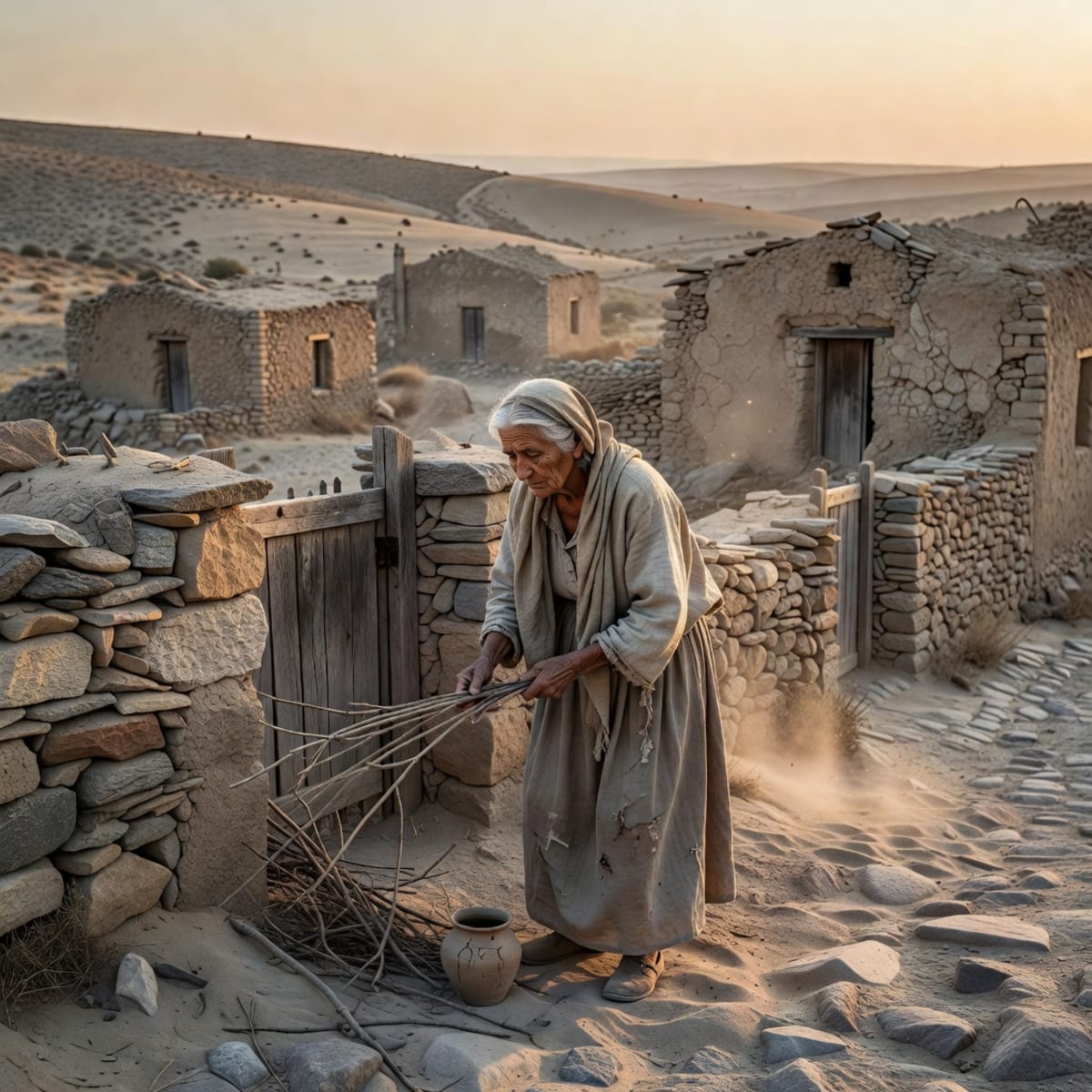
At the gate of Zarephath, a widow is gathering sticks for a funeral meal. She has a handful of flour, a smear of oil, a son, and a plan that ends tonight. A prophet who lost his brook that morning asks her for water. Then he asks for bread.
The request sounds small until you hear her answer. She swears by the Lord his God, not hers, that the house is empty. She is a Sidonian woman in Jezebel’s country, gathering fuel for one last cake, and a Hebrew prophet has arrived with an empty stomach and a word. Most leaders would read the room and walk on. The math does not work. There is not enough.
Yesterday the method ended at Kerith. God closed the ravine and named this village. Today the assignment has a face, and the face is a woman who thinks she is about to die.
So he went to Zarephath. As he arrived at the gates of the village, he saw a widow gathering sticks, and he asked her, “Would you please bring me a little water in a cup?” As she was going to get it, he called to her, “Bring me a bite of bread, too.” But she said, “I swear by the Lord your God that I don’t have a single piece of bread in the house. And I have only a handful of flour left in the jar and a little cooking oil in the bottom of the jug. I was just gathering a few sticks to cook this last meal, and then my son and I will die.” But Elijah said to her, “Don’t be afraid! Go ahead and do just what you’ve said, but make a little bread for me first. Then use what’s left to prepare a meal for yourself and your son. For this is what the Lord, the God of Israel, says: There will always be flour and olive oil left in your containers until the time when the Lord sends rain and the crops grow again!” So she did as Elijah said, and she and Elijah and her family continued to eat for many days. There was always enough flour and olive oil left in the containers, just as the Lord had promised through Elijah. (1 Kings 17:10-16, NLT)
Let that speech sit before you start mining it. God is the one who promised flour and oil. Elijah is the messenger. The widow is the one who has almost nothing. The drought Elijah announced in Ahab’s court has reached a Sidonian kitchen. Baal was supposed to own the rain. The jars are empty on schedule. The God of Israel is about to feed a Gentile household in Jezebel’s neighborhood, and He will do it without turning the prophet into a man who lives off the poor.
I will not turn this into a giving formula. This is narrative. It tells us what God did for this prophet and this widow under this word. It does not authorize a leader to walk into a strained household, ask for the last reserve, and call the request faith. Elijah does not invent the ask. Before he reached the gate, the Lord had already said, “Go and live in the village of Zarephath, near the city of Sidon. I have instructed a widow there to feed you.” (1 Kings 17:9, NLT) The instruction came from God. You and I do not get to copy a sentence we were never given. Remove the Lord’s promise from the scene and the ask becomes theft with religious language.
Here is the principle. When there is not enough, faithful leadership depends on God’s provision and refuses to manufacture supply by squeezing the people with the least. Obedience in scarcity is not a technique for forcing a miracle. The jars fill because the Lord promised they would. The leader’s work is to tell the truth about the shortage, to refuse the easy extraction, and to take the next obedient step without confusing himself with the Provider. God remains the actor. Elijah speaks a word he was given. The widow obeys a word she was given. None of that is a template for a capital campaign.
The dangerous line is the one leaders love to quote out of order: “make a little bread for me first.” Read without the promise, it sounds like spiritualized self-interest. James will not let that reading stand. “Pure and genuine religion in the sight of God the Father means caring for orphans and widows in their distress and refusing to let the world corrupt you.” (James 1:27, NLT) James is writing to believers who could talk a holy game while ignoring people in actual distress. If your scarcity plan begins with the intern, the contractor, the vendor who cannot float you, or the family member with the smallest voice, you are not walking in Elijah’s steps. You are walking past James. God fed the widow. He did not use her as fuel for the prophet’s reputation.
I have watched scarcity make otherwise decent leaders ugly in two directions. A director staring at three payrolls of runway starts cutting the people who cannot push back, while the travel budget and the executive search stay intact. She calls it stewardship. It is extraction with a cleaner name. The other failure is panic dressed as faith. A founder treats an empty account as proof the work is over, or as a test he can pass by announcing a vision he has not been given. Hebrews talks to both. “Don’t love money; be satisfied with what you have. For God has said, ‘I will never fail you. I will never abandon you.’” (Hebrews 13:5, NLT) The writer is not promising a jar that refills on demand. He is promising presence. Scarcity can be a season. It is not automatically a verdict. Love of money shows up as hoarding. It also shows up as using someone else’s last handful so yours never has to be the one that runs out.
Bring this to Tuesday afternoon. Write the shortage in one line. Cash. Headcount. Time. Attention. A pipeline that used to feed the work. Then write the name of the person who would pay first if you solved it the easy way. That name is the test. The director with three payrolls of runway already knows it. She has been circling it in meetings without saying it. This week she writes it down, then writes what she will cut instead, something that belongs to her comfort rather than someone else’s rent. Do not dress a squeeze as a faith opportunity for them. If you follow Christ, ask whether God has actually given a next step, or whether you are trying to force a sequel to Kerith. If you are still exploring faith, the next move is still honest. Tell the truth about the number to the people who deserve it. Cut something you can cut before you cut someone who cannot absorb it. Take one obedient action that does not require a miracle you have not been promised.
This will not feel like leadership on a dashboard. Refusing to raid the last jar looks like inaction to people who only measure movement. The flour and the oil never became a strategy Elijah could take on the road. They remained a daily mercy in a house that was still hungry enough to need tomorrow’s portion. Tomorrow the story gets harder. The boy dies, and Elijah does not protect his image or offer a slogan. He stays in the crisis. The month still builds toward Stand and Rebuild, the paid field guide at the end of September. Today’s piece of that work is narrower than fire and more expensive than a motivational verse about jars. When there is not enough, do not confuse dependence with extraction. God can feed a household in a drought. He has not authorized you to empty one.
Leadership Challenge: Where is there not enough this week? Write the shortage in one line, then write the name of the person who would pay first if you solved it the easy way. What is the next obedient step that does not require squeezing that person or inventing a miracle you have not been promised?
I write about leadership at the intersection of timeless principles and modern workplaces. Follow for weekly insights on building teams that actually work. For more articles like this consider subscribing to my Substack at: https://christianleadership.now