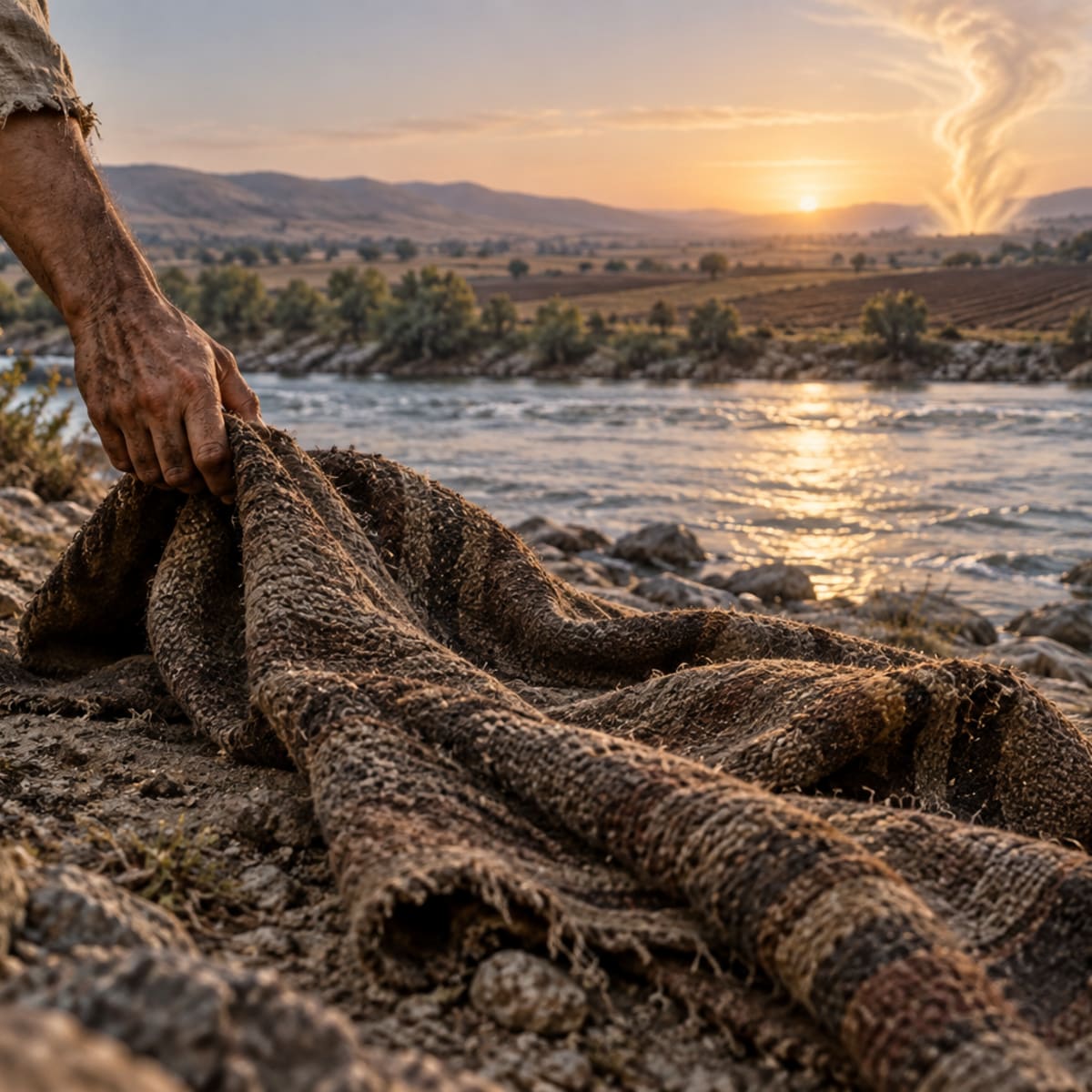
The cloak Elijah threw across a young farmer’s shoulders in a plowed field would one day strike the Jordan River and part it. Elijah would not be there to see it. He would be gone, carried up in a whirlwind, and the man wearing that cloak would be standing alone on the riverbank asking where the God of Elijah had gone. The whole arc of a leader’s legacy is compressed into that one garment. It started as a near-wordless gesture in a field and ended as authority passed into someone else’s hands.
The story begins the moment Elijah comes down from Horeb. Yesterday we watched God meet the exhausted prophet in a gentle whisper and hand him a new assignment that included three names to anoint. The last of those names was his own replacement. Elijah walked off the mountain of despair carrying instructions to raise up the man who would take his place.
So Elijah went and found Elisha son of Shaphat plowing a field. There were twelve teams of oxen in the field, and Elisha was plowing with the twelfth team. Elijah went over to him and threw his cloak across his shoulders and then walked away. Elisha left the oxen standing there, ran after Elijah, and said to him, “First let me go and kiss my father and mother good-bye, and then I will go with you!” Elijah replied, “Go on back, but think about what I have done to you.” So Elisha returned to his oxen and slaughtered them. He used the wood from the plow to build a fire to roast their flesh. He passed around the meat to the townspeople, and they all ate. Then he went with Elijah as his assistant. (1 Kings 19:19-21, NLT)
Consider what the scene refuses to make dramatic. There is no fire from heaven here, no showdown with false prophets, no royal audience. There is a man in a field behind twelve teams of oxen, which tells us Elisha was prosperous and had plenty to lose. Elijah walks over, drops his cloak across the younger man’s shoulders, and keeps walking. The cloak is the mantle, the visible sign of the prophetic office. A tired prophet identifies his successor and begins the handoff before he has any idea how much time he has left.
Elisha’s response is worth watching. He asks to say goodbye to his parents, then he goes back and slaughters the very oxen he was plowing with and burns the equipment to cook them. He does not keep the farm as a fallback. He burns the plow so there is nothing to return to, feeds the town, and follows Elijah as his assistant. The word translated assistant is the language of apprenticeship. Elisha does not start by parting rivers. He starts by serving, watching, and learning under a leader who will not always be there.
Here is the principle the day is built on. Leadership that outlives the leader requires two things at once, and most leaders are tempted to pick only one. It requires moral courage in the present, the willingness to keep telling the truth while you still hold the office. It also requires the deliberate preparation of the person who will carry the work after you are gone. Elijah did both. He confronted a king, he raised a successor, and he understood that the mantle on his shoulders was never his property to keep.
Look first at the courage. Calling Elisha did not send Elijah into a quiet retirement. Two chapters later God sends him back into the hardest room he knows, the presence of King Ahab, this time over a murder dressed up as a real estate transaction. Ahab had wanted Naboth’s vineyard, Naboth had refused to sell his family inheritance, and Jezebel had arranged to have him killed on false charges so the king could take the land.
Give him this message: “This is what the Lord says: Wasn’t it enough that you killed Naboth? Must you rob him, too? Because you have done this, dogs will lick your blood at the very place where they licked the blood of Naboth!” “So, my enemy, you have found me!” Ahab exclaimed to Elijah. “Yes,” Elijah answered, “I have come because you have sold yourself to what is evil in the Lord’s sight.” (1 Kings 21:19-20, NLT)
Ahab greets him as an enemy, which is exactly what a truth-teller becomes to a leader who has sold himself to what is wrong. Elijah does not soften the message to protect what little influence he has left. He names the theft and the blood. This is legacy work too, though it does not look like it. A leader who spends his final seasons managing his reputation and avoiding costly rooms leaves his successor a diminished office. Elijah handed Elisha a mantle that still meant something, because he never stopped using it for its purpose.
Then comes the release. Years later the two men walk together toward the Jordan, and Elijah knows he is about to be taken.
When they came to the other side, Elijah said to Elisha, “Tell me what I can do for you before I am taken away.” And Elisha replied, “Please let me inherit a double share of your spirit and become your successor.” “You have asked a difficult thing,” Elijah replied. “If you see me when I am taken from you, then you will get your request. But if not, then you won’t.” (2 Kings 2:9-10, NLT)
Notice what Elijah does not do. Elisha asks for a double portion of his spirit, and Elijah does not pretend the gift is his to hand out. He calls it a difficult thing and places the outcome entirely in God’s hands. The mantle was never Elijah’s possession. He wore it on assignment. The power behind it belonged to God, and the succession would be God’s to grant. A leader who believes the anointing is his own will cling to it. A leader who knows it was only ever on loan can let it go.
What follows is one of the strangest scenes in Scripture, and I will not tame it into a tidy management lesson. A chariot of fire and horses of fire come between them, and Elijah is carried into heaven by a whirlwind. Elisha cries out, tears his clothes, and then does the one thing that matters for everything after.
Elisha picked up Elijah’s cloak, which had fallen when he was taken up. Then Elisha returned to the bank of the Jordan River. He struck the water with Elijah’s cloak and cried out, “Where is the Lord, the God of Elijah?” Then the river divided, and Elisha went across. (2 Kings 2:13-14, NLT)
The cloak that started in a field is now on the ground, fallen from a leader who is gone. Elisha picks it up and asks the only question that matters. Not where is Elijah, but where is the God of Elijah. The mantle was never the point. The God behind the mantle was. When the river parts a second time, the watching prophets say the spirit of Elijah now rests on Elisha, and they bow. The office continued because the leader prepared someone to carry it and then got out of the way.
Paul says the same thing to Timothy in plainer language, and last month’s series lived inside that relationship.
You have heard me teach things that have been confirmed by many reliable witnesses. Now teach these truths to other trustworthy people who will be able to pass them on to others. (2 Timothy 2:2, NLT)
Four generations sit inside that one verse. Paul, Timothy, the trustworthy people, and the others they will teach. The measure of Paul’s leadership was never the size of his own platform. It was whether the truth kept moving after he was gone. That is the test the whole month has been circling. Faithfulness, not visible success, is the real measure, and faithfulness includes what you leave in someone else’s hands.
Land this where you actually lead. The hardest part of succession is not choosing the person. It is releasing the control. Most leaders will happily mentor someone as long as the final decision, the real authority, and the visible credit stay with them. That is not raising a successor. That is keeping an assistant. Elijah threw the cloak and walked away. He let Elisha follow, watch, and eventually ask for more than Elijah could give.
Ask the uncomfortable questions. If you were taken out of your role tomorrow, who picks up the cloak? Can you name the person, or have you avoided naming anyone because being irreplaceable feels like security? Have you handed that person real weight, actual decisions with actual consequences, or only the tasks you did not want? Are you still using your own influence for its purpose in the present, or have you slipped into protecting a reputation instead of telling the truth?
This closes the first half of the month. Across two weeks we have followed Elijah from a hidden brook to a public mountain, through collapse and a whisper, and now to a cloak passed into younger hands. Tomorrow the series changes leaders entirely. We leave the solitary prophet and meet a cupbearer named Nehemiah, who hears that a city lies in ruins and weeps before he ever picks up a tool. Elijah’s assignment was to stand, confront, and then release. Nehemiah’s assignment will be to rebuild. Different callings, different tones, the same dependence on the same God.
Elijah’s greatest act of leadership may not have been the fire on Carmel or the confrontation with Ahab. It may have been a quiet moment in a field, dropping a cloak on a plowing farmer and trusting God to make it fit. The leaders we remember longest are not the ones who held on the tightest. They are the ones who did their work with courage, named the person who would come next, and then let the mantle fall from their shoulders into stronger and younger hands. What you build with your own hands ends when you do. What you hand to someone else can outlive you by a generation.
Leadership Challenge: If you were pulled out of your role tomorrow, who is ready to pick up the cloak, and be honest about whether you have actually handed that person real authority or only kept them close as an assistant? What is the one decision, relationship, or piece of visible credit you could release to them this week to begin a handoff instead of guarding an office you will not hold forever?
I write about leadership at the intersection of timeless principles and modern workplaces. Follow for weekly insights on building teams that actually work. For more articles like this consider subscribing to my Substack at: https://christianleadership.now