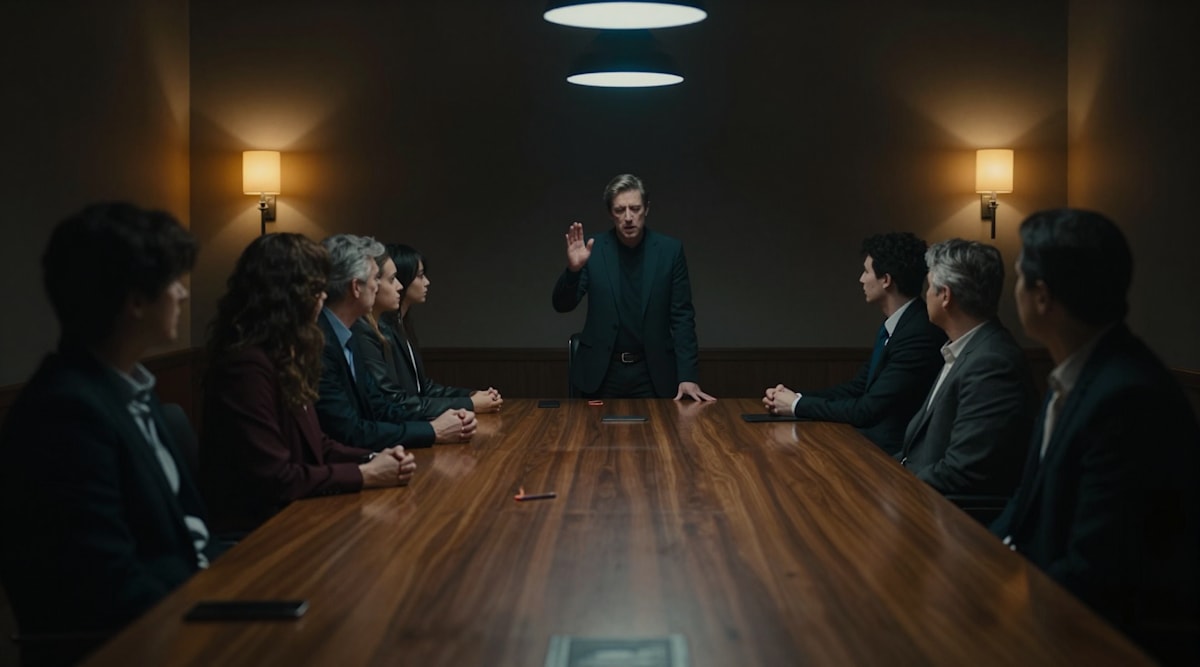
A board meeting runs three hours. Six directors, the chief executive, the general counsel, an outside advisor brought in for the agenda item. The board is weighing a major acquisition. The chief executive has presented. The investment bank has presented. The integration team has presented. Five of the six directors voice their support, some with enthusiasm, some with the careful neutrality of people who know they are watching a freight train pass through the room. The sixth director, a quiet woman who has been on the board for eleven years, raises her hand. She does not give a speech. She asks one question, she names one risk, and she says she cannot vote yes. The room responds the way rooms respond to a single dissenter. The chief executive acknowledges her concern with practiced grace. The general counsel notes it in the minutes. The board moves on. The acquisition closes the following quarter. Eighteen months later, the integration has failed, the company has written down half the purchase price, and the board chair circulates a memo asking why no one warned them.
This is Ignoring the One Witness Who Disagrees, and it is the third failure mode in the ALIGN family. Yesterday we named the Echo Chamber Jury, the room rigged so a dissenter never makes it to the table. Today's anti-pattern is the room that does contain a dissenter, and what the leader does to that voice when it speaks. The construction of the echo chamber is the slower failure, the one that happens over years of hiring decisions and seating charts. The dismissal of the lone "no" is the faster failure, the one that happens in a single meeting, in the seconds after a single sentence, in the moment the leader's body language changes and the room learns what to do with that voice the next time it tries to speak.
The Watchman's Protocol does not run on majority votes. The third step, ALIGN, is built on the Three Witnesses: Scripture, Counsel, and Conscience. Chapter 9 of Book 2 names the rule for what to do when those witnesses disagree, and it is a rule most leaders quietly violate the first time obedience to it costs them something. If all three witnesses say "Stop" and you go anyway, that is disobedience, not a mistake. The corollary is the part most leaders miss. If one witness says "Stop" with calibrated clarity, the action does not get to proceed. One "no" from any of the Three Witnesses is enough to halt the decision. ALIGN does not look for consensus among the witnesses. It looks for a clear "Stop" from any of them, because any single witness can be the one carrying the data the others have not yet seen.
The Scripture that turns this anti-pattern over and shows the bottom of it sits in 1 Kings 22, and it is one of the more uncomfortable passages in the historical books for a leader to sit with. Ahab, king of Israel, is preparing to go to war over Ramoth-gilead. Jehoshaphat, king of Judah, is visiting. The two kings are about to ally for the campaign. Jehoshaphat asks the question every leader in a major decision should ask. "But first let's find out what the LORD says" (1 Kings 22:5, NLT). Ahab summons four hundred of his prophets. They speak with one voice. Go up, the LORD will give the city into your hand. The room is unanimous. The energy is high. The verdict is in.
Jehoshaphat, to his credit, is not satisfied. He asks if there is a prophet of the LORD they have not heard from. Ahab answers with a sentence that names the anti-pattern out loud, in the leader's own voice, with no disguise on it. "There is one more man who could consult the LORD for us, but I hate him. He never prophesies anything but trouble for me!" (1 Kings 22:8, NLT). The man's name is Micaiah son of Imlah. Ahab knew, before the summons went out, what Micaiah was going to say. He did not call for Micaiah to gather another data point. He called for Micaiah because Jehoshaphat made him. The messenger sent to fetch the prophet tried to coach him in the corridor. The other prophets are unanimous, the messenger said, so make sure your message agrees with theirs. Micaiah refused. He stood in the throne room and told the truth. "In a vision I saw all Israel scattered on the mountains, like sheep without a shepherd" (1 Kings 22:17, NLT). The army will lose. The king will fall. The campaign is over before it starts.
Ahab turned to Jehoshaphat and said, in effect, see, I told you. He had Micaiah thrown in prison on bread and water. He marched on Ramoth-gilead anyway. He disguised himself in the battle, hoping to slip the prophecy by hiding his identity in the line. An arrow fired at random struck him between the joints of his armor. He bled to death in his chariot by sundown. Every detail Micaiah spoke came to pass. Ahab heard the witness who disagreed and did exactly the thing Ignoring the One Witness Who Disagrees teaches a leader to do. He dismissed the messenger because of the messenger's history. He proceeded with the verdict the rest of the room had blessed. He died on the field his unanimous prophets had promised would be his victory.
The diagnosis underneath this anti-pattern is harder than the diagnosis underneath any other ALIGN failure, because the leader running it cannot plead ignorance. The witness was in the room. The voice was heard. The "Stop" was articulated cleanly enough to be transcribed into the minutes. What the leader did was a deliberate triage, performed in real time, on the strength of evidence he had every tool to weigh. The flesh under the surface is not negligence. It is the calculation that one voice can be discounted because the majority of voices say something else. The leader running this pattern has not invented a new error. He has inherited the oldest one. The majority is loud. The majority feels safe. The majority gives him cover for the decision he already wanted to make. The single dissenter is a problem with one obvious solution: make the single dissenter smaller until the decision can move.
There is a second layer to the diagnosis that the leader running it almost never sees in himself, though everyone around him sees it clearly. The dismissal is rarely on the merits. The leader has learned, over time, a set of rationalizations that allow him to discount the dissenter without ever engaging the dissenter's argument. The dissenter has a track record of being negative. The dissenter does not understand the full picture. The dissenter has personal reasons for objecting. The dissenter raised the concern too late, or too early, or in the wrong tone, or in the wrong forum. The leader has built a library of reasons to ignore this person specifically, and the library has been updated every time the dissenter said something the leader did not want to hear. By the time the meeting that mattered arrived, the leader had a fully indexed catalog of reasons why this particular voice did not count. The work of dismissal was finished years before the words were spoken.
The proper pattern, ALIGN running clean, requires a discipline most leaders have never built. When one of the Three Witnesses raises a clear "Stop," the action halts. Not for a vote. Not for a counter-argument. Not for a process of weighing the lone dissenter against the consensus. The action halts long enough to ask one question. What is this witness seeing that the others are not? Scripture, Counsel, and Conscience are not equal departments in a bureaucracy where motions pass by simple majority. They are three independent watchmen on three different walls of the same fortress, each looking out at a different angle of attack. Any one of them spotting a threat is the threat. The other two have not seen it yet. The dissenting witness is the early warning system. The wise leader does not poll the witnesses against each other; the wise leader stops, walks to the wall the dissenter is watching, and looks.
The recovery from Ignoring the One Witness Who Disagrees is one move, and it is small enough to fit on a single page of a leadership journal. Call it the Micaiah Test. The next time you find yourself ready to dismiss a single dissenting voice in a high-stakes decision, write the dissenter's name on the left side of a sheet of paper. On the right side, write down the words they actually said, not your characterization of those words. Do not write down the dissenter's history. Do not write down the dissenter's motives. Do not write down the room's reaction. Write down the words. Then ask yourself one question. If those exact words had come out of the mouth of the advisor you trust most, would you have stopped the decision? If the answer is yes, the decision was already stopped, and the only reason it is still moving is the identity of the person who spoke. That is not ALIGN. That is preference filtering disguised as discernment. The verdict was about the messenger.
The hard truth at the bottom of this anti-pattern is the part most leaders have to face alone, in a quiet room, with no one else watching them work it through. The voice you keep dismissing is almost always the voice carrying the data you most need. The witness with the track record of unwelcome accuracy is not the obstacle to the decision. The witness with the track record of unwelcome accuracy is the gift you have spent years training yourself to refuse. The Three Witnesses do not all speak at once. They do not always speak in chorus. Sometimes Scripture is silent, Conscience is conflicted, and the only Counsel willing to tell you the truth is the one voice in the room you wish would stop talking. That voice is the witness. The "Stop" is enough.
Tomorrow we name the fourth anti-pattern in the ALIGN family, the Seared Conscience. Today's failure mode is the dissenter in the room you choose to silence. Tomorrow's is the dissenter inside your own chest that has been silenced so many times it no longer speaks. The pattern progresses on a timeline. The leader who dismisses the external witness this year is the leader whose internal witness goes quiet the next. Today we name the dismissal that happens in public, in front of a room. Tomorrow we name the dismissal that has happened so completely the room never gets to hear the voice at all.
Leadership Challenge: Think of the most recent high-stakes decision where one voice in the room raised a clear "Stop" and you proceeded anyway. Write down what that person actually said, then read those words back to yourself as if your most trusted advisor had spoken them. Would you have stopped the decision then? If the honest answer is yes, who in your decision-making rhythm right now is being filtered by identity rather than weighed on merit, and what does it cost you this week to stop doing that?