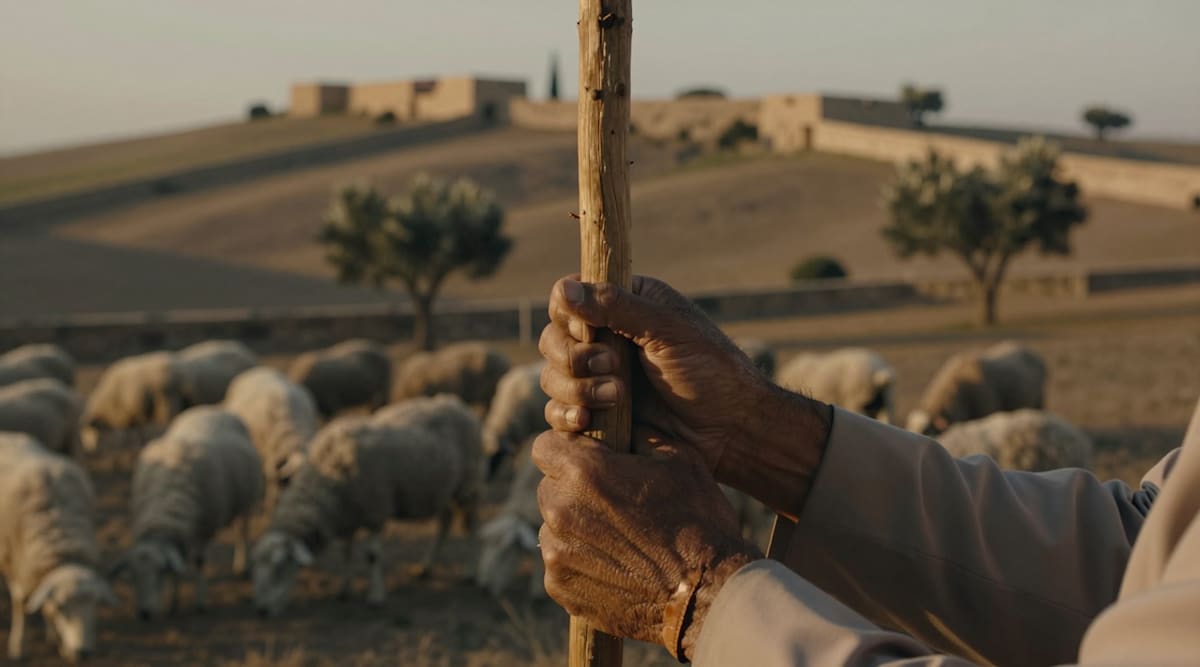
If you had to summarize a forty-year reign in one sentence, what would you keep? David ruled Israel through civil war, foreign invasion, family scandal, military victory, ecclesiastical reform, and a census that nearly cost him the kingdom. He wrote songs that the church is still singing three thousand years later. He built a capital. He drafted the plans for a temple he would never get to construct. He had every ingredient for a complicated obituary. When the writer of Psalm 78 closes out the story, he chooses two words to carry the weight of all of it. Not victories. Not conquests. Not the size of the army or the wealth of the treasury. Two words about the leader himself. We are closing out week one of The Leader’s Bible, and this is the verse that names the whole job.
Psalm 78:72 (NLT): “He cared for them with a true heart and led them with skillful hands.”
That is the entire summary. Read it again and notice what is missing. There is no mention of strategy. There is no mention of revenue. There is no mention of headcount or territory or organizational chart. The psalmist had David’s whole resume in front of him, and he chose to remember the king the way God remembers leaders. Inside, a true heart. Outside, skillful hands. The order matters. Character first, competence second. Both required. Neither sufficient on its own.
The context gives the verse its weight. Psalm 78 is one of the longest psalms in the Bible, written by Asaph, a worship leader appointed by David himself. It is a history lesson set to music, walking Israel through the cycle of God’s faithfulness and the people’s forgetting. Asaph spends seventy-one verses cataloging failure. Egypt. The wilderness. The grumbling. The idols. The judges. The fall of Shiloh. The capture of the ark. By the time you reach verse 70, you are exhausted by the wreckage of bad leadership and worse followership. Then Asaph pivots. God chose David. He took him from the sheep pens, from following ewes with young lambs, and set him over Jacob, his people, and Israel, his special possession. The whole psalm has been a slow march toward this moment, and the moment lands on a single line about who David was as a leader. Verse 72 is not a footnote on a long story. It is the point of the long story. After all of that wandering and failing, God finally raised up a shepherd who had a true heart and skillful hands.
The leadership demand here is precise and double-edged. This verse requires you to tend to two things at once that most leaders treat as a trade-off. The inside, your motives, your honesty, your love for the people in your care. The outside, your craft, your judgment, your ability to actually do the work of leading. A true heart without skillful hands produces a sincere leader who cannot deliver. Skillful hands without a true heart produces a polished operator who quietly destroys the people underneath the polish. Scripture refuses to let you choose. David is held up as the model not because he was the best tactician in Israel’s history, though he was extraordinary, and not because he was the most pure-hearted man in Israel’s history, because his story makes clear he was not. He is the model because God could trust both his motive and his execution at the same time. The two halves were not in competition. They were the same leadership.
Psalm 78:72 (NLT): “He cared for them with a true heart and led them with skillful hands.”
That is how God summarized David’s entire reign. Forty years of a complicated kingship, distilled to one sentence. No mention of strategy. No mention of revenue. No mention of the size of the army. Two phrases. A true heart. Skillful hands.
Most leaders pick one. Some pour themselves into character and assume sincerity will cover incompetence. Others sharpen their craft and assume results will excuse cold motives. Scripture refuses the trade. David is the model because God could trust both his heart and his hands at the same time.
Here is the gap. Look at any leader you admire and ask honestly which side they are working on this week. Most of us drift toward whichever one is easier for our personality. The visionary works on heart and lets execution slip. The operator works on hands and lets honesty erode. The drift is invisible until something breaks.
The practice is simple. This week, name the side you have been neglecting and spend one deliberate hour tending it. If your heart has gone cold, sit with God and tell Him why. If your hands have gone dull, learn the part of the work you have been avoiding. Both halves are required. Neither half is optional.
The confrontation lands hard. Most leaders pick a side without realizing they are picking. They drift toward whichever half comes more naturally to their wiring, and they tell themselves that the other half is someone else’s job. The visionary leader, the one who loves the people and prays for the team and weeps over the mission, slowly outsources execution and tells himself that his heart is what matters most. The operator leader, the one who runs the dashboards and hits the numbers and runs the machine, slowly outsources the human work and tells herself that results are what matter most. Both are half-leaders. Both are violating Psalm 78:72. The text does not allow either escape route. God did not raise up David because his heart was true and the rest could be delegated. God did not raise up David because his hands were skillful and the rest could be hired. He raised up David because both were present in the same person at the same time, and that combination is rare enough that God spent seventy-one verses building up to it.
There is a second confrontation hiding in the verse, and it shows up in the source of David’s qualifications. Asaph tells us that God took David from the sheep pens. The hands were already skillful before David ever sat on a throne, because David had been doing real work with real consequences for years. Caring for sheep is not a metaphor here. It is a job. Lions came. Bears came. Lambs got lost. The shepherd who would later pick up a sling against Goliath had been picking up that sling against predators since he was a boy, and the heart that would later weep over Absalom had been formed in long quiet hours of caring for animals nobody else thought were worth the time. The integrity and the skill were not a gift dropped on him at his coronation. They were forged in obscurity. Most leaders want the throne without the sheep pens. The text says it does not work that way. The leader God uses publicly is the one who has been faithful with small responsibilities privately. If you are not tending the people in front of you now, you will not tend the larger group later. Skill is built in repetition. Integrity is built in moments no one is watching.
The practice for this week is concrete and uncomfortable. Take out a sheet of paper. Draw a line down the middle. On the left, write “True Heart.” On the right, write “Skillful Hands.” Under “True Heart,” answer one question honestly: am I currently leading these people because I love them, or because they are useful to my goals? Write whatever comes out. Do not edit it. Then under “Skillful Hands,” answer a different question: where in my actual craft am I lazy, dull, or dependent on someone else to cover for me? Name it specifically. Now look at the page. Most leaders will see one side that is healthy and one side that has been neglected. That neglected side is your assignment this week. If your heart has gone cold toward the people you lead, take it to God and tell Him why. Do not perform repentance. Bring Him the actual condition. If your hands have gone dull, pick the part of the work you have been avoiding and put one hour on the calendar this week to learn it, practice it, or do it yourself. Both halves are required. Neither half is optional. The fortress is built by tending both at the same time.
This month we are studying what Scripture says directly to the person in charge. Week one closes today. Micah 6:8 defined the job. Moses asked who he was. Isaiah said, “Send me.” Jeremiah was told that age was not the qualifier. Samuel learned that God looks at the heart. Solomon taught us how to lead without full visibility. Today, David’s whole reign is summarized in one sentence about a true heart and skillful hands. Tomorrow we open week two, the leader’s character, with Proverbs 11:3 and the line every leader should keep within reach: “Honesty guides good people; dishonesty destroys treacherous people.” We will sit with what integrity actually is, and what it is not. For now, sit with David’s two phrases. Ask which one you have been neglecting. The shepherd God promoted from the sheep pens did not get to choose. Neither do we.
I write about leadership at the intersection of timeless principles and modern workplaces. Follow for weekly insights on building teams that actually work. For more articles like this consider subscribing to my Substack at: https://christianleadership.now