A CEO sits across from his board chair on a Wednesday morning and agrees to fire his head of sales. The numbers are clear. The behavior has been documented for fourteen months. Two trusted advisors and his own wife have told him the same thing in three different ways. He has prayed about it. He has sat with it. He has run the Protocol clean. On Wednesday night he tells himself he is going to do it Friday. On Friday morning he walks into the conference room, sits down across from the head of sales, and instead of terminating him he offers a sixty-day performance plan with a six-figure retention bonus tied to specific milestones, two of which he privately believes are unhittable. He walks out of the room feeling lighter. He calls his wife and says, "I did the hard thing." He did not do the hard thing. He did half of it. He left the other half on the table, dressed it up as mercy, and convinced himself the dressing was the whole meal.
This is Half-Obedience, the second failure mode in the ACT family of the Watchman's Protocol. Yesterday we named Knowing Without Doing, the leader who runs all the way to the gate, sees the verdict, and never opens it. Today we name his cousin. Half-Obedience opens the gate, takes one step through, and then turns sideways to bring along the part of the old life he was not willing to leave behind. The man who Knows Without Doing leaves the gate closed and lies to himself about why. The man who half-obeys opens the gate and lies to himself about whether he walked through it.
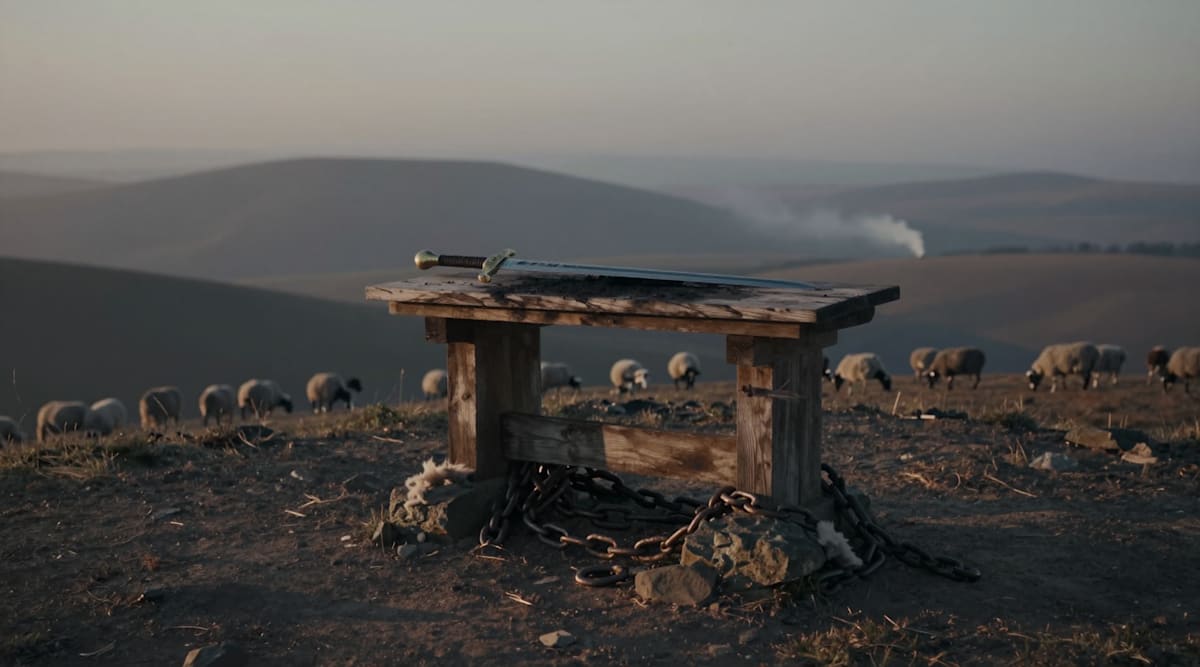
The Bible names this pattern with brutal clarity in 1 Samuel 15. God gives Saul a specific instruction through the prophet Samuel: completely destroy the Amalekites, every person and every animal, as judgment for what they did to Israel coming out of Egypt. Saul mobilizes the army. Saul wins the battle. Saul does most of the thing. He spares one person and the best of the livestock. "Saul and his men spared Agag's life and kept the best of the sheep and goats, the cattle, the fat calves, and the lambs, everything, in fact, that appealed to them. They destroyed only what was worthless or of poor quality" (1 Samuel 15:9, NLT). Saul kept what he wanted. He destroyed what he was willing to lose. He went back to camp believing the campaign had been a success. When Samuel arrives the next morning, the first words out of Saul's mouth are the words of every leader who has half-obeyed since: "May the Lord bless you. I have carried out the Lord's command!" (1 Samuel 15:13, NLT). Samuel's reply is one of the great quiet questions of the Old Testament. "Then what is all the bleating of sheep and lowing of cattle I hear?" (1 Samuel 15:14, NLT). The animals were the evidence. The animals were the confession Saul did not know he was making.
This is the diagnosis at the center of Half-Obedience. The leader who half-obeys does not believe he is disobeying. He believes he is obeying with intelligence, with mercy, with shrewdness, with stewardship, with whatever virtue is most available for the dressing. Saul rationalizes the spared animals as a sacrifice for the Lord. He tells Samuel the soldiers wanted to keep them to offer to God. The spiritual language is real, and the spiritual language is a cover. The animals were not for God. The animals were for Saul, his men, and the appearance of victory. The framing of obedience was the most dangerous part. The framing made it harder for Saul to see what he had actually done.
Samuel's response is the verse the church has remembered for three thousand years, and it is the verse every leader in the ACT phase of the Protocol needs to hear before he walks out of the room. "What is more pleasing to the Lord: your burnt offerings and sacrifices or your obedience to his voice? Listen! Obedience is better than sacrifice, and submission is better than offering the fat of rams. Rebellion is as sinful as witchcraft, and stubbornness as bad as worshiping idols. So because you have rejected the command of the Lord, he has rejected you as king" (1 Samuel 15:22-23, NLT). Note what Samuel does not do. He does not grade Saul on the curve. He does not say, "You got most of it." He does not say, "Eighty percent is better than nothing." He says rebellion. He uses the strongest possible word for the gap between the command and the compliance, and he uses it about a man who won the battle, killed almost everyone, and brought back almost everything God said to destroy. Almost is not the category Samuel is working in.
The anti-pattern shows up in modern leadership with predictable shapes. The leader who knows he needs to fire a high performer with a toxic pattern and instead writes a performance plan he privately knows will not work. The leader who has been convicted to cut a vendor relationship that is compromising the company's integrity and instead negotiates a new scope of work that keeps the relationship alive on smaller terms. The leader who is supposed to apologize for a specific harm and instead delivers a long, contextualizing speech that mentions the harm but spends most of its weight explaining how it happened. The leader who is supposed to walk away from a deal and instead restructures it so he can stay in the room. In each case the man can point to the part he did. In each case Samuel would hear the bleating.
There is a particular dressing the half-obedient leader reaches for, and it is the same dressing Saul reached for. The dressing is sacrifice. Saul did not say, "I kept the animals because I wanted to." He said, "I kept them to offer to the Lord." The modern equivalent is the spiritualized half-measure. The leader who half-obeys will almost always describe the half he did not do in ministry language. "I want to give him one more chance because that is what grace looks like." "I want to keep the relationship alive because we are called to be peacemakers." "I want to soften the conversation because love is patient." Each of those sentences has a true version, and each of them is being used here as a cover. The test is simple. If the half-measure is what the Spirit named through Scripture, Counsel, and Conscience, it is obedience. If the half-measure is what the leader negotiated down to after the verdict was already returned, it is sacrifice offered in place of obedience. Samuel knew the difference. Saul did not.
The proper pattern is the same simple beat we named yesterday, applied with sharper edges. ACT under the Protocol means executing the full verdict ALIGN returned, not a renegotiated version of it. If Scripture, Counsel, and Conscience converged on terminating the head of sales, the action is termination, not a sixty-day plan. If the convergence was on closing the vendor relationship, the action is closing it, not refactoring it. The Protocol does not get a fourth round of negotiation between ALIGN and ACT. The verdict in ALIGN is the verdict ACT executes. The leader who finds himself drafting a softer version of the action in the parking lot on the way to the meeting has not entered the ACT phase. He has reopened ALIGN, given himself a fresh hearing, and quietly substituted his own preferred ruling. Saul's mistake was not poor execution. Saul's mistake was that he held a second trial after the first one was over, and he was the only one who voted.
Half-Obedience has a second engine, and it hides better than the sacrifice dressing. The second engine is risk management. The half-obedient leader is usually a competent leader, and competent leaders are trained to hedge. Full obedience feels like an unhedged position, and the professional instinct is to never take an unhedged position. He keeps a piece of the old thing the way a portfolio manager keeps a small allocation in a position he is winding down, and he calls it prudence. The hedge is not prudence in that context. The hedge is the part of the man that does not trust the verdict yet. Saul kept Agag because killing a king felt like an irreversible move, and irreversible moves frighten competent men. The competence was the wrong tool for the job.
The recovery from Half-Obedience requires the same mechanical posture we named yesterday, with one additional discipline: the audit of the completed action. The leader who half-obeys is rarely caught in the act by himself. He is caught by Samuel. He needs a Samuel. After the action, inside seventy-two hours, the leader sits down with the same trusted person who heard the verdict in ALIGN and walks through what he actually did. Not what he intended. Not what felt right in the room. What he did. The witness asks the Samuel question. "Then what is all the bleating I hear?" The witness names the parts that look like leftover livestock. The leader either confirms full obedience or he names the half-measure and goes back. The point of the audit is not condemnation. The point of the audit is that the flesh, left to itself, will rewrite the meeting on the drive home, and by Sunday the half-measure will have become the full thing in the leader's own memory. The audit is the mirror James talked about, held up after the action instead of before it.
The hard truth underneath Half-Obedience is that God does not grade on percentage. The leader who obeys eighty percent of a clear command has not obeyed eighty percent of the command; he has substituted his own command for God's at the twenty percent line, and the substitution is the rebellion. The famous Samuel verse is not hyperbole. Rebellion as witchcraft is exactly the comparison the prophet reaches for, because both are the act of putting your own will in the place where God's word belongs. The kingdom Saul lost was not lost in the fields where the army fought. It was lost in the camp where Saul looked at the animals and the king he had spared and decided that what he had done was good enough. The Watchman's Protocol does not have a category for good enough. The verdict is the verdict. The action is the verdict carried out. The bleating, if there is any, is the leader's own voice testifying against him.
Tomorrow we name the third ACT failure mode, the leader who knows the action and waits for the courage to arrive before he moves. Waiting for the Feeling is the man who treats emotional readiness as the precondition for obedience, when the order has always run the other direction. The feeling of closeness is the reward for obedience, not the fuel for it. Half-Obedience kept the part it wanted. Waiting for the Feeling never moved at all, and called the waiting reverence.
Leadership Challenge: Name the last clear verdict the Spirit returned through Scripture, Counsel, and Conscience that you turned into a renegotiated, softer version of itself when you got to the room. Write down the original verdict in one sentence and the action you actually took in one sentence next to it. If the two sentences match, name them honestly to your spouse or a trusted friend this week. If they do not match, ask yourself which virtue you used as the dressing, mercy, grace, prudence, stewardship, peacemaking, and what specifically you kept off the altar. Then decide, before Sunday, whether you are going to go back and finish the obedience, or whether you are going to keep the bleating in your camp and call that wisdom.