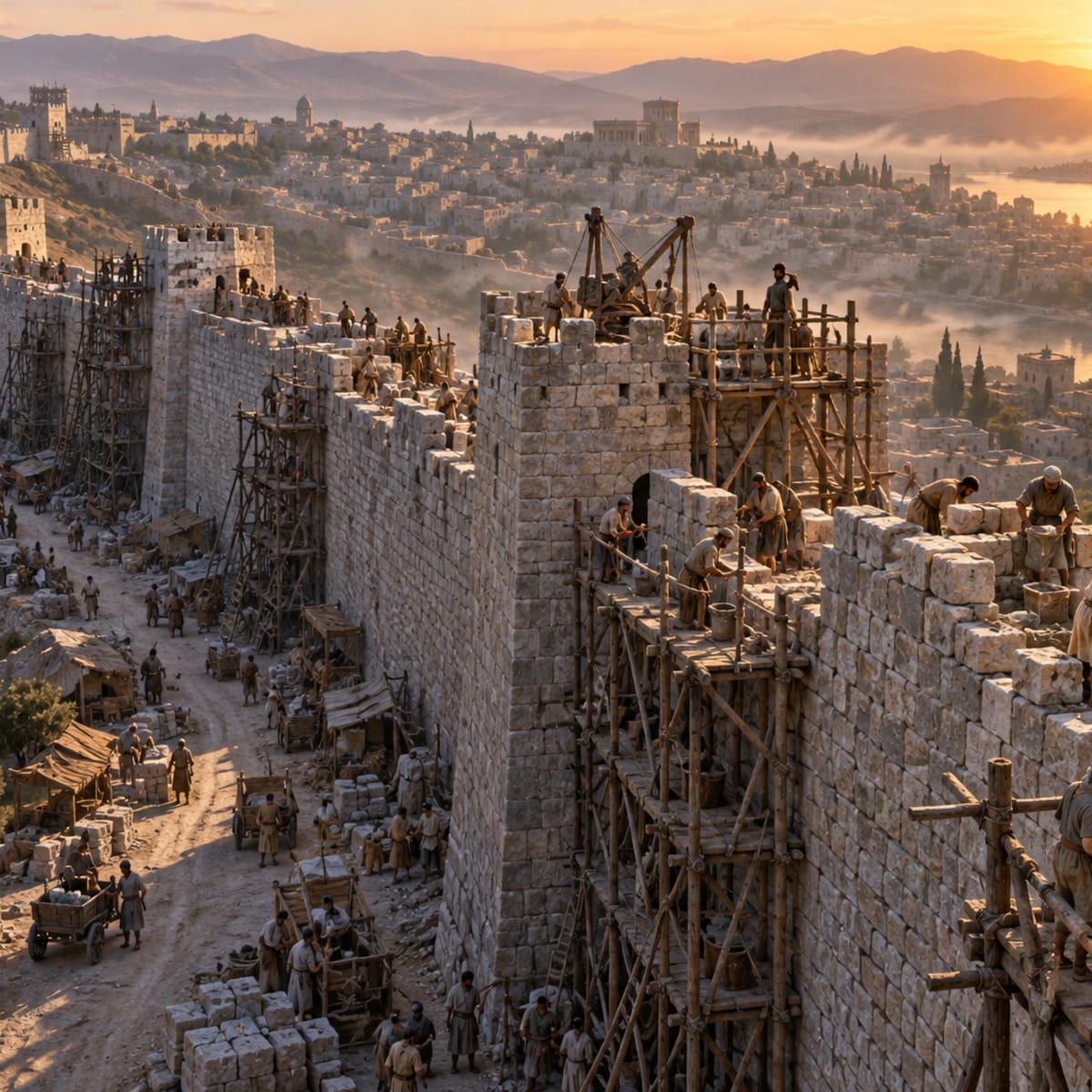
Nehemiah 3 is the chapter most readers skim. It reads like a page torn from a property registry: unfamiliar names, obscure gates, and family after family assigned to a stretch of stone. The reader who came for fire from heaven and courage before kings finds a construction log instead. That instinct to skip it runs exactly backward. This unremarkable list of who repaired what is where Nehemiah’s burden finally became a city’s work. The vision was announced in chapter 2. The wall rises in chapter 3, and it rises because every family knew which section belonged to them.
Here is how the work begins.
Then Eliashib the high priest and the other priests started to rebuild at the Sheep Gate. They dedicated it and set up its doors, building the wall as far as the Tower of the Hundred, which they dedicated, and the Tower of Hananel. People from the town of Jericho worked next to them, and beyond them was Zaccur son of Imri. The Fish Gate was built by the sons of Hassenaah. They laid the beams, set up its doors, and installed its bolts and bars. Meremoth son of Uriah and grandson of Hakkoz repaired the next section of wall. Beside him were Meshullam son of Berekiah and grandson of Meshezabel, and then Zadok son of Baana. Next were the people from Tekoa, though their leaders refused to work with the construction supervisors. (Nehemiah 3:1-5, NLT)
Read the whole chapter aloud and a rhythm emerges. Next to them. Beyond them. Beside him. Next. After him. The phrase repeats more than thirty times, section after section, name after name, all the way around the city. It is the least quotable chapter in the book and one of the most instructive.
By this point the hard front-end work is done. The king had granted safe passage and timber. The people had answered Nehemiah’s honest appeal with a single sentence: “Yes, let’s rebuild the wall!” (Nehemiah 2:18, NLT). Enthusiasm, though, does not lay stone. A crowd that agrees to build is not yet a workforce that knows what to do. Between the yes and the finished wall stood a management problem: how does one man turn a shared burden into a thousand specific tasks?
Nehemiah could not build the wall himself. No leader carries a city-sized assignment alone. Generations earlier, Moses learned the same limit when his father-in-law watched him try to judge every dispute in Israel single-handed and warned him plainly:
“You’re going to wear yourself out—and the people, too. This job is too heavy a burden for you to handle all by yourself.” (Exodus 18:18, NLT)
Nehemiah’s answer to that limit fills chapter 3. He did not clone himself or work faster. He divided the wall into sections and gave each one a name.
This is the principle hidden in the dull list: shared ownership requires clearly defined sections. The wall did not rise because Nehemiah delivered an inspiring speech. It rose because every family knew exactly which stretch of stone was theirs to repair. The priests took the Sheep Gate. The sons of Hassenaah took the Fish Gate. The people of Jericho worked one length, Meremoth worked the next, Meshullam the next after that. No section belonged to everyone, which is another way of saying no section belonged to no one. Clarity is what turned a willing crowd into a working city.
Look closer at who built where, and a second pattern appears. Many people repaired the section of wall nearest their own homes.
Above the Horse Gate, the priests repaired the wall. Each one repaired the section immediately across from his own house. (Nehemiah 3:28, NLT)
The same note repeats for Zadok, for Shemaiah, for Meshullam: each rebuilt the wall across from where he lived. There is wisdom in that arrangement. A man who repairs the wall protecting his own family works with a care no hired laborer can match. Nehemiah did not assign sections at random. Where he could, he placed people where they already held a stake, where the finished work would guard something they loved. Faithful leaders look for that overlap between a person’s assignment and a person’s investment, because ownership is strongest when the work protects something that matters to the one doing it.
Notice, too, who is holding the tools. The high priest starts the work. Goldsmiths and perfume-makers and merchants take their turns on the wall. These were not day laborers. They were people of standing who could have supervised from a distance and instead set their own hands on the stone. Nehemiah 3 is a portrait of leaders who work, not merely leaders who assign. The section a leader is unwilling to touch is a section the team quietly learns it can neglect.
The chapter is honest about the exception. In the middle of the roll call comes a quiet sting: the people of Tekoa built their section, “though their leaders refused to work with the construction supervisors” (Nehemiah 3:5, NLT). Their nobles would not stoop to the labor. The detail is left there without comment, a permanent record that some who should have led would not lift a stone. What is striking is what happened anyway. The common people of Tekoa built their assigned length, then went back and repaired a second section that others had left undone (Nehemiah 3:27). The wall rose through the willing. A leader cannot force the unwilling to own their part, but a clear assignment means their refusal is visible, and the work does not have to stop because a few withhold their hands.
The pattern in the rubble matches a pattern Paul later described for the church. He wrote about how a healthy body actually works:
He makes the whole body fit together perfectly. As each part does its own special work, it helps the other parts grow, so that the whole body is healthy and growing and full of love. (Ephesians 4:16, NLT)
Its own special work. That is the engine of both a wall and a team. Growth and completion come not from a few heroic builders doing everything but from each part doing the specific thing it was given. The leader’s task is to make sure every part knows what its part is.
This is where most leaders lose the wall. The vision is cast, the room says yes, and then the work gets handed to “the team” rather than to a person. A task owned by everyone is a task owned by no one. The report nobody finishes, the account nobody calls, the broken process nobody fixes: trace it back and you will usually find a section of wall that was never assigned to a name. Clarity is not micromanagement. It is the difference between a crowd that agrees and a workforce that builds. This week, take the initiative you care about most and ask a blunt question of every piece of it: whose section is this? If you cannot name the person, the wall is not being built there, no matter how many people agreed it should be.
Nehemiah carried the burden alone in chapter 1. He wept alone, prayed alone, and inspected the ruins alone at night. By chapter 3 the burden has a hundred names attached to it, each one bent over a defined length of wall. That is the movement faithful leadership makes. The weight begins with the leader, but the work belongs to the people, and it belongs to them because the leader took the trouble to divide it, define it, and hand it over. A leader is not the one who builds the whole wall. A leader is the one who makes sure every stretch of it has a name beside it.
Tomorrow the work meets its first real resistance. Sanballat and his allies will move from mockery to the threat of violence, and Nehemiah will have to teach the same builders to hold a tool in one hand and a weapon in the other. A divided wall is a beginning. Defending it is the next test.
Leadership Challenge: Take the initiative you care about most right now and walk it piece by piece. Which section of that work is currently owned by “the team” instead of a named person? Name the one part that has no name beside it, and assign it this week before you announce anything new.
I write about leadership at the intersection of timeless principles and modern workplaces. Follow for weekly insights on building teams that actually work. For more articles like this consider subscribing to my Substack at: https://christianleadership.now