Some leaders use action to avoid dependence. They build the plan, assign the owners, set the checkpoints, and keep moving so they never have to admit how much of the outcome they cannot control. Other leaders use the language of dependence to avoid action. They keep praying about a decision whose next faithful step is already clear. One tries to carry what belongs to God. The other hands God a responsibility that belongs to the leader. Scripture gives us a more demanding pattern. Prayer does not replace faithful action. It places that action under God’s authority.
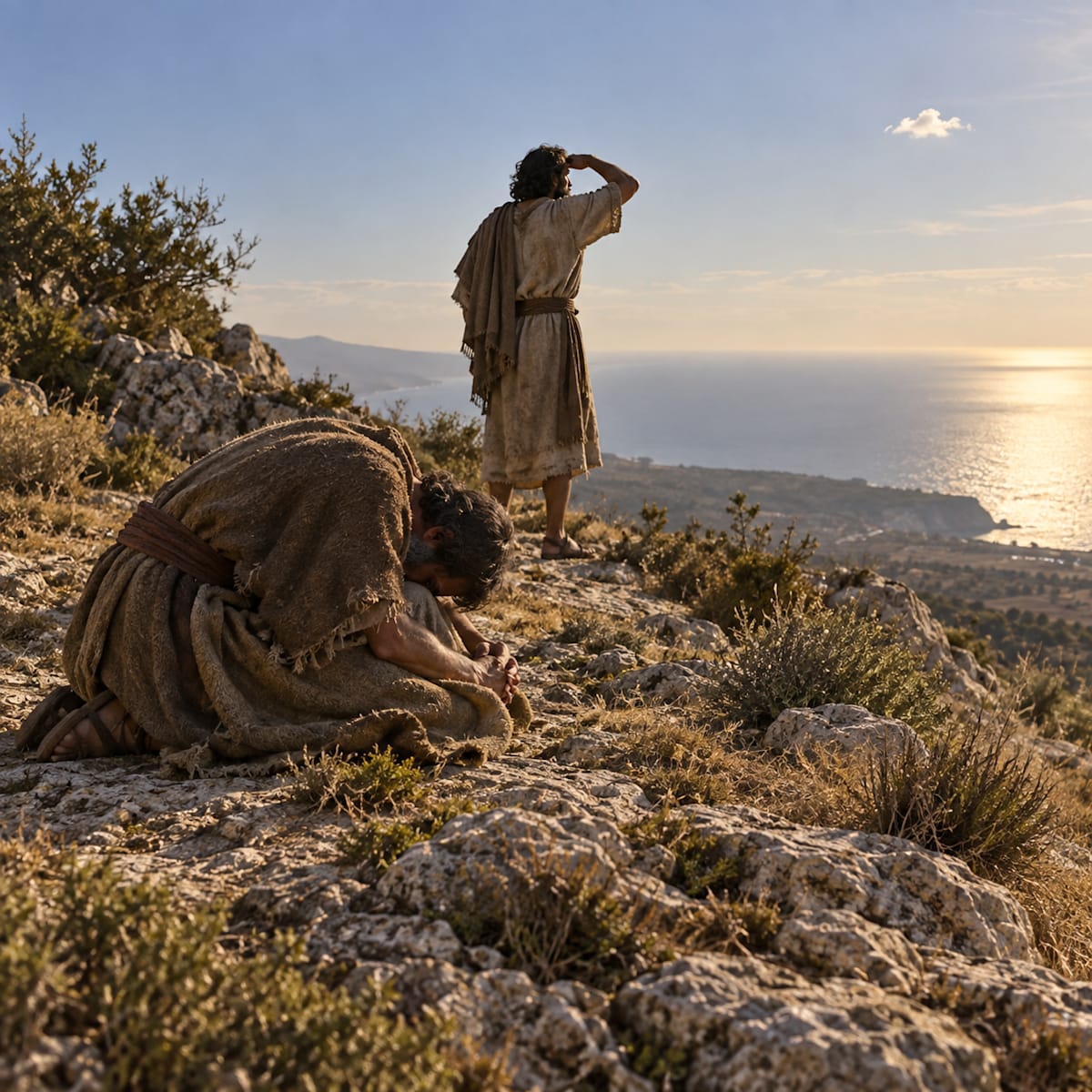
Elijah reaches the top of Mount Carmel after years of drought and the public confrontation over Israel’s divided loyalty. Earlier in 1 Kings 18, the Lord had told him rain was coming. The fire had already fallen, and the people had confessed that the Lord is God. Still, the promised rain had not begun. Elijah did not manufacture it, and he did not treat God’s promise as permission to stop praying:
So Ahab went to eat and drink. But Elijah climbed to the top of Mount Carmel and bowed low to the ground and prayed with his face between his knees. Then he said to his servant, “Go and look out toward the sea.” The servant went and looked, then returned to Elijah and said, “I didn’t see anything.” Seven times Elijah told him to go and look. Finally the seventh time, his servant told him, “I saw a little cloud about the size of a man’s hand rising from the sea.” (1 Kings 18:42-44, NLT, excerpt)
Elijah bows, prays, sends his servant to look, receives six reports of nothing, and sends him again. When the small cloud appears, Elijah acts on the change immediately and warns Ahab to leave before the rain stops him. God sends the storm. Elijah’s persistence does not control God, earn the answer, or turn prayer into a technique. James later points to Elijah to teach that earnest prayer matters while reminding readers that he “was as human as we are” (James 5:17, NLT, excerpt). Dependence is not pretending the leader has no work. It is doing the work while refusing to mistake the work for the source of the result.
Nehemiah shows the same pattern under a different assignment. He is governing a vulnerable community rebuilding after exile, and the work has drawn ridicule followed by a coordinated threat. The danger is real. His answer fits in one sentence:
But we prayed to our God and guarded the city day and night to protect ourselves. (Nehemiah 4:9, NLT)
The pairing matters. Nehemiah prays to God and posts guards. He later reorganizes the work, stations families at exposed places, establishes an alarm, and reminds the people that God will fight for them. Nehemiah’s response is not permission to treat ordinary disagreement like warfare or turn Jerusalem’s defenses into a corporate playbook. It does expose the false choice between prayer and preparation. Nehemiah does not act as if the city’s survival rests entirely on his systems. He also does not call an avoidable failure faith when responsible protection was available.
Biblical dependence relocates confidence without surrendering responsibility. Self-sufficiency says, “If I plan well enough, I can control the outcome.” Passivity says, “If God wants this done, He will do it without my costly obedience.” Faith rejects both claims. I call this kinetic faith: once truth is clear, faith moves before the feeling of readiness arrives. Governed leaders neither let ambition consume them nor use spiritual-sounding delay for cover. They pray, seek counsel, tell the truth, make the decision, and leave the outcome where it belongs.
Imagine a product leader facing a launch with a serious but uncertain reliability risk. Self-sufficiency keeps the concern private, tightens the schedule, and works through the night to preserve the date. Passivity says the team has prayed and proceeds without a contingency because raising the risk might look fearful. Dependence produces a different response. The leader names the uncertainty before God, asks what faithfulness requires, brings the right people into the decision, defines the threshold that would stop the launch, assigns monitoring and rollback ownership, and tells the customer what remains unknown. Prayer does not guarantee a clean release. It brings the leader’s motives and choices before God while the team does honest work.
Take one decision you are currently “praying about” and divide a page into two questions. First, what lies outside the authority God has entrusted to you? Name the people you cannot control, the future you cannot see, and the result you cannot force. Second, what responsibility has God entrusted to you? Name the conversation you can have, the analysis you can complete, the boundary you can set, the owner you can assign, or the contingency you can put in place today. If you are still exploring faith, begin by naming what exceeds human control and what responsible action remains. Pray over both sides, then complete one action before the day ends. The point is not to prove your faith by staying busy. The point is to stop using activity as a substitute for trust and stop using trust as an excuse for inaction.
Elijah and Nehemiah show that dependence has a recognizable shape: prayer, attention, and obedient movement under God’s authority. Tomorrow’s final article will gather the month’s practices and point readers to the Stand and Rebuild field guide, including a Prayer-to-Plan Worksheet that makes today’s exercise reusable. The essential move begins now. Carry the responsibility God has actually given you, and refuse the burden of pretending the outcome belongs to you.
Leadership Challenge
Where are you trying to carry an outcome that belongs to God, and where are you withholding an action He has entrusted to you? Release the first in prayer, then complete one conversation, plan, boundary, or assignment before the day ends.
I write about leadership at the intersection of timeless principles and modern workplaces. Follow for weekly insights on building teams that actually work. For more articles like this consider subscribing to my Substack at: https://christianleadership.now