A founder calls an all-hands at 8:47 on a Thursday morning, twenty-two minutes after he hangs up the phone with a board member who told him something he did not want to hear. He has not eaten. He has not opened his Bible. He has not called the two advisors he keeps on retainer for exactly this kind of moment. He stands in front of the company and announces a reorganization, a hiring freeze, and the elimination of two roles, and he frames the speed of the announcement as conviction. He uses the word clarity twice. He uses the word obedience once. He says the Lord made it plain on the call, and that he wants to honor that plainness by moving today instead of waiting for committee. His leadership team applauds politely. His COO does not. By Friday afternoon two of the moves are already being walked back, because the board member's comment was not what he heard it as, and the eliminated roles held quiet load-bearing relationships nobody had mapped. He will tell the story later as a hard but holy moment. The story he will not tell, because he cannot see it, is the one underneath. The motion he called obedience never had a source.
This is Acting Out of Order, the fifth and final anti-pattern in the ACT family of the Watchman's Protocol, and the one that hides the longest because it looks the most like leadership. The four ACT failure modes we have already named this week show up as stalling, as editing, as delay, as performance. Today's pattern is the inverse of all of them. The man running Acting Out of Order is not stalling. He is moving. He is moving fast. He is moving in front of witnesses. He is moving with conviction. The only problem is that the motion has no upstream. He never arrested. He never audited. He never aligned. He skipped to the fourth A and called the speed of the skip the proof that the move was from God.
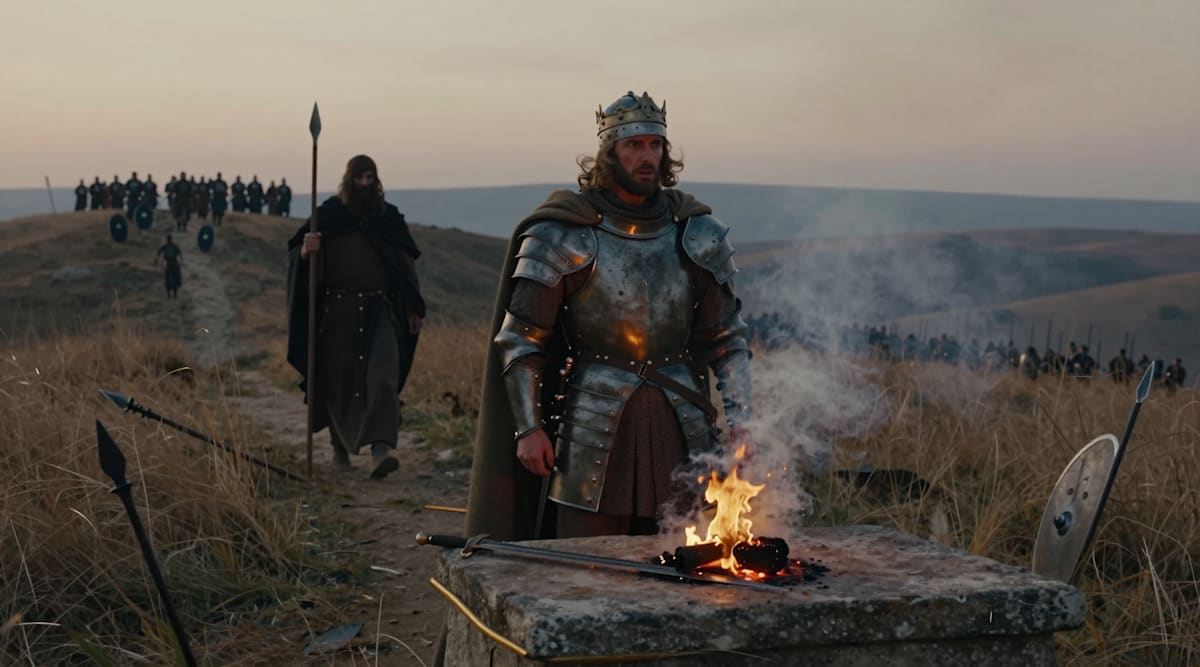
The textbook case of this anti-pattern lives in 1 Samuel 13. Saul has been sitting at Gilgal for seven days waiting for Samuel to arrive and offer the sacrifice before the battle with the Philistines. Samuel's instruction was specific. Wait. Saul's men are scattering. The Philistines are massed at Micmash. The pressure is rising every hour. On the seventh day, Saul cannot stand it anymore. He calls for the burnt offering himself and offers it. He has just finished when Samuel walks in. "But Samuel said, 'What is this you have done?' Saul replied, 'I saw my men scattering from me, and you didn't arrive when you said you would, and the Philistines are at Micmash ready for battle. So I said, "The Philistines are ready to march against us at Gilgal, and I haven't even asked for the Lord's help!" So I felt compelled to offer the burnt offering myself before you came'" (1 Samuel 13:11-12, NLT). Read Saul's defense slowly. It is the cleanest spiritual language in the chapter. He says he had not asked for the Lord's help. He says he felt compelled. He describes the action as obedience to a felt necessity. Samuel does not buy a word of it. "How foolish! You have not kept the command the Lord your God gave you. Had you kept it, the Lord would have established your kingdom over Israel forever. But now your kingdom must end, for the Lord has sought out a man after his own heart. The Lord has already appointed him to be the leader of his people, because you have not kept the Lord's command" (1 Samuel 13:13-14, NLT). The verdict is sharp. Saul did the right outward act. He offered the right kind of sacrifice. He even said the right kind of words about it afterward. The kingdom still left him, because the act was untethered from the prior obedience. Saul did the fourth A and skipped the first three, and the skip cost him the throne.
The diagnosis under Acting Out of Order is source-stripped motion. The leader has decided, often without naming the decision, that the prior A's are the slow parts and the ACT is the real part. He is going to honor the Protocol the way an athlete honors a warmup. Get the warmup done quickly, get to the game. The Protocol does not work that way. ARREST is the gate where the false starts get filtered out. AUDIT is where the source of the impulse gets identified. ALIGN is where the move gets calibrated against the Three Witnesses of Scripture, Counsel, and Conscience. ACT is downstream of all three. ACT is the obedient execution of a verdict the first three A's already returned. When a leader skips the first three and starts at the fourth, he is not acting on a verdict. He is acting on an impulse and labeling the impulse a verdict after the fact. Proverbs frames the problem in a single line. "Enthusiasm without knowledge is no good; haste makes mistakes" (Proverbs 19:2, NLT). Enthusiasm is the felt heat of the impulse. Knowledge is what the first three A's produce. Haste is the leader skipping the knowledge to keep the heat. The Watchman is not the leader who hears a thing and moves on it. The Watchman is the leader who hears a thing, halts at the gate, checks the credentials, calibrates to the Standing Orders, and then moves. The move is the same shape. The source is the difference.
The most defensible version of Acting Out of Order is the leader who believes speed is itself a virtue. He has read the books on bias for action. He has built a leadership identity around being the one who moves while everyone else is still talking. Bias for action is a real and useful posture when the prior A's are intact and the verdict is in. Bias for action without the prior A's is just impulsivity wearing a leadership word. The board member's call did not return a verdict. It returned a data point. The data point went straight to the announcement without passing through arrest, audit, or alignment, and the announcement carried all the weight of the gate without any of the prior weight that would have made the gate honest. A leader can move quickly and have the source intact. The Watchman who has been running the Protocol every Tuesday afternoon for years can run ARREST, AUDIT, and ALIGN inside ninety seconds when the situation demands it, because the prior reps have made the work fast. A leader who has not been running the Protocol has not earned the right to speed, and the speed he displays in the moment is just the surface of an unaudited reflex.
The proper pattern is the corrected ACT, and the correction here is the most surgical of the five ACT failure modes. ACT is downstream. ACT is always downstream. The Protocol is a sequence, not a menu. Joshua 3 is the proper-order example the Saul story inverts. The priests carrying the Ark do not step into the Jordan first to see if the river will part. They wait for the word. The word comes. They step. "It was the harvest season, and the Jordan was overflowing its banks. But as soon as the feet of the priests who were carrying the Ark touched the water at the river's edge, the water above that point began backing up a great distance away at a town called Adam, which is near Zarethan. And the water below that point flowed on to the Dead Sea until the riverbed was dry. Then all the people crossed over near the town of Jericho" (Joshua 3:15-16, NLT). The act of stepping into a flooding river is decisive. It is the same physical motion Acting Out of Order is producing. The difference is what is upstream. The priests had the word, the Ark, and the sequence. Saul had the pressure. The river parted for the priests. The kingdom left Saul. Same physical motion, completely different source, completely different fruit.
The recovery has two moves. The first is the public delay. The leader who notices the impulse to act before the prior A's have run announces the delay out loud, to whichever witnesses are in the room. The line is short. "I am not ready to call this. I need until tomorrow." He does not explain. He does not apologize. He does not pre-litigate the eventual decision. He just installs a gate where the absence of one was about to do damage. The public delay is a Standing Order he is enforcing on himself in front of witnesses, and the public nature of it is the part that makes it stick. A leader who announces a delay to a room cannot quietly skip the prior A's once the room has left. The delay forces the work. The second move is the inventory of the skipped A's. Before the act, the leader writes one sentence on each of the prior three. What is the source of the impulse, was it audited, what does the text say, and is there a Three Witnesses confirmation that the impulse is the verdict. If the answer to any of the three is empty, the act is not yet authorized. The act may still happen. It does not get to wear the word obedience until the prior three have signed off.
The hard truth under this anti-pattern is that the speed of an act is not evidence of its source. A leader can move at the velocity of the Spirit. A leader can also move at the velocity of his own panic, his own pride, his own boredom with sitting still, and the velocity will look identical from the outside. The Watchman is the leader who knows the difference and refuses to act on velocity alone. Saul did the right outward act in the wrong upstream sequence and lost the throne. The priests at the Jordan did the same kind of act in the right sequence and watched the river break in half. The Protocol is not a suggestion about the order. The order is the Protocol. A move with no source is not faith. It is just a move.
This week has been the ACT anti-patterns end to end. Tomorrow we close the audit and turn the lens fully back on the reader. The May 30 article is the inflection of the month, the day the reader maps the specific anti-patterns that have shown up most often in his own leadership over the last twenty-nine days. Bring a pen.
Leadership Challenge: Pick the most recent decision you made fast, in the last seven days. Write down what triggered it. Write down whether you arrested before you acted, whether you audited the source of the impulse, and whether you aligned the move against Scripture, Counsel, and Conscience before you executed. Three sentences. If you cannot write a clean sentence on each of the prior three A's, the move you made was not obedience. It was velocity. Today, before the day ends, name the next decision in your queue that is currently scheduled to run at speed. Install a public delay on it. Tell one person you are not calling it until tomorrow, and that you are running the prior three A's between now and then. The delay is the recovery. The sequence is the obedience. Which decision in your queue is currently set to act without a source.